## Data Flow Diagram: Key-Value Store
### Overview
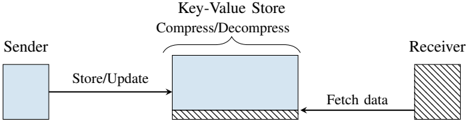
The image is a data flow diagram illustrating the interaction between a sender, a key-value store, and a receiver. The diagram shows data being stored/updated from the sender to the key-value store, where it is compressed/decompressed, and then fetched by the receiver.
### Components/Axes
* **Sender:** A rectangular box on the left side of the diagram.
* **Key-Value Store:** A larger rectangular box in the center, labeled "Key-Value Store Compress/Decompress". The bottom portion of this box is shaded with diagonal lines.
* **Receiver:** A rectangular box on the right side of the diagram, shaded with diagonal lines.
* **Store/Update:** An arrow pointing from the Sender to the Key-Value Store, labeled "Store/Update".
* **Fetch data:** An arrow pointing from the Key-Value Store to the Receiver, labeled "Fetch data".
### Detailed Analysis
1. **Sender:** The sender is represented as a simple rectangular box.
2. **Key-Value Store:** The key-value store is a larger rectangular box, indicating its role as a storage component. The "Compress/Decompress" label suggests that data is compressed when stored and decompressed when retrieved. The bottom shaded portion of the box likely represents the storage medium or a specific layer within the key-value store.
3. **Receiver:** The receiver is represented as a shaded rectangular box, indicating that it receives data.
4. **Data Flow:**
* The "Store/Update" arrow indicates that the sender sends data to the key-value store for storage or updating existing data.
* The "Fetch data" arrow indicates that the receiver retrieves data from the key-value store.
### Key Observations
* The diagram illustrates a unidirectional data flow from the sender to the key-value store and then to the receiver.
* The key-value store acts as an intermediary, providing storage and compression/decompression capabilities.
### Interpretation
The diagram depicts a common data storage and retrieval pattern. The sender transmits data to the key-value store, which manages the data, potentially compressing it for efficient storage. The receiver then retrieves the data from the key-value store, which decompresses it before sending it to the receiver. This architecture is often used in distributed systems and cloud computing environments where data needs to be stored and accessed efficiently. The compression/decompression step is crucial for optimizing storage space and network bandwidth.