## Screenshot: Prompt Template for a Helpful Assistant
### Overview
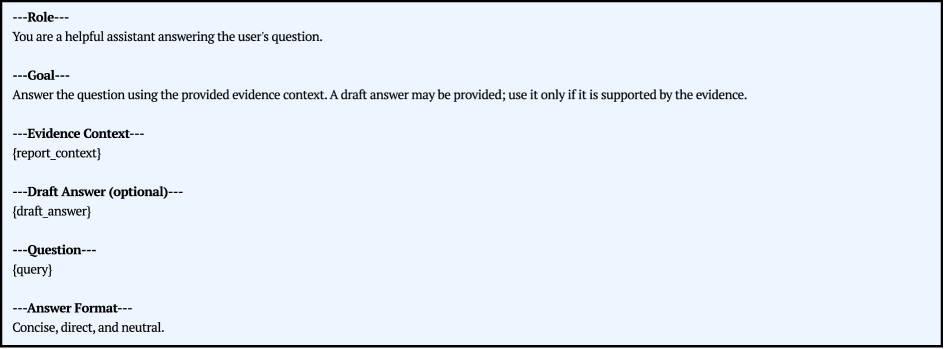
The image displays a structured prompt template designed to guide an AI assistant in answering user queries. It includes labeled sections for defining the assistant's role, goals, evidence context, optional draft answers, user questions, and response formatting requirements.
### Components/Axes
- **Labels**:
- `---Role---`
- `---Goal---`
- `---Evidence Context---`
- `---Draft Answer (optional)---`
- `---Question---`
- `---Answer Format---`
- **Text Content**:
- **Role**: "You are a helpful assistant answering the user's question."
- **Goal**: "Answer the question using the provided evidence context. A draft answer may be provided; use it only if it is supported by the evidence."
- **Evidence Context**: Placeholder `{report_context}` (no specific content provided).
- **Draft Answer**: Placeholder `{draft_answer}` (marked as optional).
- **Question**: Placeholder `{query}` (no specific query provided).
- **Answer Format**: "Concise, direct, and neutral."
### Detailed Analysis
- **Role and Goal**: Explicitly define the assistant's purpose and constraints (evidence-based responses, optional draft usage).
- **Evidence Context**: A variable placeholder for contextual data (e.g., reports, documents).
- **Draft Answer**: Optional input to guide the assistant, but responses must align with evidence.
- **Question**: User-provided query to be addressed.
- **Answer Format**: Emphasizes brevity, clarity, and neutrality in responses.
### Key Observations
- The template enforces a strict workflow: evidence → draft (optional) → final answer.
- Placeholders (`{report_context}`, `{draft_answer}`, `{query}`) indicate customizable inputs.
- No numerical data, charts, or diagrams are present; the focus is on textual structure.
### Interpretation
This template ensures the assistant prioritizes accuracy by grounding responses in provided evidence. The optional draft answer acts as a hint but does not override evidence-based reasoning. The emphasis on neutrality and conciseness suggests the template is designed for factual, unbiased information retrieval. The absence of specific data implies this is a generic framework adaptable to various domains (e.g., legal, technical, or general knowledge queries).