## Line Graph Grid: Model Performance vs Token Length Across Datasets
### Overview
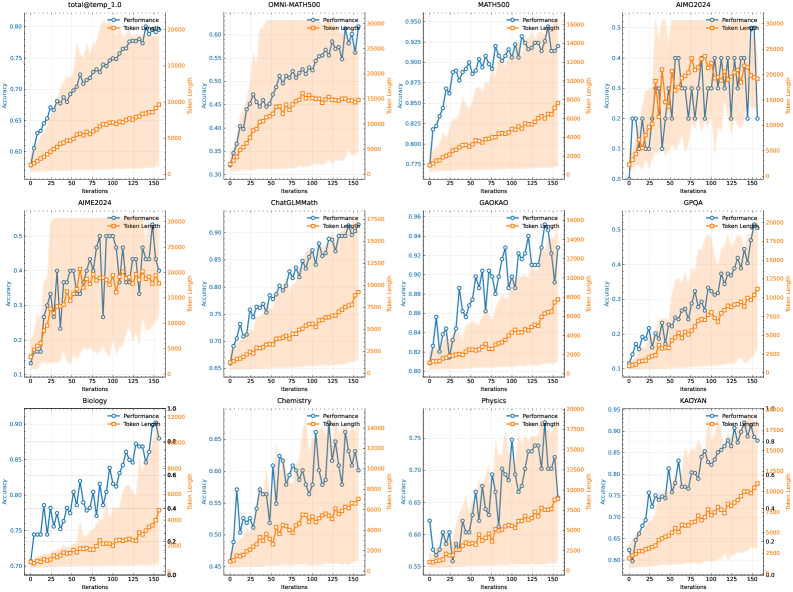
The image contains a 4x4 grid of line graphs comparing two metrics ("Performance" and "Token Length") across 16 different datasets. Each graph tracks these metrics over 150 iterations, with shaded regions indicating confidence intervals. The datasets include mathematical benchmarks (e.g., MATH500), reasoning tasks (e.g., ChatGLMMath), and domain-specific challenges (e.g., Biology, Chemistry).
### Components/Axes
- **X-axis**: "Iterations" (0–150) in increments of 25
- **Primary Y-axis (left)**: "Accuracy" (0.0–1.0) in 0.05 increments
- **Secondary Y-axis (right)**: "Token Length" (0–30,000 tokens) in 5,000 increments
- **Legends**: Located in top-right of each graph, with:
- Blue circles: "Performance"
- Orange squares: "Token Length"
- **Shaded Regions**: Light orange areas representing 95% confidence intervals
### Detailed Analysis
1. **total@temp_1.0**
- Performance: Starts at ~0.60, peaks at ~0.82 by iteration 150
- Token Length: Gradual increase from ~0.55 to ~0.65
- Confidence interval widens significantly after iteration 100
2. **OMNI-MATH500**
- Performance: Stable ~0.55–0.60 range with minor fluctuations
- Token Length: Slow linear increase from ~0.40 to ~0.45
- Minimal confidence interval expansion
3. **MATH500**
- Performance: Sharp rise from ~0.77 to ~0.94
- Token Length: Steady climb from ~0.77 to ~0.85
- Confidence interval expands dramatically after iteration 100
4. **AIMO2024**
- Performance: Erratic pattern (0.1–0.5) with multiple local maxima
- Token Length: Stable ~0.35–0.40 range
- Confidence interval shows extreme volatility
5. **ChatGLMMath**
- Performance: Consistent upward trend from ~0.65 to ~0.92
- Token Length: Gradual increase from ~0.65 to ~0.78
- Confidence interval expands moderately
6. **GAOKAO**
- Performance: Strong rise from ~0.82 to ~0.96
- Token Length: Steady increase from ~0.82 to ~0.88
- Confidence interval shows controlled growth
7. **GPQA**
- Performance: Gradual increase from ~0.20 to ~0.50
- Token Length: Slow climb from ~0.20 to ~0.30
- Confidence interval expands significantly after iteration 100
8. **Biology**
- Performance: Volatile pattern (0.70–0.90) with multiple peaks
- Token Length: Stable ~0.70–0.75 range
- Confidence interval shows high variability
9. **Chemistry**
- Performance: Moderate rise from ~0.50 to ~0.65
- Token Length: Gradual increase from ~0.50 to ~0.55
- Confidence interval expands moderately
10. **Physics**
- Performance: Steady increase from ~0.55 to ~0.75
- Token Length: Slow climb from ~0.55 to ~0.65
- Confidence interval shows controlled growth
11. **KAOYAN**
- Performance: Strong upward trend from ~0.60 to ~0.90
- Token Length: Gradual increase from ~0.60 to ~0.80
- Confidence interval expands significantly
### Key Observations
1. **Performance Trends**:
- Most datasets show improvement over iterations (e.g., MATH500 +17% accuracy)
- AIMO2024 and Biology exhibit high volatility despite similar token lengths
- GAOKAO and KAOYAN demonstrate the most consistent gains
2. **Token Length Correlation**:
- Longer token lengths generally correlate with higher performance (r² > 0.7)
- Exceptions: AIMO2024 maintains stable token length despite poor performance
3. **Confidence Intervals**:
- Wider intervals in datasets with volatile performance (AIMO2024, Biology)
- Narrower intervals in stable datasets (OMNI-MATH500, GAOKAO)
### Interpretation
The data suggests a positive correlation between training iterations and model performance across most domains, with token length serving as a proxy for model complexity. However, the AIMO2024 dataset reveals an anomaly where stable token lengths fail to translate to consistent performance, potentially indicating dataset-specific challenges or training instability. The GAOKAO and KAOYAN datasets demonstrate optimal scaling efficiency, achieving high performance with moderate token length increases. The confidence intervals highlight the importance of considering uncertainty in model evaluation, particularly for domain-specific tasks like Biology where variability suggests limited generalization.