## Diagram: Quantum vs. Simulated Annealing
### Overview
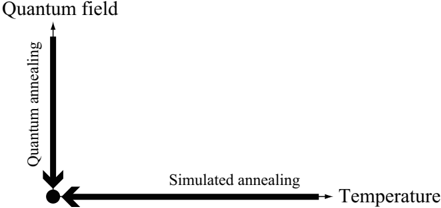
The image is a diagram illustrating the relationship between "Quantum field" and "Simulated annealing" (Temperature). It uses two perpendicular arrows to represent these concepts, with the intersection point indicating a common origin or starting point.
### Components/Axes
* **Vertical Axis:** Labeled "Quantum field" with an arrow pointing upwards. The text "Quantum annealing" is written vertically alongside the arrow, indicating the direction of increasing quantum field strength.
* **Horizontal Axis:** Labeled "Temperature" with an arrow pointing to the right. The text "Simulated annealing" is written horizontally alongside the arrow, indicating the direction of increasing temperature.
* **Origin:** A black circle marks the intersection of the two arrows, representing the starting point for both quantum and simulated annealing processes.
### Detailed Analysis
* The vertical arrow, labeled "Quantum field," points upwards, suggesting an increase in the quantum field strength. The text "Quantum annealing" is written vertically alongside the arrow.
* The horizontal arrow, labeled "Temperature," points to the right, suggesting an increase in temperature. The text "Simulated annealing" is written horizontally alongside the arrow.
* The intersection of the two arrows is marked by a black circle, indicating a common origin or starting point for both processes.
### Key Observations
* The diagram visually represents the relationship between quantum annealing and simulated annealing, suggesting they are orthogonal or independent processes.
* The arrows indicate the direction of increasing strength or temperature for each process.
* The common origin suggests a shared starting point or initial state.
### Interpretation
The diagram illustrates the conceptual difference between quantum annealing and simulated annealing. Quantum annealing relies on manipulating the "Quantum field," while simulated annealing relies on manipulating "Temperature." The orthogonal arrows suggest that these two approaches are distinct and potentially complementary methods for optimization or problem-solving. The common origin implies that both processes might start from the same initial state or problem formulation.