## Diagram: Ant Colony Optimization Workflow
### Overview
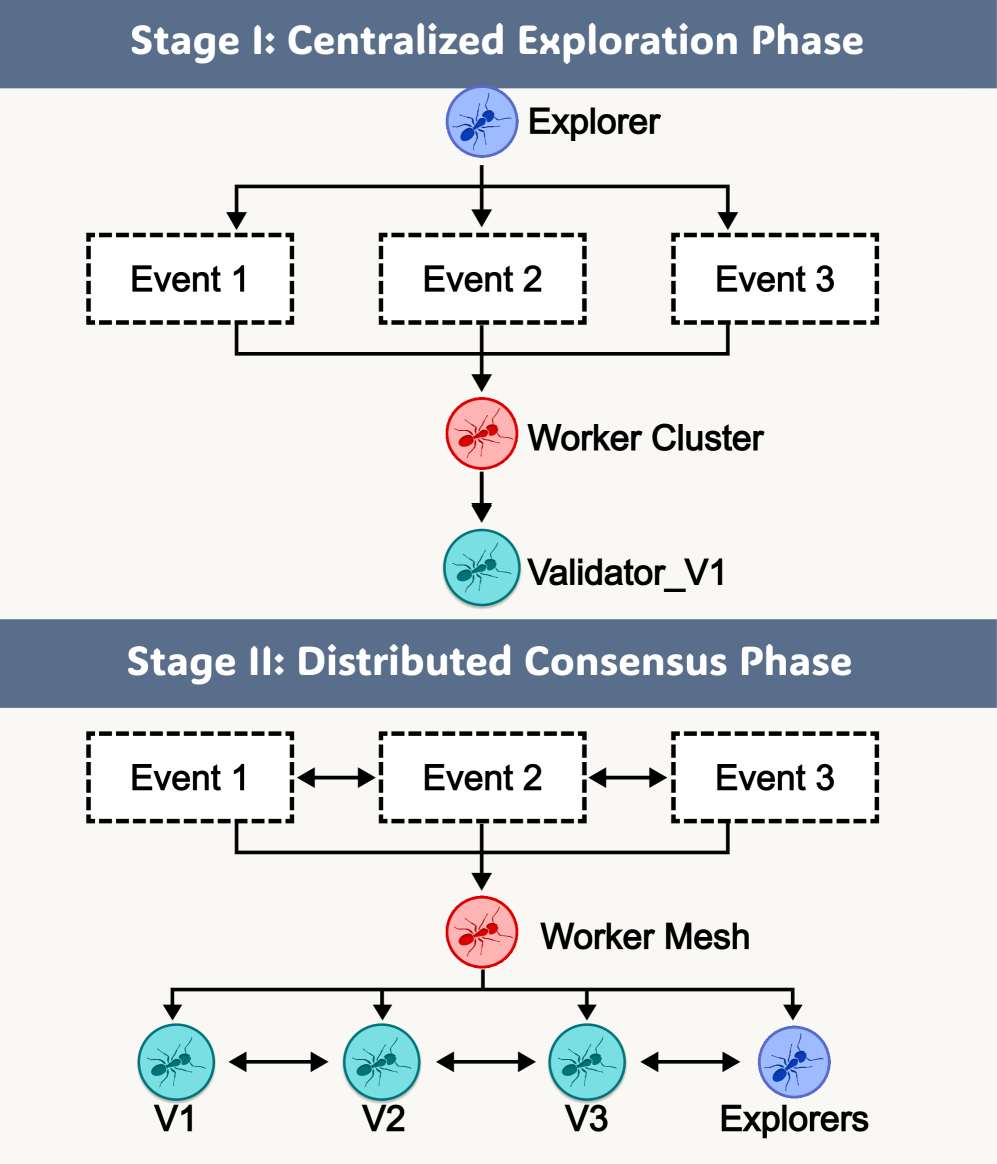
The image depicts a two-stage workflow inspired by ant colony optimization algorithms. Stage I represents a centralized exploration and validation process, while Stage II illustrates a distributed consensus mechanism. The diagram uses color-coded nodes (blue, red, green) and directional arrows to represent roles, data flow, and interactions.
### Components/Axes
- **Nodes**:
- **Explorer** (blue circle): Initiates exploration in Stage I.
- **Worker Cluster** (red circle): Centralized processing unit in Stage I.
- **Validator V1** (green circle): Centralized validation in Stage I.
- **Worker Mesh** (red circle): Distributed processing network in Stage II.
- **Validators V1, V2, V3** (green circles): Distributed validation nodes in Stage II.
- **Explorers** (blue circles): Distributed exploration agents in Stage II.
- **Events**:
- **Event 1, Event 2, Event 3** (dashed rectangles): Tasks or data points processed in both stages.
- **Arrows**:
- Solid arrows indicate unidirectional data flow.
- Bidirectional arrows (Stage II) indicate mutual communication between nodes.
### Detailed Analysis
#### Stage I: Centralized Exploration Phase
1. **Flow**:
- The **Explorer** (blue) sends data to **Event 1, 2, 3** (dashed rectangles).
- Events are processed by the **Worker Cluster** (red), which forwards results to **Validator V1** (green).
2. **Key Features**:
- Centralized control: Single Worker Cluster and Validator handle all events.
- Linear workflow: Explorer → Events → Worker Cluster → Validator.
#### Stage II: Distributed Consensus Phase
1. **Flow**:
- **Event 1, 2, 3** are processed by the **Worker Mesh** (red), which communicates bidirectionally with **Validators V1, V2, V3** (green).
- Validators exchange data with **Explorers** (blue) via bidirectional arrows.
2. **Key Features**:
- Decentralized architecture: Multiple Validators and Explorers collaborate.
- Peer-to-peer communication: Bidirectional arrows between Validators and Explorers.
### Key Observations
- **Transition from Centralized to Distributed**:
- Stage I uses a single Worker Cluster and Validator, while Stage II employs a Mesh and multiple Validators.
- **Bidirectional Communication**:
- Stage II introduces feedback loops between Validators and Explorers, enabling dynamic consensus.
- **Event Processing**:
- Events are processed in parallel in Stage II, unlike the sequential flow in Stage I.
### Interpretation
This diagram models the evolution of an optimization process from a centralized to a distributed system.
- **Stage I** mirrors traditional algorithms where a central authority (Worker Cluster/Validator) manages exploration and validation.
- **Stage II** reflects advanced systems (e.g., blockchain, swarm intelligence) where decentralized nodes (Validators, Explorers) collaborate to achieve consensus.
- The **Worker Mesh** in Stage II suggests scalability and fault tolerance, as no single node dominates processing.
- **Bidirectional arrows** imply real-time data exchange, critical for adaptive systems requiring rapid adjustments.
The diagram emphasizes the trade-off between simplicity (Stage I) and robustness (Stage II), highlighting how distributed systems enhance resilience and efficiency in complex environments.