## Diagram: Centralized vs. Distributed System Interaction
### Overview
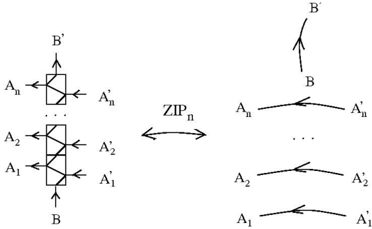
The diagram illustrates a comparison between a centralized system (left) and a distributed system (right), connected via a bidirectional "ZIP_n" mechanism. Arrows indicate data flow, feedback loops, and transformations between components labeled A_n, A'_n, B, and B'.
### Components/Axes
- **Left Side (Centralized System)**:
- **Block**: Contains nested arrows between A_n → A'_n and B → B', suggesting sequential processing or transformation.
- **Labels**: A_n, A'_n, B, B' with vertical alignment.
- **Right Side (Distributed System)**:
- **Individual Arrows**: Direct connections between A_n → A'_n, A_2 → A'_2, A_1 → A'_1, and B → B', indicating parallel or decentralized operations.
- **Curved Arrows**: Feedback loops from B' to B and A'_n to A_n, implying iterative adjustments or error correction.
- **ZIP_n**: A bidirectional arrow between the two systems, symbolizing synchronization, data exchange, or protocol bridging.
### Detailed Analysis
- **Centralized System**:
- A_n and B are input nodes feeding into a single processing block.
- Outputs A'_n and B' are generated after transformation within the block.
- Vertical stacking of A_1, A_2, ..., A_n suggests hierarchical or layered processing.
- **Distributed System**:
- Each A_i and B operates independently, with direct transformations to A'_i and B'.
- Feedback loops (B' → B, A'_n → A_n) indicate dynamic recalibration or validation.
- **ZIP_n**:
- Positioned centrally, acting as a bridge between centralized and distributed components.
- Bidirectional flow implies mutual dependency or real-time coordination.
### Key Observations
1. **Centralization vs. Distribution**: The left side represents a monolithic architecture, while the right side depicts modular, parallel processing.
2. **Feedback Mechanisms**: Both systems incorporate feedback, but the distributed system emphasizes localized adjustments (e.g., A'_n → A_n).
3. **ZIP_n Role**: Likely a protocol or middleware enabling interoperability between centralized and distributed components.
### Interpretation
The diagram highlights a hybrid architecture where a centralized system (e.g., a server) interacts with distributed nodes (e.g., clients or edge devices) via a synchronization protocol (ZIP_n). Feedback loops suggest adaptive behavior, such as error correction or load balancing. The bidirectional ZIP_n flow implies that both systems influence each other, possibly for data consistency or resource optimization. This could model scenarios like cloud-edge computing, distributed databases, or IoT networks with centralized management.