## Bar Chart: Performance Comparison of Different Methods on Question Answering Datasets
### Overview
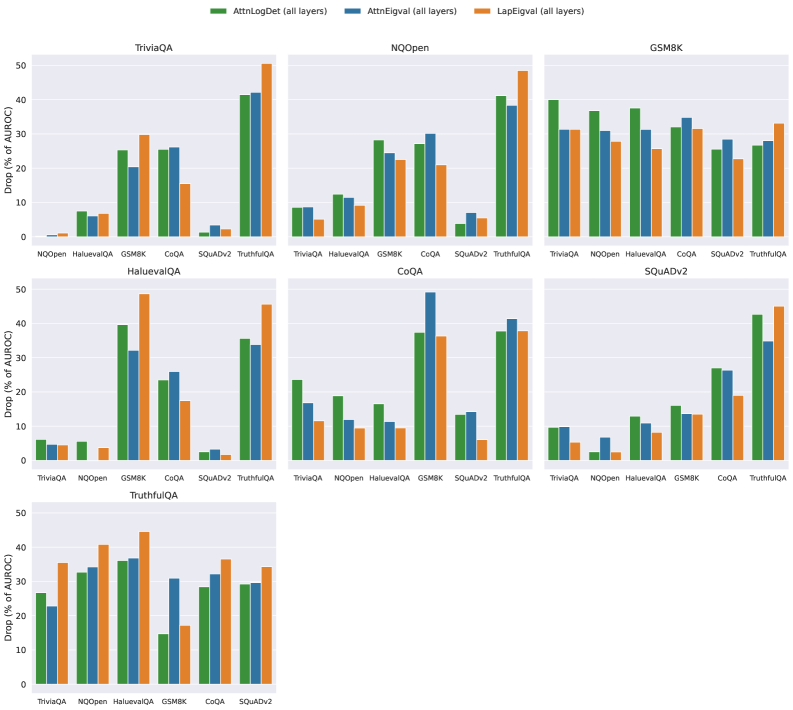
The image presents a series of bar charts comparing the performance of three methods – AttnLogDet (all layers), AttnEigval (all layers), and LapEigval (all layers) – across seven different question answering datasets: TriviaQA, NQOpen, GSM8K, HaluevalQA, CoQA, SQuADv2, and TruthfulQA. The performance metric is "Drop (%) of AUROC", representing the percentage drop in Area Under the Receiver Operating Characteristic curve. The charts are arranged in a 3x3 grid, with the datasets displayed on the x-axis and the Drop (%) of AUROC on the y-axis.
### Components/Axes
* **X-axis:** Datasets - TriviaQA, NQOpen, GSM8K, HaluevalQA, CoQA, SQuADv2, TruthfulQA.
* **Y-axis:** Drop (%) of AUROC, ranging from 0 to 50, with increments of 10.
* **Legend:**
* Green: AttnLogDet (all layers)
* Orange: AttnEigval (all layers)
* Brown: LapEigval (all layers)
* **Grid:** The charts are arranged in a 3x3 grid. The top row contains TriviaQA, NQOpen, and GSM8K. The middle row contains HaluevalQA, CoQA, and SQuADv2. The bottom row contains TruthfulQA.
* **Horizontal Gridlines:** Light gray horizontal lines are present at y-axis intervals of 10.
### Detailed Analysis or Content Details
**Top Row:**
* **TriviaQA:** AttnLogDet ~42%, AttnEigval ~22%, LapEigval ~25%.
* **NQOpen:** AttnLogDet ~38%, AttnEigval ~18%, LapEigval ~20%.
* **GSM8K:** AttnLogDet ~25%, AttnEigval ~22%, LapEigval ~24%.
**Middle Row:**
* **HaluevalQA:** AttnLogDet ~40%, AttnEigval ~28%, LapEigval ~25%.
* **CoQA:** AttnLogDet ~12%, AttnEigval ~8%, LapEigval ~10%.
* **SQuADv2:** AttnLogDet ~8%, AttnEigval ~5%, LapEigval ~6%.
**Bottom Row:**
* **TruthfulQA:** AttnLogDet ~32%, AttnEigval ~30%, LapEigval ~34%.
**Trend Verification & Specific Values:**
* **TriviaQA:** AttnLogDet shows the highest drop, significantly outperforming the other two methods.
* **NQOpen:** AttnLogDet again exhibits the largest drop, followed by AttnEigval and LapEigval.
* **GSM8K:** The drop values are relatively close for all three methods, with AttnLogDet slightly higher.
* **HaluevalQA:** AttnLogDet shows the highest drop, followed by AttnEigval and LapEigval.
* **CoQA:** AttnLogDet shows the highest drop, followed by LapEigval and AttnEigval.
* **SQuADv2:** AttnLogDet shows the highest drop, followed by LapEigval and AttnEigval.
* **TruthfulQA:** LapEigval shows the highest drop, followed by AttnLogDet and AttnEigval.
### Key Observations
* AttnLogDet consistently outperforms AttnEigval and LapEigval on most datasets (TriviaQA, NQOpen, GSM8K, HaluevalQA, CoQA, SQuADv2).
* LapEigval and AttnEigval show similar performance on several datasets (GSM8K, HaluevalQA).
* TruthfulQA is the only dataset where LapEigval shows the highest drop, indicating a potential advantage of this method on this specific task.
* The drop values are generally higher for TriviaQA, NQOpen, and HaluevalQA, suggesting these datasets are more sensitive to the differences between the methods.
* The drop values are relatively low for CoQA and SQuADv2, indicating that the methods perform similarly on these datasets.
### Interpretation
The data suggests that AttnLogDet is generally the most effective method across a range of question answering datasets, as evidenced by its consistently higher drop in AUROC compared to AttnEigval and LapEigval. However, the performance of the methods varies depending on the dataset. The superior performance of LapEigval on TruthfulQA suggests that this method may be particularly well-suited for tasks requiring truthful reasoning or knowledge.
The differences in performance across datasets could be attributed to the specific characteristics of each dataset, such as the type of questions asked, the complexity of the reasoning required, and the presence of biases or noise. The relatively low drop values for CoQA and SQuADv2 may indicate that these datasets are less challenging or that the methods have already achieved a high level of performance on these tasks.
The consistent outperformance of AttnLogDet suggests that the features or mechanisms it employs are generally beneficial for question answering. Further investigation into the specific differences between these methods could provide insights into the factors that contribute to their performance and guide the development of more effective question answering systems. The fact that LapEigval performs best on TruthfulQA is interesting and suggests that the eigval approach may be more robust to generating truthful answers.