\n
## Diagram: Convolutional Neural Network Layer Configuration
### Overview
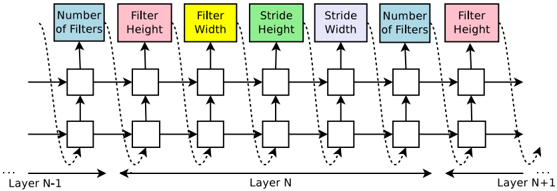
The image depicts a diagram illustrating the configuration of layers in a convolutional neural network (CNN). It shows the connections between layers N-1, N, and N+1, highlighting key parameters associated with each layer. The diagram uses boxes to represent layers and arrows to indicate data flow and parameter influence.
### Components/Axes
The diagram consists of the following components:
* **Layers:** Represented as rectangular blocks, labeled "Layer N-1", "Layer N", and "Layer N+1" along the horizontal axis.
* **Parameters:** Boxes positioned above the layers, labeled with:
* "Number of Filters" (Light Blue)
* "Filter Height" (Pink)
* "Filter Width" (Yellow)
* "Stride Height" (Light Green)
* "Stride Width" (Dark Green)
* **Data Flow:** Represented by solid arrows indicating the primary data path through the layers.
* **Parameter Influence:** Represented by dashed arrows connecting the parameter boxes to the layers they influence.
* **Horizontal Axis:** Indicates the progression of layers, labeled "...Layer N-1", "Layer N", "...Layer N+1".
### Detailed Analysis or Content Details
The diagram illustrates how parameters from the parameter boxes influence the layers. Each layer receives input from the previous layer and passes output to the next. The parameters associated with each layer are:
* **Layer N-1:** Influenced by "Number of Filters", "Filter Height", and "Filter Width".
* **Layer N:** Influenced by "Filter Width", "Stride Height", and "Stride Width".
* **Layer N+1:** Influenced by "Number of Filters", "Filter Height", and "Filter Width".
The diagram does not provide specific numerical values for any of the parameters. It only shows the relationships between the layers and the parameters that affect them. The arrows indicate that the parameters influence the layers they point to. The solid arrows show the flow of data between layers.
### Key Observations
* The diagram emphasizes the importance of parameters like filter size, stride, and the number of filters in defining the behavior of convolutional layers.
* The parameters are not consistent across layers. For example, "Stride Height" and "Stride Width" only influence Layer N, while "Number of Filters" influences both Layer N-1 and Layer N+1.
* The diagram is a conceptual representation and does not include details like padding, activation functions, or pooling layers.
### Interpretation
This diagram illustrates the core concepts of convolutional layers in a CNN. It demonstrates how the choice of parameters (number of filters, filter size, stride) impacts the processing of data as it moves through the network. The diagram suggests that different layers may have different parameter configurations, allowing the network to learn hierarchical features. The use of dashed lines to represent parameter influence highlights that these parameters are not directly part of the data flow but rather control how the data is transformed. The diagram is a simplified representation, focusing on the key parameters and their relationships, and omitting other important aspects of CNN architecture. It serves as a visual aid for understanding the fundamental building blocks of a CNN.