## Auditory Processing Diagram: Binaural Matrix Feature Decoder
### Overview
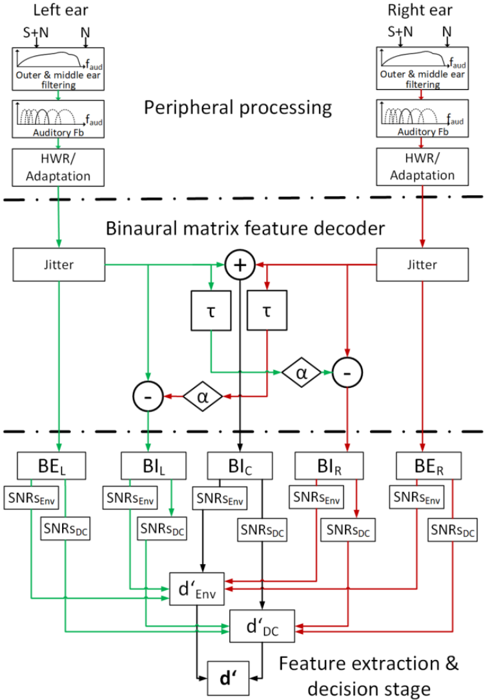
The image presents a block diagram illustrating a model of auditory processing, specifically focusing on binaural (two-ear) processing. It depicts the flow of auditory information from the left and right ears through various stages, including peripheral processing, binaural matrix feature decoding, and feature extraction/decision making. The diagram highlights the integration of information from both ears to extract relevant features for sound localization and perception.
### Components/Axes
* **Top:**
* **Left Ear:** Labeled "Left ear" with input signals "S+N" (Signal + Noise) and "N" (Noise).
* "Outer & middle ear filtering" block with "f_aud" label.
* "Auditory Fb" block with "f_aud" label.
* "HWR/Adaptation" block.
* **Right Ear:** Labeled "Right ear" with input signals "S+N" (Signal + Noise) and "N" (Noise).
* "Outer & middle ear filtering" block with "f_aud" label.
* "Auditory Fb" block with "f_aud" label.
* "HWR/Adaptation" block.
* **Peripheral processing:** Label above the left and right ear processing blocks.
* **Middle:**
* **Binaural matrix feature decoder:** Label for the central processing unit.
* Processing blocks including "Jitter", summation (+), subtraction (-), delay (τ), and scaling (α).
* Green lines represent processing from the left ear.
* Red lines represent processing from the right ear.
* **Bottom:**
* **BEL, BIL, BIC, BIR, BER:** Blocks representing binaural elements (likely Left Ear, Interaural Left, Interaural Center, Interaural Right, Right Ear).
* **SNRSEnv:** Signal-to-noise ratio of the envelope.
* **SNRSDC:** Signal-to-noise ratio of the direct current component.
* **d'Env:** Decision variable based on the envelope.
* **d'DC:** Decision variable based on the direct current component.
* **d':** Final decision variable.
* **Feature extraction & decision stage:** Label for the final processing stage.
### Detailed Analysis
* **Peripheral Processing (Top):**
* The auditory signal (S+N) enters both ears. Noise (N) is also present.
* The signal undergoes filtering in the outer and middle ear, represented by the "Outer & middle ear filtering" block. The frequency response is denoted by "f_aud".
* Auditory feedback ("Auditory Fb") is applied, also related to frequency "f_aud".
* Half-wave rectification and adaptation ("HWR/Adaptation") are performed.
* **Binaural Matrix Feature Decoder (Middle):**
* The processed signals from the left (green lines) and right (red lines) ears enter the binaural decoder.
* "Jitter" blocks are present for both left and right ear signals.
* The signals are combined through summation (+) and subtraction (-) operations.
* Delay elements (τ) are introduced in the signal paths.
* Scaling factors (α) are applied to certain signal paths.
* **Feature Extraction & Decision Stage (Bottom):**
* The outputs of the binaural decoder feed into blocks labeled "BEL", "BIL", "BIC", "BIR", and "BER".
* For each of these blocks, the signal-to-noise ratios of the envelope ("SNRSEnv") and direct current component ("SNRSDC") are extracted.
* These SNR values are used to compute decision variables "d'Env" and "d'DC".
* Finally, these decision variables are combined to produce the final decision variable "d'".
* **Signal Flow:**
* The green lines indicate the flow of information primarily from the left ear.
* The red lines indicate the flow of information primarily from the right ear.
* The signals are combined and processed in the binaural matrix feature decoder to extract relevant features.
### Key Observations
* The diagram illustrates a model of how the brain processes auditory information from both ears to extract features relevant for sound localization and perception.
* The binaural matrix feature decoder plays a crucial role in integrating information from both ears.
* The model considers both the envelope and direct current components of the auditory signal.
* The use of delay elements (τ) and scaling factors (α) suggests that the model accounts for interaural time differences and interaural level differences, which are important cues for sound localization.
### Interpretation
This diagram represents a computational model of binaural hearing. It suggests that the brain processes auditory information from both ears in a series of stages, starting with peripheral processing and culminating in a decision about the sound source. The model incorporates several key features of binaural hearing, including interaural time differences, interaural level differences, and the extraction of envelope and direct current components. The model's architecture, with its summation, subtraction, delay, and scaling operations, suggests a sophisticated mechanism for integrating information from both ears to enhance sound localization and perception. The presence of "Jitter" blocks suggests that the model also accounts for the variability in neural responses. The model likely aims to simulate how the brain extracts relevant features from the auditory scene to make decisions about the location and identity of sound sources.