## Comparative Visual Chart: Hierarchical-3DGS vs. FloD-3DGS Performance
### Overview
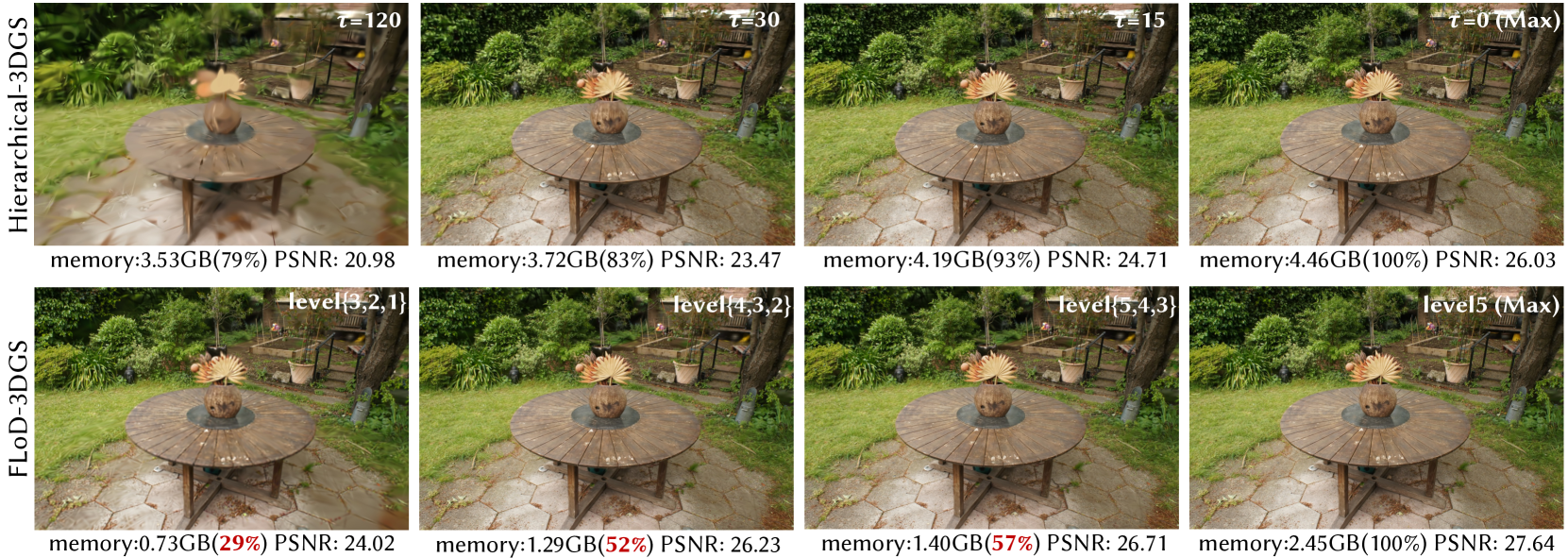
The image is a 2x4 grid comparing the visual quality and resource usage of two 3D Gaussian Splatting (3DGS) methods: **Hierarchical-3DGS** (top row) and **FloD-3DGS** (bottom row). Each row shows four progressive levels of detail or quality settings for the same 3D scene (a garden patio with a wooden table and a decorative object). Below each sub-image, quantitative metrics for memory usage and Peak Signal-to-Noise Ratio (PSNR) are provided.
### Components/Axes
* **Structure:** A grid with two rows and four columns.
* **Row Labels (Left Side):**
* Top Row: `Hierarchical-3DGS` (written vertically).
* Bottom Row: `FloD-3DGS` (written vertically).
* **Column/Parameter Labels (Top-Right of each sub-image):**
* **Top Row (Hierarchical-3DGS):** Parameters are denoted by `τ` (tau). From left to right: `τ=120`, `τ=30`, `τ=15`, `τ=0 (Max)`.
* **Bottom Row (FloD-3DGS):** Parameters are denoted by `level` sets. From left to right: `level{3,2,1}`, `level{4,3,2}`, `level{5,4,3}`, `level5 (Max)`.
* **Data Labels (Below each sub-image):** Each contains two metrics:
1. `memory: X.XXGB (YY%)` - Memory usage in Gigabytes and as a percentage of the maximum.
2. `PSNR: XX.XX` - Peak Signal-to-Noise Ratio, a measure of image reconstruction quality.
### Detailed Analysis
**Row 1: Hierarchical-3DGS**
* **Trend:** As `τ` decreases (moving left to right), visual clarity improves, memory usage increases, and PSNR increases.
* **Data Points:**
1. **τ=120 (Top-Left):** Image is very blurry. `memory:3.53GB(79%) PSNR: 20.98`
2. **τ=30:** Image is less blurry, details emerge. `memory:3.72GB(83%) PSNR: 23.47`
3. **τ=15:** Image is clear. `memory:4.19GB(93%) PSNR: 24.71`
4. **τ=0 (Max) (Top-Right):** Image is sharpest. `memory:4.46GB(100%) PSNR: 26.03`
**Row 2: FloD-3DGS**
* **Trend:** As the level set expands (moving left to right), visual clarity improves, memory usage increases, and PSNR increases. The memory percentages are highlighted in **red**.
* **Data Points:**
1. **level{3,2,1} (Bottom-Left):** Image is reasonably clear. `memory:0.73GB(**29%**) PSNR: 24.02`
2. **level{4,3,2}:** Image is clearer. `memory:1.29GB(**52%**) PSNR: 26.23`
3. **level{5,4,3}:** Image is very clear. `memory:1.40GB(**57%**) PSNR: 26.71`
4. **level5 (Max) (Bottom-Right):** Image is sharpest. `memory:2.45GB(100%) PSNR: 27.64`
### Key Observations
1. **Efficiency Disparity:** FloD-3DGS achieves significantly higher PSNR values at much lower memory footprints compared to Hierarchical-3DGS. For example, FloD-3DGS at `level{4,3,2}` (PSNR 26.23, 1.29GB) surpasses the quality of Hierarchical-3DGS at its maximum setting (PSNR 26.03, 4.46GB) while using less than 30% of the memory.
2. **Visual Quality Correlation:** The visual improvement in the images directly correlates with the increasing PSNR values for both methods.
3. **Memory Scaling:** The maximum memory usage for FloD-3DGS (2.45GB) is approximately 55% of the maximum memory used by Hierarchical-3DGS (4.46GB).
4. **Parameter Notation:** The methods use different parameterization schemes (`τ` vs. `level` sets) to control the quality-memory trade-off.
### Interpretation
This chart demonstrates a clear performance advantage for the **FloD-3DGS** method over **Hierarchical-3DGS** in the context of this specific 3D scene reconstruction task. The data suggests that FloD-3DGS employs a more efficient underlying representation or compression technique, allowing it to deliver superior visual fidelity (higher PSNR) while consuming substantially less GPU memory.
The progressive improvement in both rows indicates that both methods support scalable quality settings. However, FloD-3DGS provides a much more favorable trade-off curve: a small increase in memory yields a large gain in PSNR, especially in the lower memory regimes. The red highlighting of the memory percentages for FloD-3DGS likely emphasizes its efficiency as a key selling point.
From a technical standpoint, the `level` set parameterization in FloD-3DGS might correspond to a multi-resolution or hierarchical structure where more levels (e.g., `level5`) enable finer detail reconstruction. The chart effectively argues that FloD-3DGS is a more practical choice for applications where memory bandwidth or capacity is a constraint, such as real-time rendering on consumer hardware or processing large-scale scenes.