## Diagram: Process Flow from A to C
### Overview
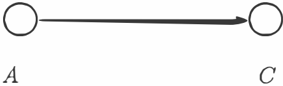
The image depicts a simple directional diagram with two labeled circular nodes ("A" and "C") connected by a single arrow. The arrow originates from node A (left) and points toward node C (right), indicating a unidirectional relationship or process flow. No additional annotations, numerical data, or contextual elements are present.
### Components/Axes
- **Nodes**:
- **A**: Left circular node, labeled "A" in black text below the circle.
- **C**: Right circular node, labeled "C" in black text below the circle.
- **Arrow**:
- A single black arrow spans horizontally between A and C, with a clear directional orientation (→).
- **No axes, scales, legends, or numerical markers are visible.**
### Detailed Analysis
- **Labels**:
- "A" and "C" are explicitly labeled beneath their respective nodes.
- **Arrow Placement**:
- The arrow is centered between the two nodes, emphasizing the direction from A to C.
- **Visual Style**:
- Minimalist design with no shading, gradients, or additional graphical elements.
### Key Observations
1. The diagram explicitly shows a one-way relationship (A → C) with no feedback loop or bidirectional indication.
2. No numerical values, timeframes, or contextual metadata are provided.
3. The simplicity suggests a conceptual or abstract representation rather than a data-driven visualization.
### Interpretation
This diagram likely represents a foundational process, workflow, or causal relationship where entity A initiates or precedes entity C. The absence of additional nodes or complexity implies a focus on the core interaction between A and C. Without further context, the nature of the relationship (e.g., cause-effect, sequential steps) remains ambiguous. The diagram serves as a schematic placeholder for a linear progression, requiring external context to define its practical application.