## Diagram: Masked Row Attention
### Overview
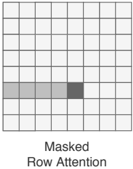
The image displays a 7x7 grid visualization representing a "Masked Row Attention" mechanism, commonly used in Transformer-based machine learning models (such as GPT). The grid illustrates how a specific token in a sequence attends to previous tokens while being prevented from "seeing" future tokens.
### Components/Axes
* **Grid Structure:** A 7x7 matrix of squares.
* **Text Label:** Located directly below the grid, reading "Masked Row Attention."
* **Visual Encoding:**
* **White Squares:** Represent masked or ignored positions (future tokens).
* **Light Gray Squares:** Represent attended positions (past tokens).
* **Dark Gray Square:** Represents the current position (the query token).
### Detailed Analysis
The diagram focuses on a single row (the 4th row from the top) to demonstrate the attention scope for a specific token.
* **Grid Dimensions:** 7 columns by 7 rows.
* **Active Row (Row 4):**
* **Columns 1 through 4 (Left to Right):** Shaded in light gray. These represent the "past" context that the current token is allowed to attend to.
* **Column 5:** Shaded in dark gray. This represents the current token position (the query).
* **Columns 6 and 7:** Unshaded (white). These represent the "future" tokens, which are masked out to prevent information leakage during training.
* **Inactive Rows:** All other rows (1-3 and 5-7) are entirely white, indicating that the diagram is isolating the attention behavior of a single token at a specific time step.
### Key Observations
* **Asymmetry:** The shading is strictly left-aligned relative to the dark gray square, creating a triangular-like pattern of attention if this were applied to all rows.
* **Causal Constraint:** The visual clearly demonstrates a "causal" constraint, where the model is restricted to looking backward in the sequence.
* **Differentiation:** The use of two shades of gray (light vs. dark) distinguishes between the *context* (past tokens) and the *focus* (current token).
### Interpretation
This diagram is a conceptual representation of **Causal Self-Attention** in Large Language Models (LLMs).
* **Why it matters:** In autoregressive models, the goal is to predict the next token based on previous tokens. If the model were allowed to "see" the future tokens (the white squares to the right of the dark gray square) during training, it would simply copy the answer rather than learning to predict it.
* **The "Mask":** The white squares represent the "mask" applied to the attention matrix. By setting the attention scores for these positions to negative infinity (before the Softmax function), the model effectively ignores them.
* **Peircean Investigative Perspective:**
* **The Sign:** The grid is an *icon* of the attention matrix.
* **The Object:** The underlying mathematical operation is the masking of the upper-triangular portion of the attention matrix.
* **The Interpretant:** The viewer understands this as a rule of sequence modeling: "You cannot know what comes next until you have processed what came before." The diagram serves as a visual proof of the model's inability to cheat during the training phase.