## Supplementary Note: Mathematical Lemma and Proof
### Overview
The image displays a section of a technical document, specifically "Supplementary Note 2," containing a formal mathematical lemma and its proof. The content is presented in a standard academic typesetting style, likely from a paper in quantum information theory or a related field. The text is entirely in English.
### Components/Axes
The document is structured as follows:
1. **Title:** "Supplementary Note 2:"
2. **Lemma Statement:** "Lemma 1: (High fidelity implies low entropy)" followed by the formal proposition.
3. **Proof:** A paragraph providing the logical derivation for the lemma, concluding with "Q.E.D."
### Detailed Analysis
**Lemma 1: (High fidelity implies low entropy)**
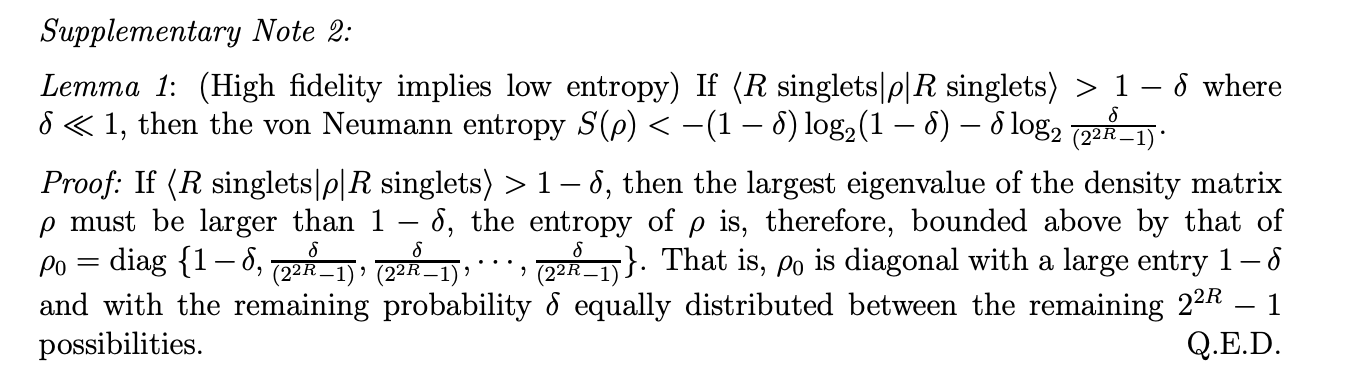
* **Condition:** If the fidelity between a state `ρ` and the state of `R` singlets is greater than `1 - δ`, where `δ` is much less than 1 (`δ ≪ 1`). This is written as: `⟨R singlets|ρ|R singlets⟩ > 1 - δ`.
* **Conclusion:** Then the von Neumann entropy `S(ρ)` is bounded above by the expression: `S(ρ) < -(1 - δ) log₂(1 - δ) - δ log₂(δ / (2^(2R) - 1))`.
**Proof:**
The proof proceeds by logical deduction:
1. **Premise:** Start with the given condition: `⟨R singlets|ρ|R singlets⟩ > 1 - δ`.
2. **Implication for Eigenvalues:** This implies that the largest eigenvalue of the density matrix `ρ` must be greater than `1 - δ`.
3. **Entropy Bound:** Therefore, the entropy of `ρ` is bounded above by the entropy of a specific diagonal density matrix `ρ₀`.
4. **Definition of `ρ₀`:** The matrix `ρ₀` is defined as: `ρ₀ = diag {1 - δ, δ/(2^(2R)-1), δ/(2^(2R)-1), ..., δ/(2^(2R)-1)}`.
5. **Interpretation of `ρ₀`:** This matrix `ρ₀` is diagonal with one large entry `(1 - δ)` and the remaining probability `δ` equally distributed among the other `2^(2R) - 1` possibilities.
### Key Observations
* The lemma establishes a direct, quantitative relationship between a high-fidelity condition (closeness to a specific pure state) and an upper bound on the von Neumann entropy (a measure of mixedness or uncertainty).
* The proof relies on a majorization argument: the state `ρ` is majorized by the constructed state `ρ₀`, and entropy is a Schur-concave function, meaning it respects this ordering.
* The bound becomes very tight for small `δ`. As `δ` approaches 0, the upper bound on entropy also approaches 0, consistent with the intuition that a state very close to a pure state must itself have very low entropy.
### Interpretation
This lemma provides a fundamental tool for analyzing quantum states. It quantifies the intuition that if a quantum system is very likely to be found in a specific, highly ordered configuration (the `R` singlets), then its overall disorder (entropy) must be low.
* **What it demonstrates:** It translates a *fidelity* criterion (a measure of state overlap) into an *entropy* bound (a measure of information content). This is crucial for protocols where maintaining a high-fidelity state is necessary, such as in quantum communication or computation.
* **Relationship between elements:** The condition `⟨R singlets|ρ|R singlets⟩ > 1 - δ` is the input. The proof constructs a "worst-case" mixed state `ρ₀` that satisfies this condition and has the maximum possible entropy. The entropy of any other state `ρ` meeting the condition cannot exceed that of `ρ₀`.
* **Notable implications:** The term `2^(2R)` in the denominator suggests the dimension of the Hilbert space involved scales exponentially with `R`, which is typical for systems of `R` entangled particles (e.g., `R` Bell pairs). The lemma is likely used in a larger argument to show that high-fidelity preparation or transmission of such states is possible only if the entropy is correspondingly low, placing limits on noise or decoherence.