## Diagram: Write Enable Selection
### Overview
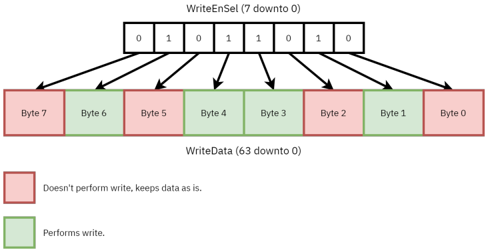
The image illustrates a write enable selection mechanism for a 64-bit data bus, where individual bytes can be selectively written based on an 8-bit enable signal. The diagram shows how each bit of the `WriteEnSel` signal corresponds to a byte in the `WriteData` bus, determining whether a write operation is performed on that specific byte.
### Components/Axes
* **WriteEnSel (7 downto 0):** An 8-bit signal represented by a row of 8 boxes, each containing a binary digit (0 or 1). This signal controls the write enable for each byte of the `WriteData` bus.
* **WriteData (63 downto 0):** A 64-bit data bus represented by a row of 8 boxes, each labeled "Byte X" (where X ranges from 7 to 0). The color of each box indicates whether a write operation is performed on that byte.
* **Arrows:** Arrows connect each bit of the `WriteEnSel` signal to the corresponding byte in the `WriteData` bus, indicating the control relationship.
* **Legend (Bottom-Left):**
* Red box: "Doesn't perform write, keeps data as is."
* Green box: "Performs write."
### Detailed Analysis
* **WriteEnSel Values:** From left to right, the `WriteEnSel` bits are: 0, 1, 0, 1, 1, 0, 1, 0.
* **WriteData Byte Colors:**
* Byte 7: Red (Doesn't perform write)
* Byte 6: Green (Performs write)
* Byte 5: Red (Doesn't perform write)
* Byte 4: Green (Performs write)
* Byte 3: Green (Performs write)
* Byte 2: Red (Doesn't perform write)
* Byte 1: Green (Performs write)
* Byte 0: Red (Doesn't perform write)
### Key Observations
The diagram clearly shows a one-to-one correspondence between the `WriteEnSel` bits and the `WriteData` bytes. A '1' in the `WriteEnSel` signal enables the write operation for the corresponding byte, while a '0' disables it, preserving the existing data.
### Interpretation
The diagram illustrates a byte-level write enable mechanism. This is a common technique in memory systems and data processing where it's necessary to selectively update portions of a larger data structure. The `WriteEnSel` signal acts as a mask, allowing specific bytes to be modified while leaving others untouched. The alternating pattern of write enables (0, 1, 0, 1, 1, 0, 1, 0) suggests a possible use case where only specific bytes within a 64-bit word need to be updated, potentially for efficiency or data integrity reasons.