## Multi-Component Analysis of Quantum Spin Systems and Machine Learning Optimization
### Overview
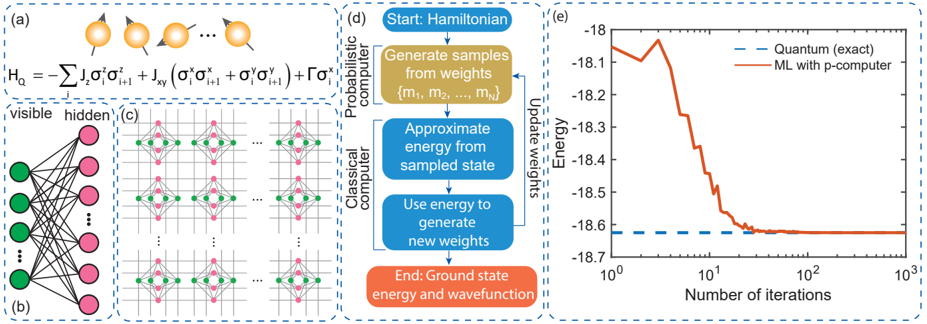
The image presents a multi-panel technical illustration detailing aspects of quantum spin systems, a machine learning model (Restricted Boltzmann Machine), a computational workflow involving probabilistic and classical computers, and a performance chart showing energy optimization. It illustrates a method for finding the ground state energy of a quantum system using a machine learning approach with a probabilistic computer.
### Components/Axes
The image is divided into five sub-figures labeled (a) through (e).
**Sub-figure (a): Quantum Spin Chain and Hamiltonian**
* **Top-left:** A visual representation of a 1D chain of five spherical particles, each with an arrow indicating a spin direction (e.g., up, down, tilted). The chain continues with "..." to the right.
* **Below the spin chain:** A mathematical equation for the Hamiltonian, labeled `H_Q`.
* `H_Q = - Σ_j J_z σ^z_i σ^z_{i+1} + J_{xy} (σ^x_i σ^x_{i+1} + σ^y_i σ^y_{i+1}) + Γσ^x_i`
**Sub-figure (b): Restricted Boltzmann Machine (RBM)**
* **Top-left label:** "visible"
* **Top-right label:** "hidden"
* **Left column:** Five green circular nodes, representing the "visible" layer. An ellipsis `...` indicates more nodes below.
* **Right column:** Five pink circular nodes, representing the "hidden" layer. An ellipsis `...` indicates more nodes below.
* **Connections:** Black lines connect every visible node to every hidden node, indicating an all-to-all bipartite connection between the layers.
**Sub-figure (c): Quantum Spin Lattice with RBM-like Units**
* **Background:** A grid of light gray lines forming squares, suggesting a 2D lattice structure.
* **Components:** Arranged in a 2x2 grid pattern (with "..." indicating continuation horizontally and vertically), there are repeating units. Each unit consists of:
* Four green circular nodes at the corners of a diamond shape.
* Four pink circular nodes inside the diamond, connected to the green nodes and to each other, forming a smaller diamond.
* The overall structure appears to be a lattice of interconnected RBM-like units.
**Sub-figure (d): Computational Workflow Flowchart**
* **Overall structure:** A vertical flowchart with a feedback loop.
* **Left-side labels:**
* "Probabilistic computer" (vertical text, aligned with the top brown box)
* "Classical computer" (vertical text, aligned with the two blue boxes)
* **Right-side label:** "Update weights" (vertical text, aligned with the arrow connecting the classical computer back to the probabilistic computer).
* **Flowchart steps (from top to bottom):**
1. **Start: Hamiltonian** (Blue rounded rectangle, top)
2. **Generate samples from weights {m₁, m₂, ..., m_N}** (Brown rounded rectangle, below "Probabilistic computer" label)
3. **Approximate energy from sampled state** (Blue rounded rectangle, below "Classical computer" label)
4. **Use energy to generate new weights** (Blue rounded rectangle, below "Classical computer" label)
5. **End: Ground state energy and wavefunction** (Orange rounded rectangle, bottom)
* **Arrows:** Indicate flow direction. An arrow from "Use energy to generate new weights" points back to "Generate samples from weights {m₁, m₂, ..., m_N}", forming the "Update weights" feedback loop.
**Sub-figure (e): Energy Optimization Chart**
* **Type:** Line chart.
* **X-axis:** "Number of iterations"
* **Scale:** Logarithmic.
* **Range:** From 10⁰ (1) to 10³ (1000).
* **Markers:** 10⁰, 10¹, 10², 10³.
* **Y-axis:** "Energy"
* **Scale:** Linear.
* **Range:** From approximately -18.7 to -18.0.
* **Markers:** -18, -18.1, -18.2, -18.3, -18.4, -18.5, -18.6, -18.7.
* **Legend (top-right):**
* **Blue dashed line:** "Quantum (exact)"
* **Orange solid line:** "ML with p-computer"
### Detailed Analysis
**Sub-figure (a): Quantum Spin Chain and Hamiltonian**
The image depicts a 1D chain of quantum spins, which are fundamental units of magnetic moment. The Hamiltonian `H_Q` describes the total energy of this system. It includes three terms:
1. `Σ_j J_z σ^z_i σ^z_{i+1}`: An interaction term between adjacent spins along the z-axis, with coupling strength `J_z`. The negative sign suggests an antiferromagnetic interaction if `J_z` is positive.
2. `J_{xy} (σ^x_i σ^x_{i+1} + σ^y_i σ^y_{i+1})`: An interaction term between adjacent spins in the xy-plane, with coupling strength `J_{xy}`. This represents a transverse interaction.
3. `Γσ^x_i`: A term representing an external magnetic field `Γ` applied along the x-axis, interacting with individual spins `σ^x_i`.
This Hamiltonian is characteristic of an anisotropic Heisenberg model with a transverse field, commonly used in condensed matter physics to describe magnetic materials.
**Sub-figure (b): Restricted Boltzmann Machine (RBM)**
This diagram illustrates a basic RBM architecture. The "visible" layer (green nodes) represents the input data (e.g., spin configurations), and the "hidden" layer (pink nodes) learns to extract features or represent latent variables. The all-to-all connections between layers, without connections within layers, are a defining characteristic of RBMs. The ellipsis indicates that the number of nodes in each layer can be larger than five.
**Sub-figure (c): Quantum Spin Lattice with RBM-like Units**
This sub-figure suggests a more complex, possibly spatially extended, machine learning architecture or a representation of a quantum system being modeled. The repeating units, each resembling a small RBM (with green and pink nodes), are arranged on a 2D grid. This could represent a tensor network state or a specific type of neural network architecture designed to capture spatial correlations in a quantum lattice system, where each unit models a local region or a bond. The green nodes might correspond to physical spins on the lattice, and the pink nodes to hidden variables or auxiliary degrees of freedom.
**Sub-figure (d): Computational Workflow Flowchart**
This flowchart outlines an iterative algorithm for finding the ground state energy and wavefunction of a quantum system using a hybrid approach involving a probabilistic computer and a classical computer.
1. **Start:** The process begins with a defined Hamiltonian (e.g., `H_Q` from sub-figure (a)).
2. **Probabilistic Computer (Sampling):** The probabilistic computer (likely a p-computer as mentioned in the chart legend) generates samples of spin configurations (`{m₁, m₂, ..., m_N}`) based on current "weights." These weights encode the trial wavefunction.
3. **Classical Computer (Energy Approximation):** The classical computer takes these sampled states and approximates the energy of the system. This typically involves calculating the expectation value of the Hamiltonian for the sampled states.
4. **Classical Computer (Weight Update):** Using the approximated energy, the classical computer then calculates gradients or applies an optimization algorithm to generate "new weights." These new weights aim to reduce the energy, moving towards the ground state.
5. **Feedback Loop:** The "Update weights" arrow indicates that these new weights are fed back to the probabilistic computer, which then generates new samples, continuing the iterative optimization process.
6. **End:** The process converges when the energy reaches a minimum, yielding the ground state energy and the corresponding wavefunction (encoded by the final weights).
**Sub-figure (e): Energy Optimization Chart**
This chart compares the energy obtained by the "ML with p-computer" method to the "Quantum (exact)" energy as a function of the number of iterations.
* **Quantum (exact) (Blue dashed line):** This line is horizontal and stable at approximately -18.62. This represents the true ground state energy of the system, serving as a benchmark.
* **ML with p-computer (Orange solid line):**
* **Initial state (approx. 1 iteration):** The energy starts high, around -18.0.
* **Early iterations (1 to ~10):** The energy rapidly decreases, showing significant optimization. It drops from -18.0 to approximately -18.5 by 10 iterations. There are some fluctuations, but the overall trend is a steep descent.
* **Mid iterations (~10 to ~50):** The rate of decrease slows down. The energy continues to drop, approaching the exact value. By around 30-40 iterations, it is very close to -18.6.
* **Later iterations (~50 onwards):** The energy converges and stabilizes, closely matching the "Quantum (exact)" value of -18.62. The line becomes nearly flat, indicating that the ML algorithm has found the ground state energy.
### Key Observations
* The image integrates theoretical physics (Hamiltonian, spin chains) with machine learning (RBMs) and computational methods (flowchart, optimization chart).
* Sub-figures (a), (b), and (c) provide different representations of the physical system and the machine learning model used to describe it. (a) is the problem definition, (b) is a basic building block, and (c) is a more complex application of that building block to a lattice.
* The flowchart (d) clearly delineates the roles of probabilistic and classical computing in an iterative optimization loop. The probabilistic computer handles sampling, while the classical computer handles energy calculation and weight updates.
* The performance chart (e) demonstrates the effectiveness of the "ML with p-computer" approach, showing that it successfully converges to the exact ground state energy of the quantum system within a relatively small number of iterations (around 50-100).
* The logarithmic scale on the x-axis of chart (e) highlights the rapid initial convergence and the subsequent fine-tuning phase.
### Interpretation
This document describes a method for solving quantum many-body problems, specifically finding the ground state energy of a quantum spin system, using a machine learning approach implemented with a probabilistic computer.
The Hamiltonian in (a) defines the quantum system whose ground state energy is sought. This is a fundamental problem in quantum physics, often computationally challenging for large systems.
The RBM in (b) and its lattice extension in (c) represent the variational ansatz (a trial wavefunction) used to approximate the quantum state. RBMs are known for their ability to represent complex quantum states, including entangled states. The lattice structure in (c) suggests that the RBM is adapted to capture the spatial correlations inherent in a lattice-based quantum system. The green nodes likely represent the physical spins, and the pink nodes are auxiliary variables that help encode the quantum correlations.
The flowchart in (d) illustrates a variational Monte Carlo (VMC) or similar optimization algorithm. The probabilistic computer's role in "Generate samples from weights" is crucial for exploring the vast configuration space of quantum states. This sampling step is often the most computationally intensive part for classical computers, making a probabilistic computer (like a p-computer, which might be specialized hardware for sampling from Boltzmann distributions) a potential accelerator. The classical computer then performs the deterministic tasks of evaluating the energy and updating the variational parameters (weights) to minimize this energy, effectively "learning" the ground state.
The chart in (e) provides empirical evidence for the success of this hybrid approach. The "ML with p-computer" method starts with a high energy (poor approximation) but quickly and smoothly converges to the "Quantum (exact)" ground state energy. This demonstrates that the iterative process, driven by the interplay of probabilistic sampling and classical optimization, is effective in finding the true ground state. The rapid initial drop in energy indicates efficient exploration of the energy landscape, while the subsequent plateau shows that the algorithm has successfully minimized the energy to the true ground state value. This suggests that such a hybrid quantum-classical or probabilistic-classical computing paradigm could be a powerful tool for tackling complex quantum problems.