## Mathematical Text: Branch Number Computation
### Overview
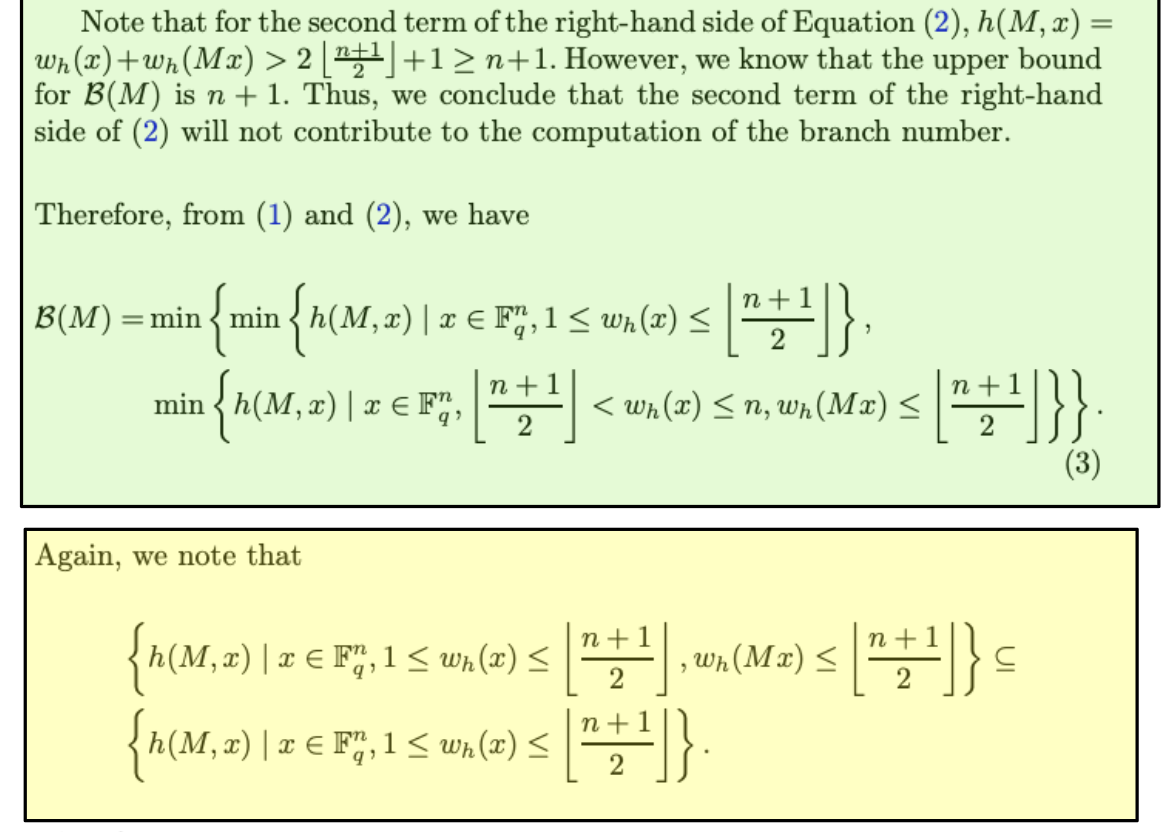
The image displays two distinct blocks of mathematical text and equations, presented on colored backgrounds (green and yellow). The content is part of a formal proof or derivation concerning the computation of a "branch number" denoted as \( \mathcal{B}(M) \). The text is in English and uses standard mathematical notation.
### Components/Axes
The image is segmented into two primary regions:
1. **Top Region (Green Background):** Contains explanatory text and a primary equation labeled (3).
2. **Bottom Region (Yellow Background):** Contains a follow-up note and a set inclusion statement.
There are no charts, axes, or legends. The "components" are the mathematical statements and the logical text connecting them.
### Detailed Analysis
#### **Top Region (Green Box)**
**Text Transcription:**
"Note that for the second term of the right-hand side of Equation (2), \( h(M, x) = w_h(x) + w_h(Mx) > 2 \left\lfloor \frac{n+1}{2} \right\rfloor + 1 \geq n+1 \). However, we know that the upper bound for \( \mathcal{B}(M) \) is \( n+1 \). Thus, we conclude that the second term of the right-hand side of (2) will not contribute to the computation of the branch number.
Therefore, from (1) and (2), we have"
**Equation (3) Transcription:**
\[
\mathcal{B}(M) = \min \left\{ \min \left\{ h(M, x) \mid x \in \mathbb{F}_q^n, 1 \leq w_h(x) \leq \left\lfloor \frac{n+1}{2} \right\rfloor \right\}, \right.
\]
\[
\left. \min \left\{ h(M, x) \mid x \in \mathbb{F}_q^n, \left\lfloor \frac{n+1}{2} \right\rfloor < w_h(x) \leq n, w_h(Mx) \leq \left\lfloor \frac{n+1}{2} \right\rfloor \right\} \right\}.
\]
**Key Symbols & Definitions:**
* \( \mathcal{B}(M) \): The branch number of a matrix \( M \).
* \( h(M, x) \): A function, likely the Hamming weight of the concatenation of \( x \) and \( Mx \).
* \( w_h(x) \): The Hamming weight of vector \( x \).
* \( \mathbb{F}_q^n \): The vector space of dimension \( n \) over the finite field \( \mathbb{F}_q \).
* \( \left\lfloor \frac{n+1}{2} \right\rfloor \): The floor function of \( (n+1)/2 \).
* The equation defines \( \mathcal{B}(M) \) as the minimum value of \( h(M, x) \) over two distinct subsets of vectors \( x \).
#### **Bottom Region (Yellow Box)**
**Text Transcription:**
"Again, we note that"
**Set Inclusion Statement Transcription:**
\[
\left\{ h(M, x) \mid x \in \mathbb{F}_q^n, 1 \leq w_h(x) \leq \left\lfloor \frac{n+1}{2} \right\rfloor, w_h(Mx) \leq \left\lfloor \frac{n+1}{2} \right\rfloor \right\} \subseteq
\]
\[
\left\{ h(M, x) \mid x \in \mathbb{F}_q^n, 1 \leq w_h(x) \leq \left\lfloor \frac{n+1}{2} \right\rfloor \right\}.
\]
**Key Observation:** This states that the set of \( h(M, x) \) values where both \( x \) and \( Mx \) have low Hamming weight is a subset of the set where only \( x \) has low Hamming weight.
### Key Observations
1. **Logical Flow:** The text presents a logical deduction. It first argues that one part of a previous equation (2) is irrelevant because its value exceeds the known upper bound for \( \mathcal{B}(M) \). This simplification leads directly to the definition in Equation (3).
2. **Structure of Equation (3):** The branch number is defined as the minimum of two separate minimization problems. The first searches over vectors \( x \) with low Hamming weight. The second searches over vectors \( x \) with higher Hamming weight, but imposes the condition that the resulting \( Mx \) has low Hamming weight.
3. **Subset Relationship:** The note in the yellow box establishes a containment relationship between two sets of function values. This is likely a step to further simplify or analyze the computation defined in Equation (3), showing that one condition is more restrictive than another.
### Interpretation
This image captures a segment of a proof in coding theory or linear algebra, specifically concerning the properties of a matrix \( M \) (likely a generator or parity-check matrix for a linear code). The "branch number" \( \mathcal{B}(M) \) is a critical parameter related to the code's resistance against certain types of attacks (e.g., differential or linear cryptanalysis).
The derivation shows how to compute \( \mathcal{B}(M) \) by considering two cases based on the Hamming weight of the input vector \( x \). The initial argument prunes the search space by eliminating vectors that cannot possibly yield the minimum value. The final subset inclusion suggests that the analysis can be focused on the first, simpler set of vectors where \( w_h(x) \) is already bounded, as the more complex condition in the second set of Equation (3) is implicitly covered. This is a common technique in proofs to reduce a problem to its most essential components.