## Diagram: LLM Agent Interaction with Environment and Memory
### Overview
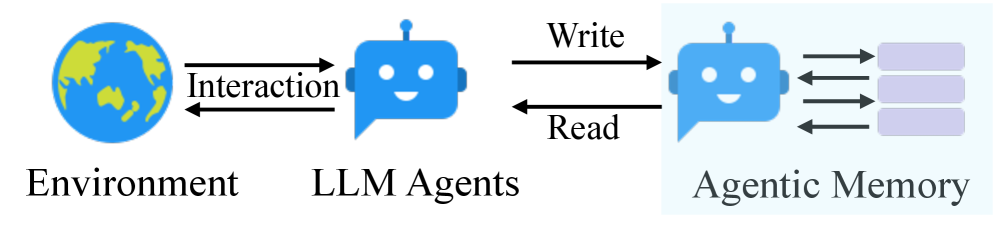
The image is a diagram illustrating the interaction of LLM (Large Language Model) Agents with an environment and an agentic memory. It shows a cyclical flow of information between these three components.
### Components/Axes
* **Environment:** Represented by a globe icon with blue oceans and green landmasses.
* **LLM Agents:** Represented by a blue robot-like icon with a speech bubble.
* **Agentic Memory:** Represented by a blue robot-like icon with a speech bubble, connected to three horizontal memory blocks.
* **Interaction:** A bidirectional arrow connecting the Environment and LLM Agents, labeled "Interaction".
* **Write:** A unidirectional arrow pointing from LLM Agents to Agentic Memory, labeled "Write".
* **Read:** A unidirectional arrow pointing from Agentic Memory to LLM Agents, labeled "Read".
### Detailed Analysis
* The "Environment" interacts with the "LLM Agents" through a two-way "Interaction".
* The "LLM Agents" "Write" to the "Agentic Memory".
* The "Agentic Memory" is read by the "LLM Agents" through a "Read" operation.
* The "Agentic Memory" consists of three horizontal blocks, each with an arrow pointing towards the "LLM Agents", indicating the flow of information during the "Read" operation.
### Key Observations
* The diagram illustrates a closed-loop system where LLM Agents interact with the environment, store information in memory, and retrieve information from memory.
* The use of robot-like icons for LLM Agents and Agentic Memory suggests that these components are intelligent and capable of processing information.
### Interpretation
The diagram depicts a system where LLM Agents learn and adapt through interaction with their environment and by utilizing a memory component. The "Interaction" with the environment provides the agents with new information, which they can then "Write" to their "Agentic Memory". This stored information can then be "Read" by the agents to inform their future interactions with the environment. This cycle allows the agents to improve their performance over time by learning from their experiences. The three memory blocks suggest that the agentic memory may be structured or tiered in some way.