TECHNICAL ASSET FINGERPRINT
c0a07381c403aa10feb2fe45
Click to view fullscreen
Press ESC or click to close
FOUND IN PAPERS
EXPERT: healer-alpha-free VERSION 1
RUNTIME: free/openrouter/healer-alpha
INTEL_VERIFIED
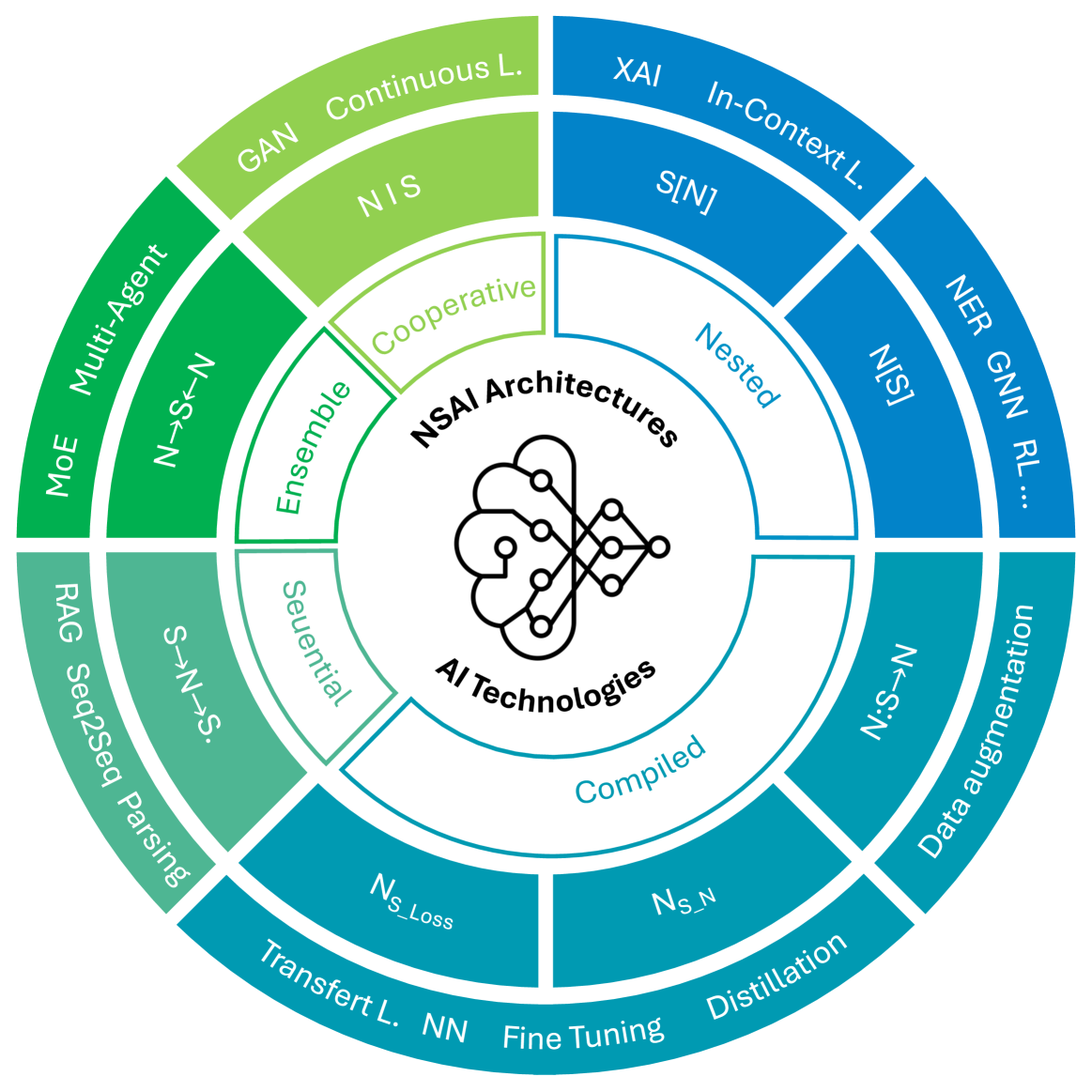
## [Diagram Type]: Hierarchical Circular Taxonomy of NSAI Architectures and AI Technologies
### Overview
The image is a multi-layered circular diagram (a sunburst or radial chart) that visually categorizes and relates various AI technologies and architectural paradigms under the central theme of "NSAI Architectures" and "AI Technologies." The diagram uses concentric rings and color-coded segments to show hierarchical relationships, with a central icon representing the integration of neural networks and knowledge graphs.
### Components/Axes
* **Central Core:** A white circle containing a black line-art icon of a brain interconnected with a network graph. Above the icon is the text **"NSAI Architectures"** and below it is **"AI Technologies"**.
* **Structure:** The diagram is organized into three primary concentric rings or layers radiating from the center.
1. **Innermost Ring (Middle Layer):** Divided into five colored segments, each labeled with a broad architectural or methodological category.
2. **Outer Ring:** Divided into multiple segments, each containing specific AI techniques, models, or concepts. These segments are color-coded to correspond with the category in the middle ring.
3. **Outermost Ring (Implicit):** The outermost edge of the diagram, where the specific technique labels are placed.
* **Color Coding & Legend (Implicit):** The diagram uses color to group related concepts. There is no separate legend box; the color association is spatial and direct.
* **Green (Light to Dark):** Associated with the "Cooperative" and "Ensemble" categories.
* **Blue (Light to Dark):** Associated with the "Nested" and "Compiled" categories.
* **Teal:** Associated with the "Sequential" category.
### Detailed Analysis
The diagram is segmented into five primary categories in the middle ring, each with associated technologies in the outer ring. The analysis proceeds clockwise from the top.
**1. Category: Cooperative (Light Green Segment, Top-Left)**
* **Associated Outer Ring Technologies (Clockwise):**
* `GAN` (Generative Adversarial Network)
* `Continuous L.` (Likely "Continuous Learning")
* `NIS` (Unclear abbreviation, possibly "Neural Inference System" or similar)
* `S[N]` (Unclear notation, possibly "System[Network]" or a specific model designation)
**2. Category: Nested (Light Blue Segment, Top-Right)**
* **Associated Outer Ring Technologies (Clockwise):**
* `XAI` (Explainable AI)
* `In-Context L.` (In-Context Learning)
* `NER` (Named Entity Recognition)
* `GNN` (Graph Neural Network)
* `RL...` (Reinforcement Learning, with ellipsis suggesting continuation or related methods)
**3. Category: Compiled (Dark Blue Segment, Bottom-Right)**
* **Associated Outer Ring Technologies (Clockwise):**
* `Data augmentation`
* `N->S_N` (Unclear notation, possibly "Network to Specific Network" or a transformation rule)
* `Distillation` (Knowledge Distillation)
* `Fine Tuning`
* `NN` (Neural Network)
* `Transfert L.` (Transfer Learning, note the French spelling "Transfert")
* `Ns_Loss` (Unclear, possibly "Network-specific Loss" or a named loss function)
**4. Category: Sequential (Teal Segment, Bottom-Left)**
* **Associated Outer Ring Technologies (Clockwise):**
* `S->N->S.` (Unclear notation, likely representing a sequence like "Sequence to Network to Sequence")
* `RAG` (Retrieval-Augmented Generation)
* `Seq2Seq` (Sequence-to-Sequence models)
* `Parsing`
**5. Category: Ensemble (Medium Green Segment, Left)**
* **Associated Outer Ring Technologies (Clockwise):**
* `N->S->N` (Unclear notation, likely "Network to Sequence to Network")
* `Multi-Agent`
* `MoE` (Mixture of Experts)
### Key Observations
* **Hierarchical Grouping:** The diagram successfully groups specific AI techniques (outer ring) under broader methodological paradigms (middle ring), suggesting a taxonomy for organizing NSAI (likely "Neuro-Symbolic AI" or similar) approaches.
* **Notation Ambiguity:** Several labels use symbolic notation (`S[N]`, `N->S_N`, `S->N->S.`) whose precise meaning is not defined within the diagram itself. These likely represent specific data flow or architectural patterns familiar to a specialized audience.
* **Color as Primary Organizing Principle:** The color gradient from green to blue to teal is the main visual cue for categorization, creating a smooth transition around the circle.
* **Central Integration Symbol:** The brain-network icon at the core visually reinforces the theme of integrating different AI paradigms (neural and symbolic, or different architectural styles).
* **Language:** All text is in English, with one instance of French spelling (`Transfert L.`).
### Interpretation
This diagram serves as a conceptual map for the field of advanced AI architectures, specifically those likely falling under the Neuro-Symbolic AI (NSAI) umbrella. It argues that the landscape can be understood through five core paradigms: Cooperative, Nested, Compiled, Sequential, and Ensemble methods.
* **Relationships:** The diagram suggests that techniques like GANs and Continuous Learning are fundamentally "Cooperative" in nature, while RAG and Seq2Seq models are "Sequential." The "Compiled" category appears to be a broad bucket for foundational training and optimization techniques (Data Augmentation, Fine Tuning, Distillation).
* **Underlying Message:** The structure implies that building complex AI systems is not about choosing a single model, but about selecting and combining techniques from these different architectural families. The central icon emphasizes that the goal is an integrated, brain-like intelligence.
* **Anomalies/Notable Points:** The inclusion of "XAI" (Explainable AI) under "Nested" is interesting, suggesting that explainability is viewed as an architectural property of nested systems rather than just an add-on feature. The use of French spelling for "Transfer Learning" might indicate the origin of the diagram or a specific academic tradition.
* **Utility:** For a researcher or engineer, this diagram provides a high-level framework to locate a specific technique within a broader architectural strategy, potentially guiding the design of hybrid AI systems. The ambiguous notations (`N->S_N`, etc.) act as pointers to more detailed technical specifications that would be needed for implementation.
DECODING INTELLIGENCE...