\n
## Image Analysis: Visual Comparison of Image Processing Techniques
### Overview
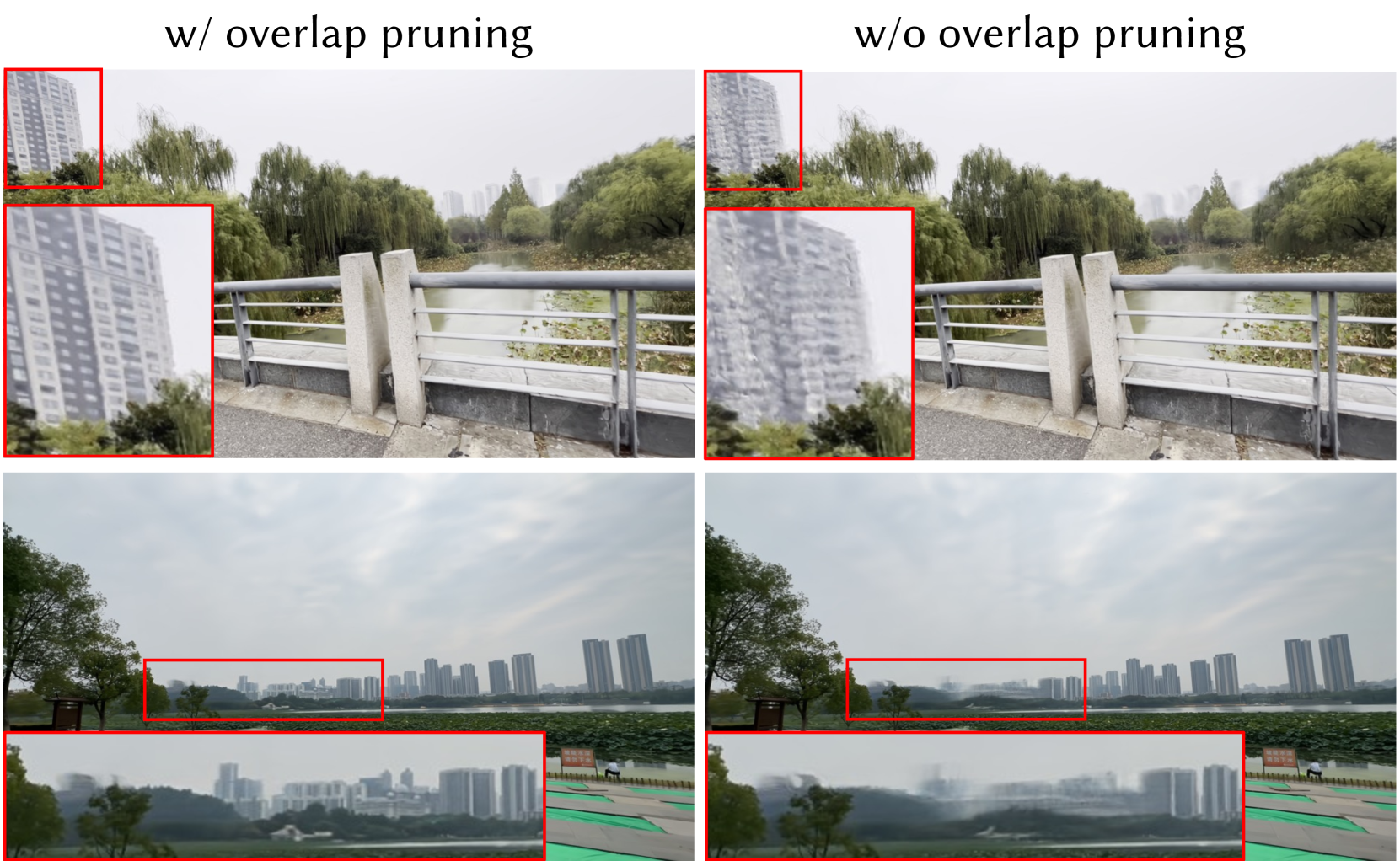
The image presents a 2x2 grid of photographs demonstrating the visual effect of "overlap pruning" in an image processing context. The top row focuses on a building and railing, while the bottom row focuses on a cityscape. Each pair of images shows the same scene, one with overlap pruning applied ("w/ overlap pruning") and one without ("w/o overlap pruning"). Red bounding boxes are overlaid on each image, highlighting areas of interest.
### Components/Axes
There are no explicit axes or scales. The comparison is purely visual. The key components are:
* **Image Pair 1 (Top Row):** Focuses on a building and a concrete railing.
* **Image Pair 2 (Bottom Row):** Focuses on a cityscape with trees in the foreground.
* **Red Bounding Boxes:** Present in all four images, highlighting specific regions.
* **Labels:** "w/ overlap pruning" (top-left) and "w/o overlap pruning" (top-right) are present.
### Detailed Analysis or Content Details
**Image Pair 1 (Building & Railing):**
* **"w/ overlap pruning":** The building appears relatively sharp and well-defined within the red bounding box. The railing is also clearly visible.
* **"w/o overlap pruning":** The building within the red bounding box appears significantly blurred and distorted. The details of the railing are also less distinct.
**Image Pair 2 (Cityscape):**
* **"w/ overlap pruning":** The cityscape within the red bounding boxes appears reasonably sharp, with discernible building structures.
* **"w/o overlap pruning":** The cityscape within the red bounding boxes appears blurred and less defined. The buildings are less distinguishable. The bottom image also has a green bounding box.
The red bounding boxes appear to be consistently positioned across the corresponding images in each pair, indicating that the same areas are being compared.
### Key Observations
* The application of "overlap pruning" consistently results in sharper, more defined images compared to the images without it.
* The blurring effect in the "w/o overlap pruning" images is particularly noticeable in the building and cityscape details.
* The green bounding box in the bottom right image is a potential anomaly, as it is not present in the other images.
### Interpretation
The image demonstrates the effectiveness of "overlap pruning" as an image processing technique. The blurring observed in the images without overlap pruning suggests that this technique helps to reduce artifacts or distortions that can occur when overlapping image segments are combined. This is likely a technique used in panorama stitching or similar applications where multiple images are merged to create a larger, more comprehensive view. The green bounding box in the bottom right image may indicate a different area of focus or a separate evaluation criterion. The technique appears to improve image quality by reducing the impact of overlapping regions, resulting in a clearer and more visually appealing final image. The comparison suggests that overlap pruning is a valuable step in image processing pipelines where image stitching or merging is involved.