## [Image Comparison]: Effect of Overlap Pruning on Image Reconstruction Quality
### Overview
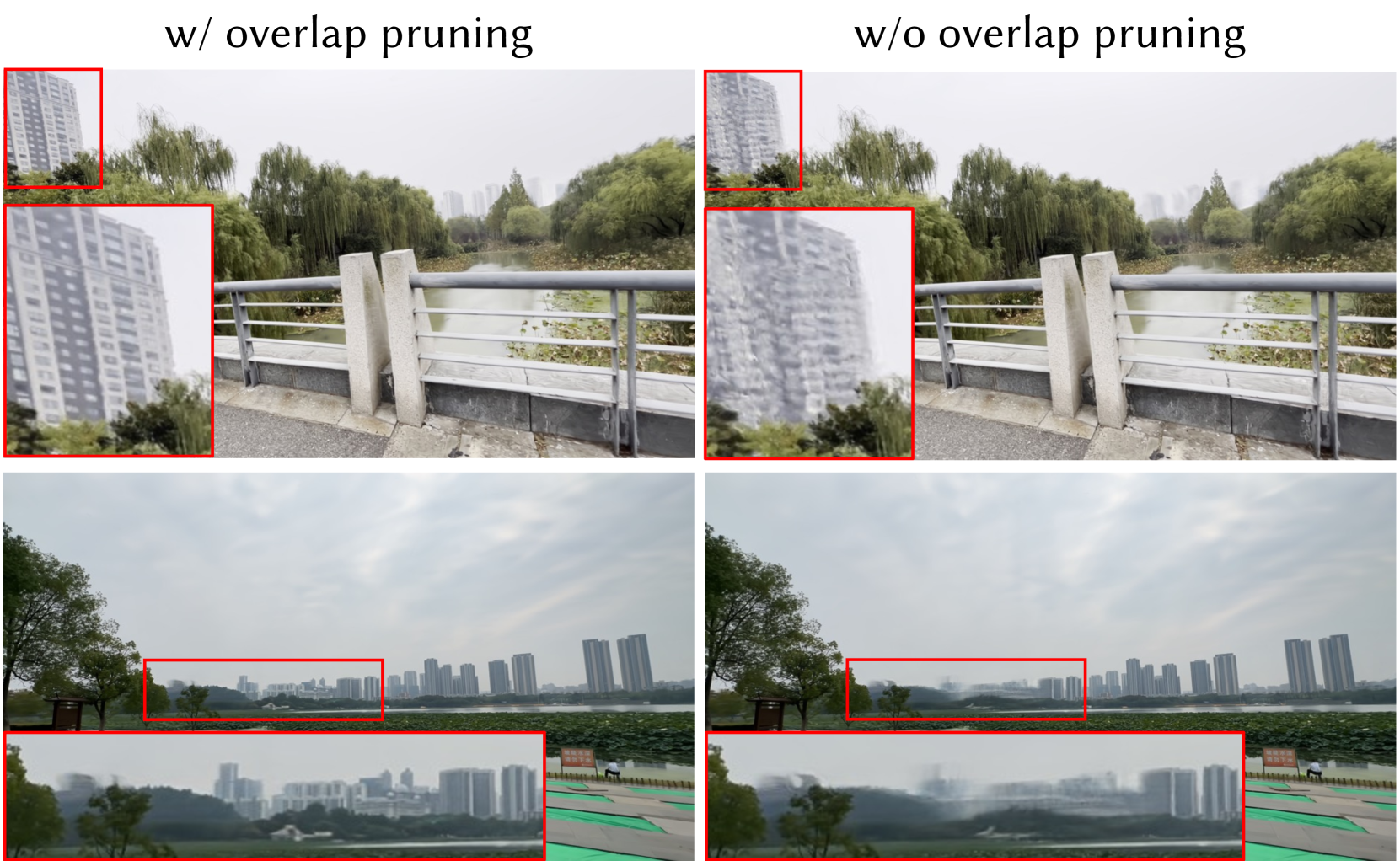
This image presents a side-by-side visual comparison demonstrating the impact of an "overlap pruning" technique on the quality of reconstructed or processed images. It consists of two columns and two rows. The left column is labeled "w/ overlap pruning" (with overlap pruning), and the right column is labeled "w/o overlap pruning" (without overlap pruning). Each of the two rows displays a different scene, with red bounding boxes highlighting specific regions of interest. Below each main image, a zoomed-in inset corresponding to the red box is provided to allow for detailed comparison of reconstruction artifacts.
### Components/Axes
* **Text Labels:**
* Top-left header: "w/ overlap pruning"
* Top-right header: "w/o overlap pruning"
* **Image Layout:** A 2x2 grid.
* **Top Row:** A scene featuring a bridge railing in the foreground, trees, and a tall building in the background.
* **Bottom Row:** A panoramic lakeside cityscape with a skyline of numerous high-rise buildings.
* **Highlighting Elements:**
* Red rectangular bounding boxes are placed on the main images to indicate regions that are magnified in the insets below.
* **Top Row:** The red box is placed on the upper-left portion of the image, focusing on the tall building.
* **Bottom Row:** The red box is placed on the central-left portion of the image, focusing on a segment of the distant city skyline.
* **Insets:** Each main image has a corresponding zoomed-in inset placed directly below it, showing the content within the red bounding box at a larger scale.
### Detailed Analysis
**Top Row Scene (Bridge and Building):**
* **"w/ overlap pruning" (Left):** The zoomed-in inset of the building shows relatively clear and distinct window patterns and architectural edges. The lines of the building are sharp, and individual windows are discernible.
* **"w/o overlap pruning" (Right):** The corresponding inset of the same building exhibits significant blurring and loss of high-frequency detail. The window patterns are smudged, edges are soft, and the building's texture appears washed out and indistinct. There is a noticeable "ghosting" or blending artifact.
**Bottom Row Scene (City Skyline):**
* **"w/ overlap pruning" (Left):** The zoomed-in inset of the city skyline shows buildings with defined shapes and edges. While atmospheric haze is present, the structures of individual buildings in the mid-ground are reasonably clear.
* **"w/o overlap pruning" (Right):** The inset for this condition shows severe degradation. The buildings in the highlighted region are heavily blurred, with their forms blending into one another and into the background. Details are almost completely lost, resulting in a smudged, low-fidelity representation.
### Key Observations
1. **Consistent Quality Difference:** In both example scenes, the images processed "with overlap pruning" demonstrate substantially higher visual fidelity and detail preservation compared to those processed "without overlap pruning."
2. **Nature of Artifacts:** The primary artifact in the "w/o overlap pruning" images is a spatial blurring or smearing, particularly noticeable on structured, high-contrast details like building edges and windows. This suggests a failure to properly align or merge image data in overlapping regions.
3. **Spatial Grounding of Comparison:** The comparison is made direct and unambiguous by using identical red bounding boxes on the same scene content, with side-by-side insets. The legend (the text headers) is positioned clearly at the top of each column, and the color of the bounding boxes (red) is consistent across all comparisons.
### Interpretation
This visual comparison serves as strong qualitative evidence for the efficacy of the "overlap pruning" technique in an image processing pipeline, likely related to tasks such as image stitching, super-resolution, or neural rendering (e.g., NeRFs).
* **What the Data Suggests:** The technique successfully mitigates artifacts that occur when processing overlapping image regions. Without it, the system likely averages or incorrectly blends information from multiple views or patches, leading to the observed blurring and loss of detail. "Overlap pruning" appears to selectively use or weight data to preserve sharpness.
* **How Elements Relate:** The layout is designed for immediate visual contrast. The headers define the experimental condition, the main images provide context, and the red-boxed insets act as a "magnifying glass" to prove the point at a granular level. The relationship is causal: the presence or absence of the technique (independent variable) directly causes the difference in image quality (dependent variable).
* **Notable Implications:** The improvement is not subtle; it is the difference between a usable, detailed reconstruction and a severely degraded one. This indicates that overlap pruning is not merely an optimization but a critical component for achieving high-quality results in this specific application. The artifacts shown ("w/o" condition) are characteristic of problems in multi-view synthesis, confirming the likely technical domain of the underlying method.