## Block Diagram: System Architecture Overview
### Overview
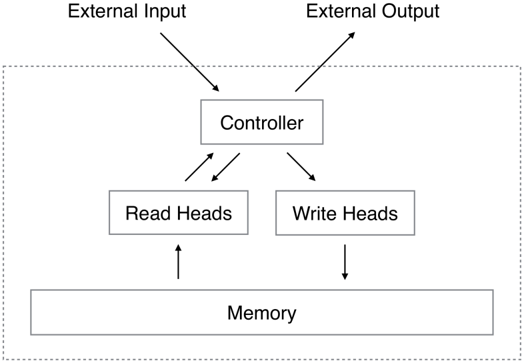
The diagram illustrates a simplified system architecture with data flow between components. It depicts bidirectional communication between a central controller and peripheral systems, with external input/output interfaces and memory storage.
### Components/Axes
1. **External Input** (Top-left): Arrows point toward the controller, indicating data entry point.
2. **Controller** (Central): Rectangular box acting as the central processing unit.
3. **Read Heads** (Bottom-left): Connected to memory via upward arrow, suggesting data retrieval.
4. **Write Heads** (Bottom-right): Connected to memory via downward arrow, indicating data storage.
5. **Memory** (Bottom): Horizontal rectangle serving as data storage medium.
6. **External Output** (Top-right): Arrows point away from controller, showing data exit point.
### Flow Relationships
- External Input → Controller (unidirectional)
- Controller ↔ Read Heads (bidirectional)
- Controller ↔ Write Heads (bidirectional)
- Read Heads → Memory (unidirectional)
- Write Heads → Memory (unidirectional)
- Controller → External Output (unidirectional)
### Key Observations
1. The controller acts as the central hub for all data processing.
2. Memory operates in a read/write architecture with dedicated interfaces.
3. External communication is strictly input/output with no direct memory access.
4. Bidirectional controller connections suggest real-time processing capabilities.
### Interpretation
This architecture resembles a simplified computer memory controller system:
- The controller manages data flow between external systems and internal memory
- Read/Write Heads represent memory access interfaces
- Bidirectional controller connections imply command/acknowledgment signaling
- The design emphasizes separation of concerns between processing (controller) and storage (memory)
The diagram suggests a Von Neumann architecture variant with explicit memory controller separation. The bidirectional controller connections indicate potential for complex command signaling beyond simple data transfer, possibly including error correction or timing synchronization protocols.