## Flowchart: Collaborative Problem-Solving Process with Iterative Refinement
### Overview
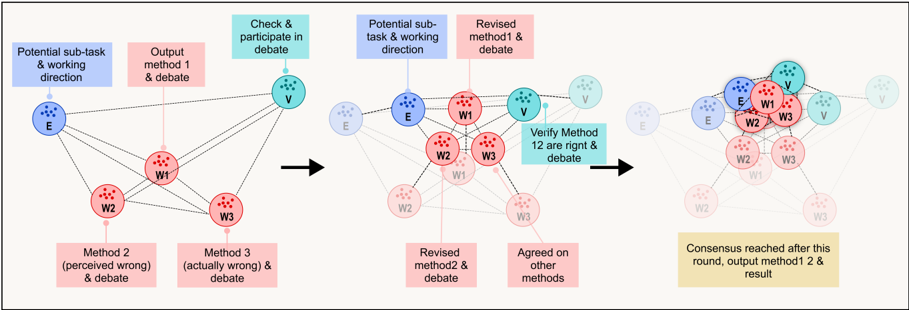
The flowchart illustrates a multi-stage collaborative process involving evaluators (E), workers (W1-W3), and verifiers (V) to resolve disagreements in method selection. It progresses through three phases: Initial Proposal, Iterative Refinement, and Consensus Reached, with explicit debate and revision cycles.
### Components/Axes
1. **Nodes**:
- **Blue (E)**: Evaluators proposing tasks/directions
- **Red (W1-W3)**: Workers proposing methods (Method 1, 2, 3)
- **Green (V)**: Verifiers checking debates and verifying methods
2. **Arrows**:
- Solid lines: Task/workflow direction
- Dashed lines: Debate participation
- Labels on arrows indicate actions (e.g., "Check & participate in debate," "Revised method 2 & debate")
3. **Stages**:
- **Initial Proposal**: First round of method proposals and debates
- **Iterative Refinement**: Second round with revisions and verification
- **Consensus Reached**: Final agreement on Method 2
### Detailed Analysis
1. **Initial Proposal Stage**:
- E proposes a task direction
- W1-W3 output methods (Method 1, 2, 3)
- V checks debates between workers
- Key conflict: Method 2 is "perceived wrong" but debated
2. **Iterative Refinement Stage**:
- E revises task direction based on initial feedback
- W1-W3 revise methods (Method 1 & 3 remain, Method 2 revised)
- V verifies Method 12 (likely a typo for Method 2) correctness
- Workers agree on other methods (Method 1 & 3)
3. **Consensus Reached Stage**:
- Final output: Method 2 selected despite initial objections
- All nodes (E, W1-W3, V) converge on Method 2
- Dashed lines fade, indicating resolved debates
### Key Observations
- **Color Consistency**: Blue (E), red (W1-W3), green (V) maintained across all stages
- **Debate Flow**: Dashed lines show bidirectional debate between workers and verifiers
- **Method Evolution**: Method 2 transitions from "perceived wrong" to consensus choice
- **Verification Threshold**: Method 12 verification (likely Method 2) acts as gatekeeper for consensus
### Interpretation
This flowchart demonstrates a structured conflict-resolution framework where:
1. **Iterative Feedback** transforms initial perceptions (Method 2 as "wrong") into validated solutions
2. **Role Specialization** (E=task direction, W=method creation, V=verification) creates checks/balances
3. **Debate as Catalyst** converts disagreements into consensus through structured discussion
4. **Method 2's Journey** highlights how perceived weaknesses can become strengths through collaborative refinement
The process emphasizes that technical validity (Method 12 verification) and social consensus (worker agreement) are both required for final acceptance. The fading dashed lines in the final stage visually represent the resolution of conflicts through this structured process.