## Diagram: Model Conversion and Similarity Calculation
### Overview
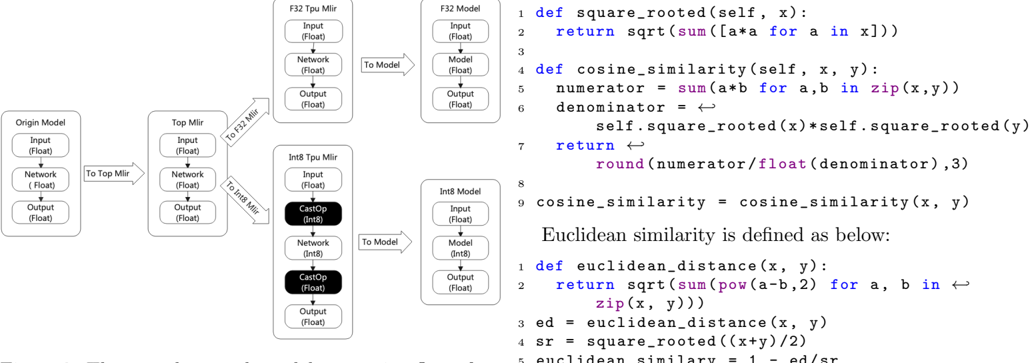
The image presents a diagram illustrating the conversion of a model from its origin to different formats (F32 and Int8) using MLIR (Multi-Level Intermediate Representation). It also includes Python code snippets for calculating cosine similarity and Euclidean similarity.
### Components/Axes
**Model Conversion Diagram (Left Side):**
* **Origin Model:**
* Input (Float)
* Network (Float)
* Output (Float)
* **Top Mlir:**
* Input (Float)
* Network (Float)
* Output (Float)
* **F32 Tpu Mlir:**
* Input (Float)
* Network (Float)
* Output (Float)
* **F32 Model:**
* Input (Float)
* Model (Float)
* Output (Float)
* **Int8 Tpu Mlir:**
* Input (Float)
* CastOp (Int8) - Highlighted in black
* Network (Int8)
* CastOp (Float) - Highlighted in black
* Output (Float)
* **Int8 Model:**
* Input (Float)
* Model (Int8)
* Output (Float)
**Code Snippets (Right Side):**
* **Cosine Similarity:** Python code for calculating cosine similarity between two vectors.
* **Euclidean Similarity:** Python code for calculating Euclidean similarity.
**Arrows:**
* "To Top Mlir" - Connects Origin Model to Top Mlir.
* "To F32 Mlir" - Connects Top Mlir to F32 Tpu Mlir.
* "To Int8 Mlir" - Connects Top Mlir to Int8 Tpu Mlir.
* "To Model" - Connects F32 Tpu Mlir to F32 Model and Int8 Tpu Mlir to Int8 Model.
### Detailed Analysis
**Model Conversion Flow:**
1. The process starts with the **Origin Model**, which uses float data types.
2. The model is converted to **Top Mlir** format, still using float data types.
3. From Top Mlir, the model branches into two paths:
* **F32 Path:** The model is converted to **F32 Tpu Mlir**, then to the **F32 Model**. All components use float data types.
* **Int8 Path:** The model is converted to **Int8 Tpu Mlir**, where CastOp operations convert the data to Int8 and back to Float. Finally, it is converted to the **Int8 Model**.
**Code Snippets:**
* **Cosine Similarity:**
```python
1 def square_rooted(self, x):
2 return sqrt(sum([a*a for a in x]))
3
4 def cosine_similarity(self, x, y):
5 numerator = sum(a*b for a,b in zip(x,y))
6 denominator = self.square_rooted(x)*self.square_rooted(y)
7 return round(numerator/float(denominator),3)
8
9 cosine_similarity = cosine_similarity(x, y)
```
* **Euclidean Similarity:**
```python
Euclidean similarity is defined as below:
1 def euclidean_distance(x, y):
2 return sqrt(sum(pow(a-b,2) for a, b in zip(x, y)))
3 ed = euclidean_distance(x, y)
4 sr = square_rooted((x+y)/2)
5 euclidean similary = 1 - ed/sr
```
### Key Observations
* The diagram illustrates the process of converting a model into different numerical formats (F32 and Int8).
* The Int8 path involves CastOp operations to convert between Float and Int8 data types.
* The code snippets provide implementations for calculating cosine and Euclidean similarity.
### Interpretation
The diagram demonstrates a common workflow in model optimization, where a model is converted to lower-precision formats (like Int8) to improve performance and reduce memory footprint. The CastOp operations in the Int8 path are crucial for handling the data type conversions. The code snippets provide context by showing how similarity metrics can be calculated, potentially for evaluating the impact of the model conversion on its performance.