## Diagram: Network of Triangles
### Overview
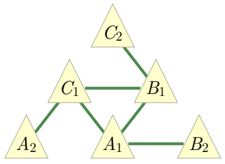
The image depicts a network diagram composed of interconnected triangles. Each triangle is labeled with a letter (A, B, or C) and a numerical subscript (1 or 2). The triangles are connected by green lines, forming a network structure.
### Components/Axes
* **Triangles:** Six triangles labeled A1, A2, B1, B2, C1, and C2. The triangles are light yellow with a thin dark outline.
* **Connections:** Green lines connecting the triangles.
* **Layout:** The triangles are arranged in a roughly triangular formation.
### Detailed Analysis
* **Triangle A1:** Located near the bottom-center of the diagram.
* **Triangle A2:** Located to the left and slightly below triangle C1.
* **Triangle B1:** Located to the right and slightly above triangle A1.
* **Triangle B2:** Located to the right and slightly below triangle A1.
* **Triangle C1:** Located above and to the left of triangle A1.
* **Triangle C2:** Located above and to the left of triangle B1.
* **Connections:**
* A1 is connected to A2, B1, B2, and C1.
* B1 is connected to A1 and C2.
* C1 is connected to A1 and B1.
### Key Observations
* The network is not fully connected; some triangles are only connected to one or two other triangles.
* Triangle A1 serves as a central node, connecting to four other triangles.
* Triangles A2 and B2 are only connected to A1.
* Triangle C2 is only connected to B1.
### Interpretation
The diagram represents a network where the triangles are nodes and the green lines are connections between them. The arrangement and connectivity suggest a specific relationship or interaction between the entities represented by the triangles. The central role of A1 indicates it may be a key component in the network. The isolated nature of A2, B2, and C2 suggests they may be peripheral or specialized components. Without additional context, the specific meaning of the network is unclear, but the diagram provides a visual representation of the relationships between these components.