# Technical Document Extraction: Combinatorics Problem and Solution Attempts
## 1. Document Overview
This document contains a mathematical word problem regarding combinatorics (specifically circular permutations with constraints) followed by three distinct "Attempts" at solving the problem. The text uses a mix of standard black font for problem statements and green/red font for the logical steps and conclusions within the attempts.
## 2. Problem Statement
**Text:**
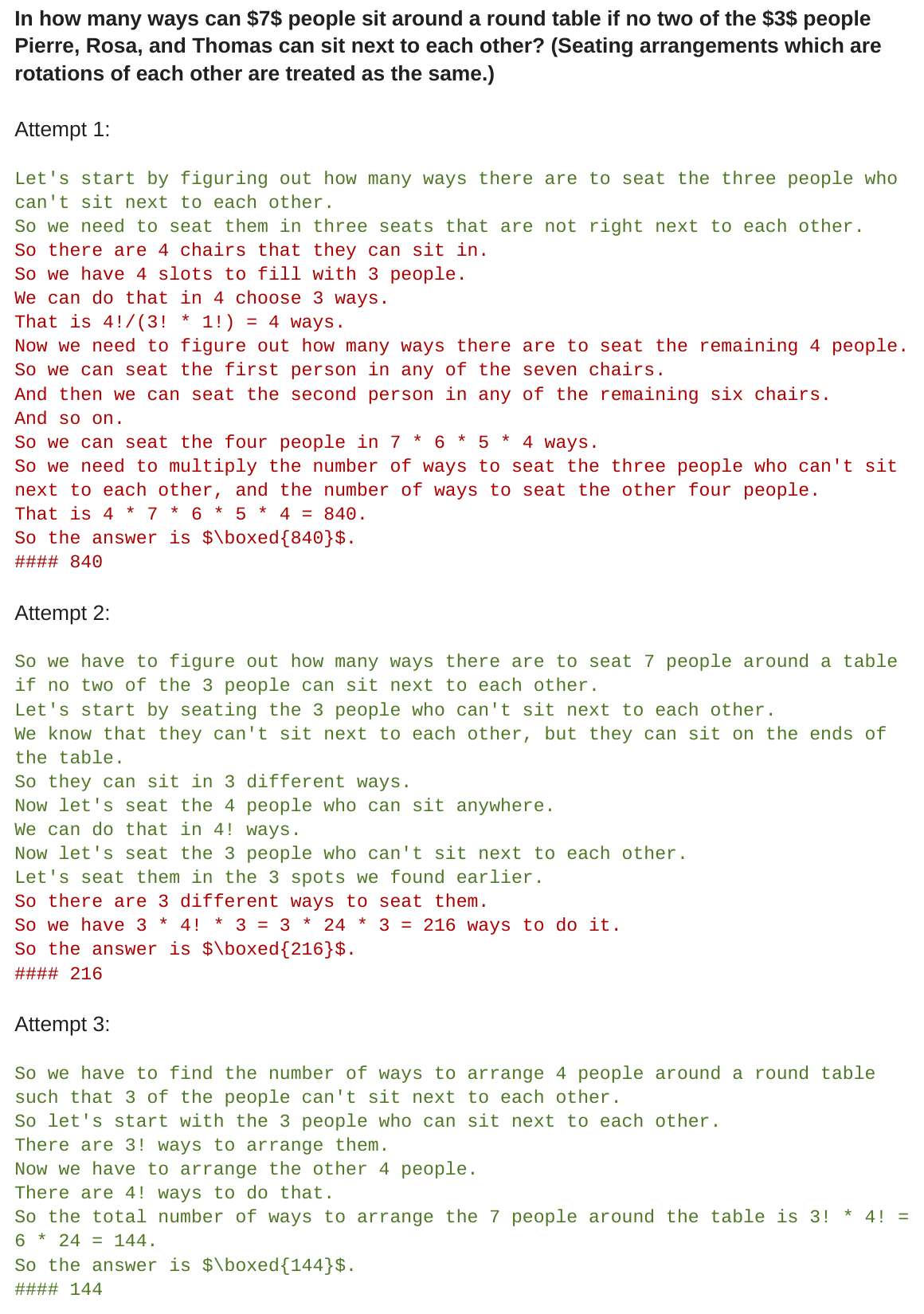
"In how many ways can $7$ people sit around a round table if no two of the $3$ people Pierre, Rosa, and Thomas can sit next to each other? (Seating arrangements which are rotations of each other are treated as the same.)"
---
## 3. Component Isolation: Solution Attempts
### Attempt 1
**Logic Flow:** This attempt uses a "slot" method but incorrectly calculates the available chairs and the seating of the remaining people.
* **Transcription:**
* "Let's start by figuring out how many ways there are to seat the three people who can't sit next to each other."
* "So we need to seat them in three seats that are not right next to each other."
* "So there are 4 chairs that they can sit in."
* "So we have 4 slots to fill with 3 people."
* "We can do that in 4 choose 3 ways."
* "That is 4!/(3! * 1!) = 4 ways."
* "Now we need to figure out how many ways there are to seat the remaining 4 people."
* "So we can seat the first person in any of the seven chairs."
* "And then we can seat the second person in any of the remaining six chairs."
* "And so on."
* "So we can seat the four people in 7 * 6 * 5 * 4 ways."
* "So we need to multiply the number of ways to seat the three people who can't sit next to each other, and the number of ways to seat the other four people."
* "That is 4 * 7 * 6 * 5 * 4 = 840."
* "So the answer is $\boxed{840}$."
* "#### 840"
### Attempt 2
**Logic Flow:** This attempt treats the table as having "ends," which contradicts the "round table" (circular) constraint mentioned in the problem.
* **Transcription:**
* "So we have to figure out how many ways there are to seat 7 people around a table if no two of the 3 people can sit next to each other."
* "Let's start by seating the 3 people who can't sit next to each other."
* "We know that they can't sit next to each other, but they can sit on the ends of the table."
* "So they can sit in 3 different ways."
* "Now let's seat the 4 people who can sit anywhere."
* "We can do that in 4! ways."
* "Now let's seat the 3 people who can't sit next to each other."
* "Let's seat them in the 3 spots we found earlier."
* "So there are 3 different ways to seat them."
* "So we have 3 * 4! * 3 = 3 * 24 * 3 = 216 ways to do it."
* "So the answer is $\boxed{216}$."
* "#### 216"
### Attempt 3
**Logic Flow:** This attempt simplifies the problem to a basic multiplication of factorials without accounting for the circular arrangement or the specific "no two next to each other" constraint correctly.
* **Transcription:**
* "So we have to find the number of ways to arrange 4 people around a round table such that 3 of the people can't sit next to each other."
* "So let's start with the 3 people who can sit next to each other."
* "There are 3! ways to arrange them."
* "Now we have to arrange the other 4 people."
* "There are 4! ways to do that."
* "So the total number of ways to arrange the 7 people around the table is 3! * 4! = 6 * 24 = 144."
* "So the answer is $\boxed{144}$."
* "#### 144"
---
## 4. Summary of Data Points (Extracted Answers)
| Attempt | Proposed Answer | Logic Note |
| :--- | :--- | :--- |
| Attempt 1 | 840 | Uses "4 choose 3" and linear seating for remaining 4. |
| Attempt 2 | 216 | Incorrectly assumes "ends" of a round table. |
| Attempt 3 | 144 | Multiplies 3! by 4!. |