\n
## Logical Deduction Problem: Text-Based Syllogism
### Overview
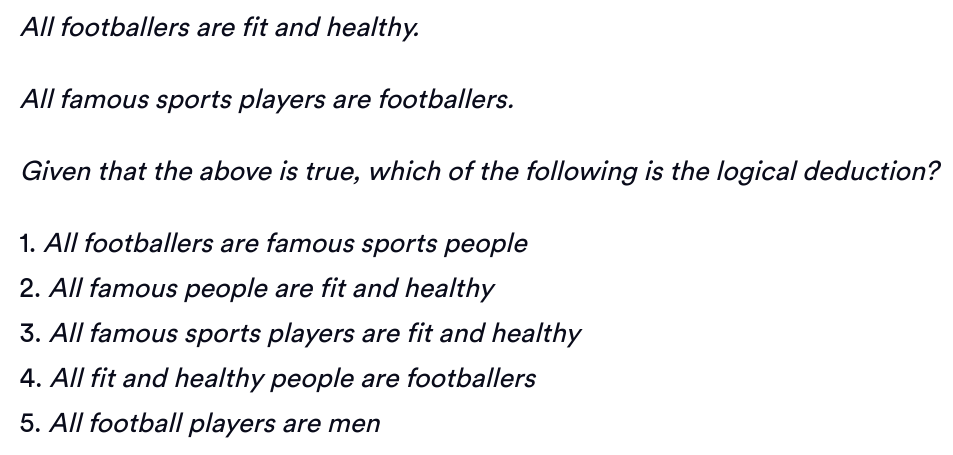
The image presents a text-based logical reasoning problem consisting of two premises, a question, and five multiple-choice answer options. The content is entirely textual, with no charts, diagrams, or numerical data. The problem tests the ability to perform categorical syllogism.
### Components/Axes
The image is structured as follows:
1. **Premise 1:** "All footballers are fit and healthy."
2. **Premise 2:** "All famous sports players are footballers."
3. **Question:** "Given that the above is true, which of the following is the logical deduction?"
4. **Answer Options:** A numbered list from 1 to 5.
### Detailed Analysis / Content Details
**Transcription of All Text:**
* **Premise 1:** `All footballers are fit and healthy.`
* **Premise 2:** `All famous sports players are footballers.`
* **Question:** `Given that the above is true, which of the following is the logical deduction?`
* **Option 1:** `1. All footballers are famous sports people`
* **Option 2:** `2. All famous people are fit and healthy`
* **Option 3:** `3. All famous sports players are fit and healthy`
* **Option 4:** `4. All fit and healthy people are footballers`
* **Option 5:** `5. All football players are men`
**Logical Structure Analysis:**
The problem is a categorical syllogism. We can represent the premises using set theory:
* Let **F** = Set of all footballers.
* Let **H** = Set of all fit and healthy people.
* Let **S** = Set of all famous sports players.
The premises state:
1. **F ⊆ H** (All footballers are a subset of fit and healthy people).
2. **S ⊆ F** (All famous sports players are a subset of footballers).
Combining these via transitivity (**S ⊆ F** and **F ⊆ H**), the valid logical deduction is: **S ⊆ H** (All famous sports players are a subset of fit and healthy people).
### Key Observations
* The text is presented in a clear, sans-serif font on a plain white background.
* The premises are stated as universal affirmative statements ("All A are B").
* The question asks for a necessary logical deduction, not a possible or probable one.
* Option 5 introduces an entirely new category ("men") not mentioned in the premises, making it irrelevant to the given logic.
### Interpretation
This is a test of deductive reasoning, specifically the validity of a syllogism in the **Barbara** (AAA-1) form.
* **Valid Deduction:** Only **Option 3 ("All famous sports players are fit and healthy")** is a logically necessary conclusion. It directly follows from the chain of inclusion: Famous Sports Players → Footballers → Fit and Healthy.
* **Invalid Deductions:**
* **Option 1** reverses the first premise. While all famous sports players are footballers, the premises do not state that all footballers are famous sports players. This is the fallacy of illicit conversion.
* **Option 2** overextends the conclusion. The premises only connect "famous sports players" to "fit and healthy," not all "famous people."
* **Option 4** also reverses a premise. Being fit and healthy is a necessary condition for being a footballer, but not a sufficient one. This is the fallacy of affirming the consequent.
* **Option 5** is a non sequitur; the gender of football players is not addressed or implied by the premises.
The problem demonstrates how formal logic requires conclusions to be derived strictly from the given premises without introducing external assumptions or reversing established relationships. The correct answer is **3**.