## Diagram: Comparison of Rendering Methods and Hardware
### Overview
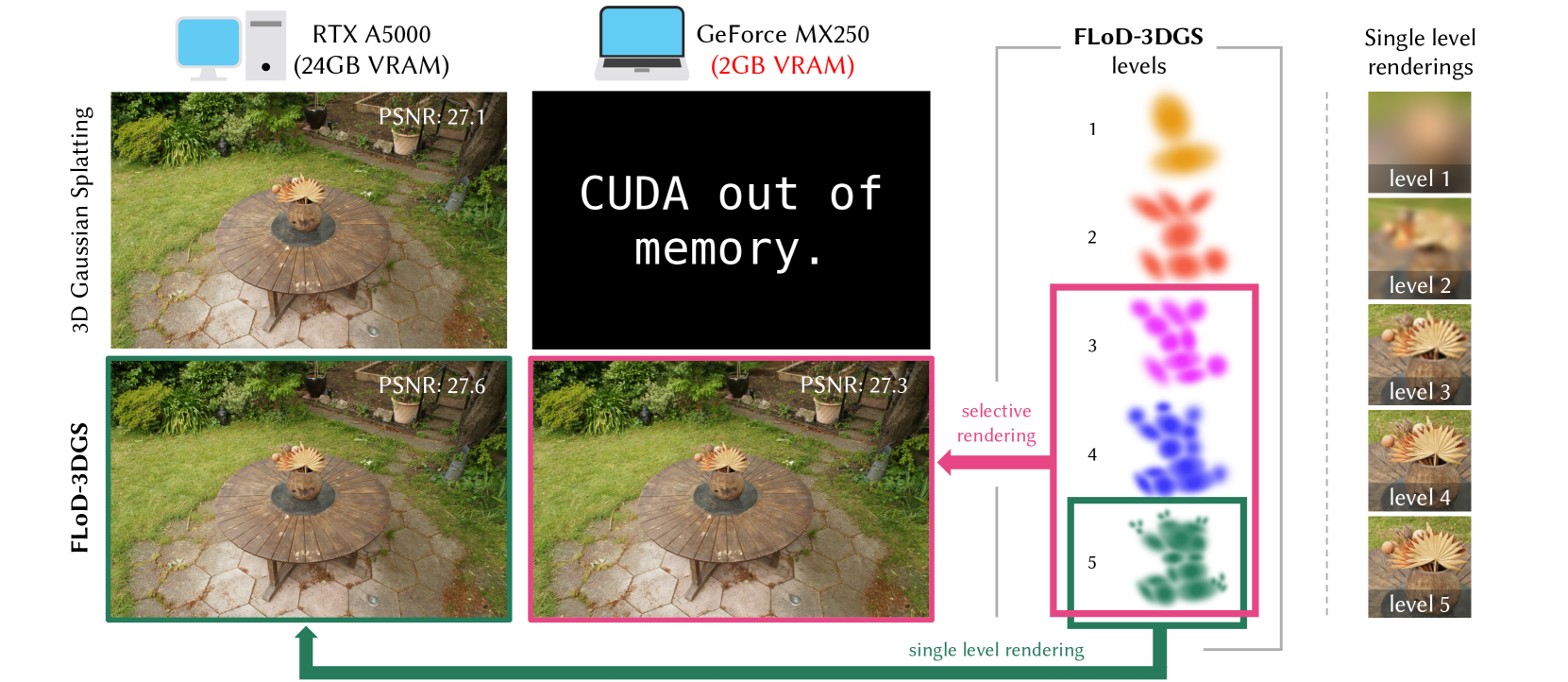
This diagram compares the rendering quality and memory usage of 3D Gaussian Splatting and FLoD-3DGS (Frame-Level Detail 3D Gaussian Splatting) on two different GPUs: an RTX A5000 (24GB VRAM) and a GeForce MX250 (2GB VRAM). It demonstrates the ability of FLoD-3DGS to render the same scene on limited hardware by utilizing different levels of detail. The diagram also shows the corresponding single-level renderings for each FLoD-3DGS level.
### Components/Axes
The diagram is structured into four main sections:
1. **Hardware Specifications:** Two computer icons representing the RTX A5000 and GeForce MX250, with their respective VRAM amounts.
2. **Rendering Results:** Four images showing the rendered scene using different methods and hardware.
3. **FLoD-3DGS Levels:** A vertical list of numbers 1 through 5, representing the different levels of detail in FLoD-3DGS.
4. **Single Level Renderings:** A vertical list of five images, each corresponding to a single-level rendering of the scene.
The Y-axis of the left two images is labeled "3D Gaussian Splatting" and "FLoD-3DGS". The X-axis is not explicitly labeled but represents the different hardware configurations.
### Detailed Analysis or Content Details
**Hardware & Rendering Results:**
* **RTX A5000 (24GB VRAM):** The 3D Gaussian Splatting rendering shows a high-quality image with a PSNR (Peak Signal-to-Noise Ratio) of 27.1. The FLoD-3DGS rendering also shows a high-quality image with a PSNR of 27.6.
* **GeForce MX250 (2GB VRAM):** 3D Gaussian Splatting results in a "CUDA out of memory" error. FLoD-3DGS successfully renders the scene with a PSNR of 27.3. The rendering is highlighted with a green box labeled "selective rendering" and a smaller box labeled "single level rendering".
**FLoD-3DGS Levels & Single Level Renderings:**
* **Level 1:** The corresponding single-level rendering is a low-resolution, blurry image.
* **Level 2:** The corresponding single-level rendering shows more detail than Level 1, but is still relatively low resolution.
* **Level 3:** The corresponding single-level rendering shows a moderate level of detail. The point cloud is colored with a gradient from purple to pink.
* **Level 4:** The corresponding single-level rendering shows a higher level of detail than Level 3. The point cloud is colored with a gradient from orange to yellow.
* **Level 5:** The corresponding single-level rendering shows the highest level of detail. The point cloud is colored green.
The FLoD-3DGS levels are visually represented by point clouds of varying density and color. The point clouds are contained within red boxes, numbered 1-5 from top to bottom.
### Key Observations
* 3D Gaussian Splatting requires significant VRAM (as demonstrated by the "CUDA out of memory" error on the GeForce MX250).
* FLoD-3DGS allows rendering of complex scenes on hardware with limited VRAM.
* The PSNR values are relatively consistent across the different rendering methods and hardware, suggesting that FLoD-3DGS maintains a comparable level of quality while reducing memory usage.
* The single-level renderings demonstrate the trade-off between detail and memory usage in FLoD-3DGS. Lower levels have less detail but require less memory.
### Interpretation
This diagram demonstrates the effectiveness of FLoD-3DGS as a technique for rendering 3D Gaussian Splatting scenes on resource-constrained hardware. By selectively rendering different levels of detail, FLoD-3DGS can overcome the memory limitations of GPUs like the GeForce MX250, while still achieving a reasonable level of rendering quality (as indicated by the PSNR values). The diagram highlights the importance of adaptive rendering techniques for making advanced rendering methods accessible to a wider range of devices. The point cloud visualizations of the FLoD-3DGS levels provide a clear illustration of how the level of detail affects the visual appearance of the scene. The consistent PSNR values suggest that the quality loss associated with using lower levels of detail is minimal. The diagram effectively communicates the benefits of FLoD-3DGS in a visually compelling manner.