## Diagram: Waves of AI Development
### Overview
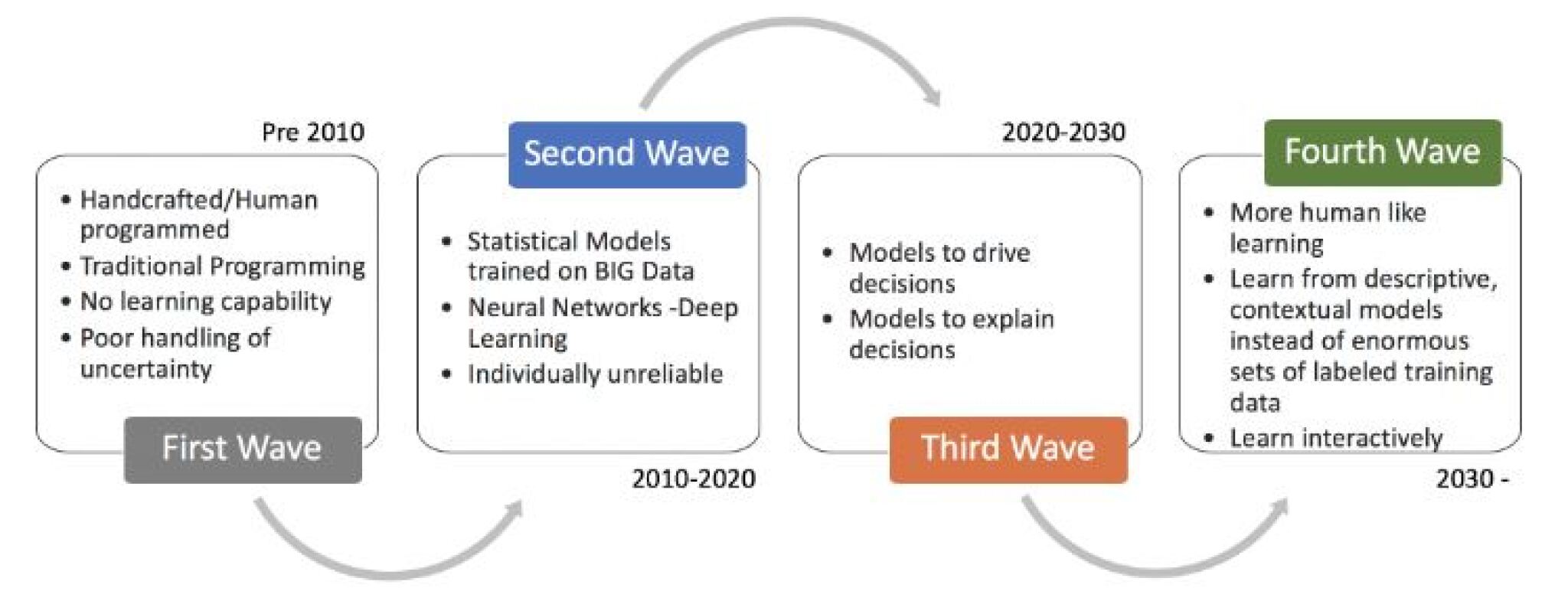
The image is a diagram illustrating the four waves of AI development, presented chronologically from left to right. Each wave is associated with a specific time period and key characteristics, represented as bullet points. The diagram uses rounded rectangles to enclose the descriptions of each wave, and curved arrows to suggest a progression from one wave to the next.
### Components/Axes
* **Wave Titles:** First Wave, Second Wave, Third Wave, Fourth Wave. Each title is displayed in a colored rectangle (grey, blue, orange, green respectively) above the description of the wave.
* **Time Periods:** Pre 2010, 2010-2020, 2020-2030, 2030-. These indicate the approximate time frame associated with each wave.
* **Wave Descriptions:** Each wave has a list of bullet points describing its characteristics.
* **Flow Arrows:** Curved arrows connect the waves, indicating the progression of AI development.
### Detailed Analysis or ### Content Details
**First Wave (Pre 2010):**
* Handcrafted/Human programmed
* Traditional Programming
* No learning capability
* Poor handling of uncertainty
**Second Wave (2010-2020):**
* Statistical Models trained on BIG Data
* Neural Networks - Deep Learning
* Individually unreliable
**Third Wave (2020-2030):**
* Models to drive decisions
* Models to explain decisions
**Fourth Wave (2030-):**
* More human-like learning
* Learn from descriptive, contextual models instead of enormous sets of labeled training data
* Learn interactively
### Key Observations
* The diagram presents a chronological progression of AI development, with each wave building upon the previous one.
* The descriptions of each wave highlight the key advancements and challenges associated with that period.
* The diagram suggests a shift from rule-based systems (First Wave) to data-driven models (Second Wave) to more explainable and interactive AI (Third and Fourth Waves).
* The time periods are approximate and serve as a general guideline for the evolution of AI.
### Interpretation
The diagram provides a high-level overview of the evolution of AI, highlighting the key trends and advancements in the field. It suggests a move towards more sophisticated and human-like AI systems that can learn from descriptive data, explain their decisions, and interact with users in a more natural way. The diagram emphasizes the importance of addressing the limitations of earlier AI systems, such as their lack of learning capability, poor handling of uncertainty, and individual unreliability. The progression suggests a future where AI is more integrated into human decision-making processes and capable of learning and adapting in real-time.