## Network Diagram: Numbered Node Connections
### Overview
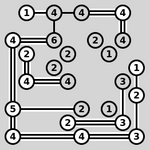
The image displays a network diagram consisting of numbered circles (nodes) connected by straight lines (edges). The diagram is monochromatic (black lines and text on a white background) and appears hand-drawn or sketched in style. There are no titles, legends, or axis labels. The primary information is the topology of connections between nodes identified by numbers.
### Components/Axes
* **Nodes:** Circles containing single-digit numbers. The numbers present are: 1, 2, 3, 4, 5, 6.
* **Edges:** Straight black lines connecting the nodes. Lines vary slightly in thickness but this does not appear to convey quantitative information.
* **Layout:** The nodes are arranged in an irregular, non-grid pattern across the canvas. There is no clear hierarchical or sequential flow indicated by the layout alone.
### Detailed Analysis
**Node Inventory and Spatial Placement:**
The diagram contains approximately 28 nodes. Below is a catalog of nodes by their approximate position and the number they contain.
* **Top Row (Left to Right):** `1` - `4` - `4` - `4`
* **Second Row (Left to Right):** `4` - `6` - `2` - `2` - `1` - `4`
* **Third Row (Left to Right):** `2` - `2` - `4` - `3` - `1`
* **Fourth Row (Left to Right):** `5` - `2` - `1` - `2`
* **Bottom Row (Left to Right):** `4` - `4` - `4` - `3`
**Connection Analysis (Edge List):**
The following describes the connections (edges) between nodes. For clarity, nodes are identified by their number and a descriptor of their location.
1. Top-left `1` connects to the `4` to its right.
2. That `4` connects to the next `4` to its right.
3. That `4` connects to the final `4` in the top row.
4. The top-left `1` also connects down to the `4` below it (start of second row).
5. That second-row `4` connects right to a `6`.
6. The `6` connects down to a `2`.
7. That `2` connects right to another `2`.
8. That second `2` connects down to a `4`.
9. The `4` from step 8 connects left to a `2`.
10. The `2` from step 9 connects up to the `6` from step 5.
11. The `4` from step 4 also connects down to a `2` (third row, leftmost).
12. That `2` connects down to a `5` (fourth row, leftmost).
13. The `5` connects down to a `4` (bottom row, leftmost).
14. The `4` from step 13 connects right to another `4`.
15. That `4` connects right to another `4`.
16. That `4` connects right to a `3` (bottom row, rightmost).
17. The `3` from step 16 connects up to a `2` (fourth row, rightmost).
18. That `2` connects up to a `1` (third row).
19. The `1` from step 18 connects up to a `3` (second row, right side).
20. The `3` from step 19 connects up to a `4` (second row, far right).
21. The `4` from step 20 connects left to a `1` (second row).
22. The `1` from step 21 connects left to a `2` (second row).
23. The `2` from step 22 connects down to a `2` (third row).
24. The `2` from step 23 connects down to a `1` (fourth row).
25. The `1` from step 24 connects right to the `2` from step 17.
26. The `4` from step 15 connects up to a `2` (fourth row, center).
27. The `2` from step 26 connects up to a `4` (third row, center).
28. The `4` from step 27 connects up to the `2` from step 7.
### Key Observations
* **Node Frequency:** The number `4` is the most frequent node (appears 10 times). The number `2` is the second most frequent (appears 9 times). The numbers `1`, `3`, and `5` are less common.
* **Connectivity Patterns:** Some nodes, particularly `4`s and `2`s, act as hubs with multiple connections. For example, the `4` in the second row (left) connects to five other nodes (`1` above, `6` right, `2` below, and indirectly to others).
* **Structural Features:** The diagram contains several closed loops or cycles. For instance, the sequence `4` (2nd row left) -> `6` -> `2` -> `2` -> `4` -> `2` -> `6` forms a loop. Another loop exists in the bottom right: `3` -> `2` -> `1` -> `2` -> `1` -> `2` -> `3`.
* **Isolates:** There are no isolated nodes; every node is connected to at least one other node.
### Interpretation
This diagram represents a **relational network or graph**. The numbers likely serve as identifiers or categorical labels for the nodes, not as quantitative values. The lines represent relationships, links, or pathways between these entities.
* **What it suggests:** The structure implies a complex, interconnected system where entities (nodes) have multiple relationships. The prevalence of `4` and `2` suggests these are core or common entity types within this system. The presence of cycles indicates feedback loops or redundant pathways, which could imply robustness or complexity in the modeled system.
* **How elements relate:** The connections define the system's architecture. The layout, while not strictly hierarchical, shows clustering. For example, the left side has a dense cluster involving `4`, `6`, and `2`, while the right side has a more linear chain from `4` down to `3`.
* **Notable anomalies:** The number `5` appears only once and is connected only to two nodes (`2` above and `4` below), making it a peripheral or unique element in the network. The number `6` also appears only once but is more central, connecting to three nodes.
* **Underlying purpose:** Without a title or legend, the exact domain is unknown. It could represent a social network, an organizational chart, a process flow, a neural network schematic, or a conceptual map. The hand-drawn style suggests it might be a preliminary sketch or a model from a brainstorming session. The key takeaway is the **topology itself**—the pattern of connections is the primary information conveyed.