\n
## Hexagonal Grid: Pattern Visualization
### Overview
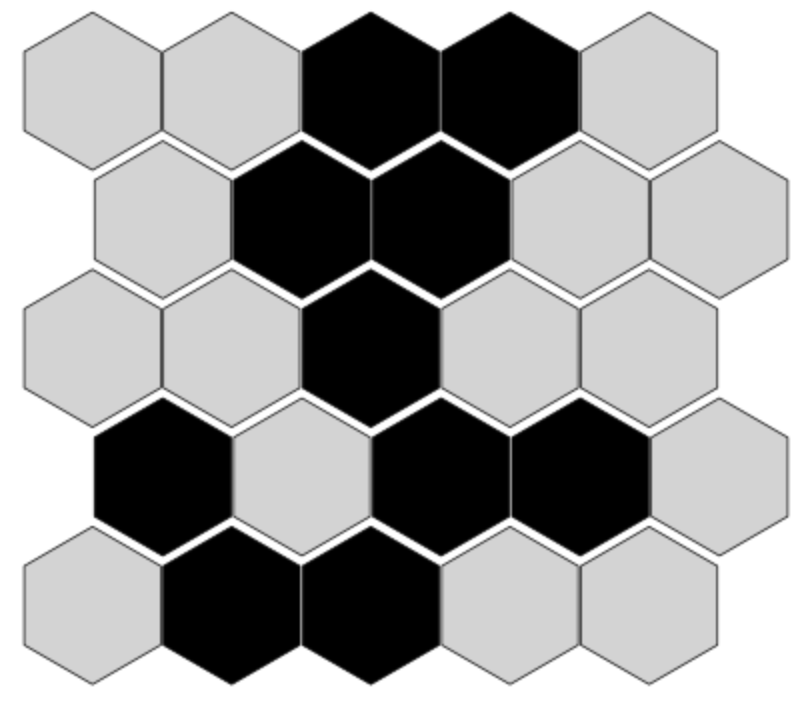
The image displays a hexagonal grid filled with alternating black and light gray hexagons. There are no axes, labels, or legends present. The arrangement appears to be a repeating pattern. The image does not contain any factual data, but rather a visual representation of a pattern.
### Components/Axes
There are no axes, labels, or legends. The image consists solely of a grid of hexagons.
### Detailed Analysis or Content Details
The grid is approximately 7 hexagons wide and 6 hexagons tall. The hexagons are arranged in a honeycomb-like structure.
* **Black Hexagons:** There are approximately 12 black hexagons. They are distributed in a checkerboard-like pattern.
* **Light Gray Hexagons:** There are approximately 22 light gray hexagons. They are also distributed in a checkerboard-like pattern, alternating with the black hexagons.
The pattern appears to be centered, with a black hexagon at the approximate center of the grid. The arrangement is symmetrical.
### Key Observations
The most notable observation is the alternating pattern of black and light gray hexagons. The pattern is consistent throughout the grid, suggesting a deliberate design. There are no obvious outliers or anomalies.
### Interpretation
The image likely represents a visual pattern or a simple demonstration of a tiling structure. The alternating colors could symbolize different states, categories, or values, but without additional context, the specific meaning is unclear. The hexagonal grid itself is a common structure in various fields, including chemistry (representing molecular structures), materials science (representing crystal lattices), and game design (representing game boards). The image could be used to illustrate concepts related to these fields, or simply as an abstract visual element. The lack of labels or data suggests the image is intended for illustrative purposes rather than conveying specific quantitative information. It is a visual representation of a repeating pattern, and its meaning is dependent on the context in which it is presented.