## Scatter Plot: TTFT_req vs TPS_req Performance Comparison
### Overview
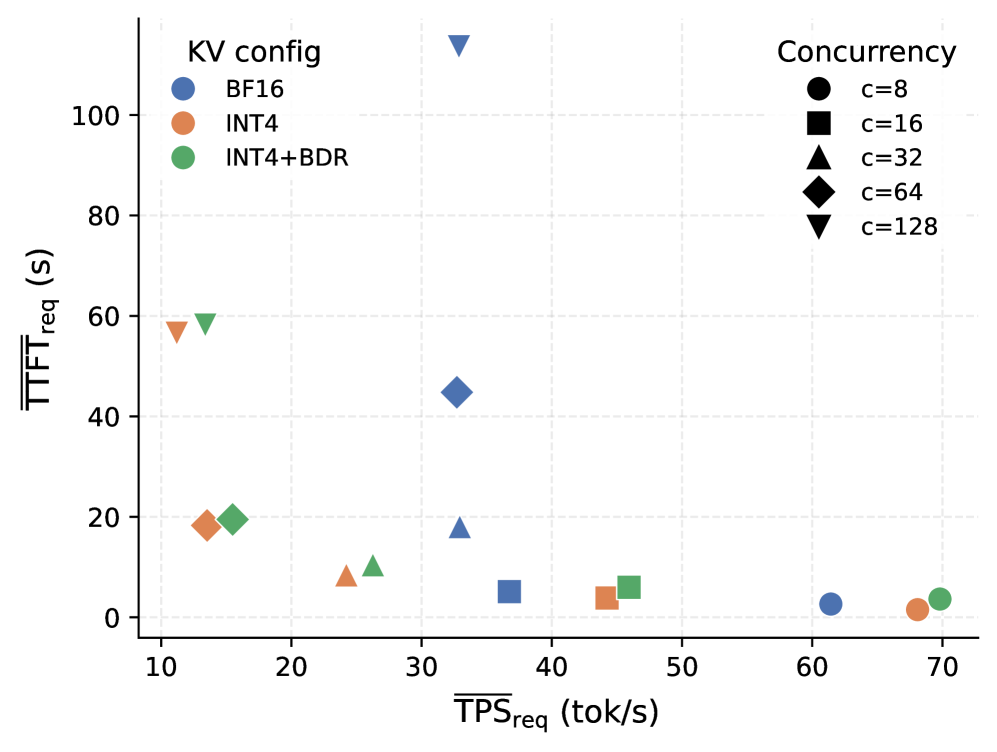
The scatter plot compares three key-value (KV) configuration types (BF16, INT4, INT4+BDR) across varying concurrency levels (c=8 to c=128). Metrics shown are Tail-to-Tail Finish Time (TTFT_req in seconds) versus Throughput (TPS_req in tokens/second). Data points are color-coded by KV config and shape-coded by concurrency level.
### Components/Axes
- **X-axis**: TPS_req (tok/s) - Throughput in tokens per second, ranging from 10 to 70
- **Y-axis**: TTFT_req (s) - Tail-to-Tail Finish Time in seconds, ranging from 0 to 100
- **Legend**:
- **KV Configs**:
- BF16 (blue circles)
- INT4 (orange squares)
- INT4+BDR (green diamonds)
- **Concurrency Levels**:
- c=8 (circles)
- c=16 (squares)
- c=32 (triangles)
- c=64 (diamonds)
- c=128 (inverted triangles)
### Detailed Analysis
1. **BF16 (Blue)**:
- Highest TTFT at low TPS: 100s at 30 tok/s (c=128, inverted triangle)
- Lowest TTFT at high TPS: ~0s at 60-70 tok/s (c=8, circle)
- Trend: TTFT decreases as TPS increases, with concurrency having minimal impact at high TPS
2. **INT4 (Orange)**:
- TTFT ranges from 18s (15 tok/s, c=8) to 60s (15 tok/s, c=128)
- TTFT increases with concurrency at fixed TPS
- TPS remains relatively stable (15-30 tok/s) across concurrency levels
3. **INT4+BDR (Green)**:
- TTFT ranges from 15s (15 tok/s, c=8) to 60s (15 tok/s, c=128)
- Similar trend to INT4 but consistently 3-5s lower TTFT at same TPS
- Best performance at high TPS: ~0s at 65-70 tok/s (c=8)
### Key Observations
- **Concurrency Trade-off**: Higher concurrency (c=128) achieves higher TPS but with significantly increased TTFT
- **INT4+BDR Advantage**: Outperforms INT4 by 3-5s across all concurrency levels at same TPS
- **BF16 Scalability**: Shows inverse relationship between TTFT and TPS, suggesting better load handling at high throughput
- **Efficiency Threshold**: All configs achieve near-zero TTFT above 60 tok/s with c=8 concurrency
### Interpretation
The data demonstrates a clear performance trade-off between throughput and latency. INT4+BDR consistently provides the best balance, maintaining low TTFT while achieving competitive TPS. BF16 excels at high-throughput scenarios but struggles with latency at lower loads. The concurrency scaling pattern suggests diminishing returns beyond c=32 for TTFT improvement, while TPS gains plateau at c=64. This indicates INT4+BDR with c=8-16 concurrency would be optimal for most workloads balancing latency and throughput requirements.