## Diagram: Sound Field Propagation Model
### Overview
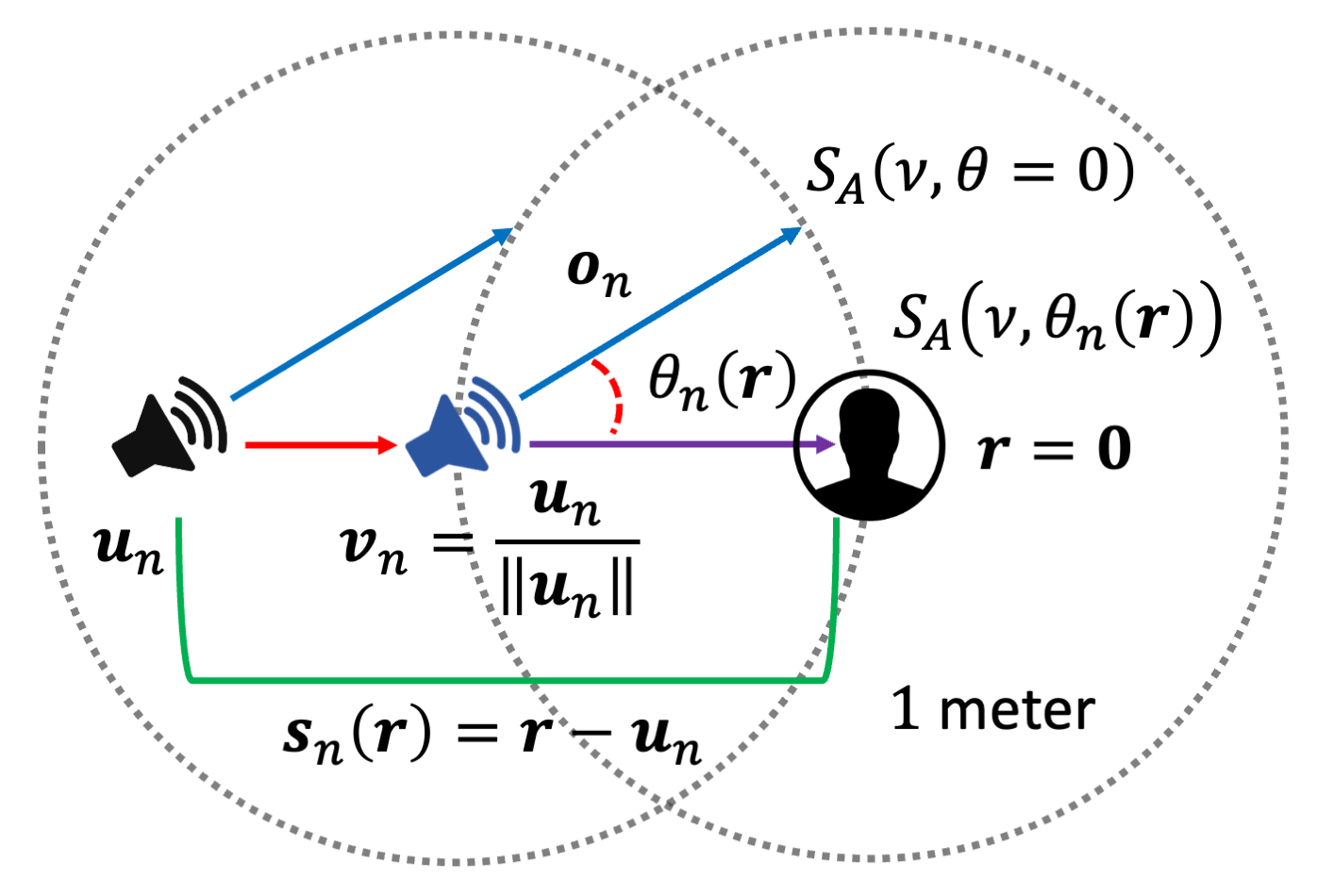
The diagram illustrates a sound propagation model involving two overlapping circular regions representing sound fields. A speaker emits sound waves, which interact with a human figure positioned at the origin (r = 0). Key elements include directional vectors, normalization operations, and spatial transformations.
### Components/Axes
1. **Circular Regions**:
- Left circle: Labeled $ S_A(v, \theta = 0) $, representing a baseline sound field.
- Right circle: Labeled $ S_A(v, \theta_n(r)) $, indicating a transformed sound field dependent on position $ r $ and angle $ \theta_n(r) $.
2. **Speaker**: Emits sound waves (blue arrow) with a red arrow indicating direction.
3. **Human Figure**: Positioned at $ r = 0 $, with a purple arrow pointing toward it.
4. **Vectors**:
- $ \mathbf{u}_n $: Green vector originating from the speaker, labeled with magnitude $ \|\mathbf{u}_n\| $.
- $ \mathbf{v}_n $: Blue vector derived from $ \mathbf{u}_n $, calculated as $ \mathbf{v}_n = \frac{\mathbf{u}_n}{\|\mathbf{u}_n\|} $.
- $ \mathbf{o}_n $: Blue arrow pointing from the speaker to the human figure.
5. **Equations**:
- $ s_n(r) = r - \mathbf{u}_n $: Spatial transformation equation.
- $ \theta_n(r) $: Angle parameter dependent on position $ r $.
6. **Distance Marker**: Explicitly labeled "1 meter" between the speaker and human figure.
### Detailed Analysis
- **Vector Relationships**:
- $ \mathbf{v}_n $ is a unit vector derived from $ \mathbf{u}_n $, normalized by its magnitude.
- $ \mathbf{o}_n $ directly connects the speaker to the human figure, suggesting a reference path for sound propagation.
- **Spatial Transformations**:
- $ s_n(r) = r - \mathbf{u}_n $ implies a positional adjustment relative to the speaker's emission point.
- $ \theta_n(r) $ modulates the sound field based on the human's position, altering the baseline $ S_A(v, \theta = 0) $.
- **Overlapping Regions**: The intersection of the two circles may represent overlapping sound fields or interference effects.
### Key Observations
1. The human figure is anchored at the origin ($ r = 0 $), serving as a reference point for spatial calculations.
2. The normalization of $ \mathbf{u}_n $ to $ \mathbf{v}_n $ ensures directional consistency in sound propagation.
3. The 1-meter distance provides a fixed scale for spatial relationships.
4. The angle $ \theta_n(r) $ introduces a dynamic parameter that varies with position, affecting the sound field $ S_A $.
### Interpretation
This diagram models how sound fields interact with a human listener in a controlled environment. The speaker's emission ($ \mathbf{u}_n $) is normalized to $ \mathbf{v}_n $, ensuring directional accuracy. The transformed sound field $ S_A(v, \theta_n(r)) $ accounts for the listener's position ($ r $) and angular adjustments ($ \theta_n(r) $), suggesting applications in acoustic engineering or spatial audio systems. The 1-meter scale anchors the model in a real-world context, while the overlapping circles may represent constructive/destructive interference or multi-path propagation effects. The equations emphasize the importance of vector normalization and positional dependency in sound field analysis.