\n
## Bar Charts: Verification Accuracy and Error Metrics for Different Model Sizes and Techniques
### Overview
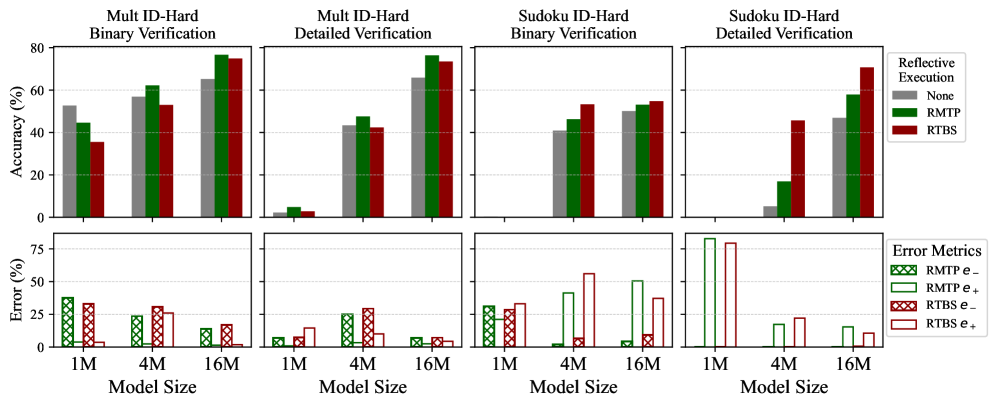
The image presents four pairs of bar charts. Each pair compares "Binary Verification" and "Detailed Verification" for two different problem types: "Mult ID-Hard" and "Sudoku ID-Hard". The top row displays accuracy (in percentage) while the bottom row displays error metrics (also in percentage). The charts compare the performance of three techniques: "None", "RMTP", and "RTBS" across different model sizes: "1M", "4M", and "16M".
### Components/Axes
* **X-axis:** Model Size (1M, 4M, 16M)
* **Y-axis (Top Charts):** Accuracy (%) - Scale ranges from 0 to 80.
* **Y-axis (Bottom Charts):** Error (%) - Scale ranges from 0 to 75.
* **Legend (Top-Right, applies to all top charts):**
* "None" (Grey)
* "RMTP" (Dark Green)
* "RTBS" (Red)
* **Legend (Bottom-Right, applies to all bottom charts):**
* "RMTP e -" (Green with 'x' marker)
* "RMTP e +" (Light Green with '+' marker)
* "RTBS e -" (Red with 'x' marker)
* "RTBS e +" (Light Red with '+' marker)
* **Titles (Top Row):**
* "Mult ID-Hard Binary Verification"
* "Mult ID-Hard Detailed Verification"
* "Sudoku ID-Hard Binary Verification"
* "Sudoku ID-Hard Detailed Verification"
### Detailed Analysis or Content Details
**Mult ID-Hard Binary Verification:**
* 1M Model Size: "None" ~52%, "RMTP" ~58%, "RTBS" ~60%
* 4M Model Size: "None" ~54%, "RMTP" ~64%, "RTBS" ~66%
* 16M Model Size: "None" ~56%, "RMTP" ~74%, "RTBS" ~78%
**Mult ID-Hard Detailed Verification:**
* 1M Model Size: "None" ~46%, "RMTP" ~54%, "RTBS" ~56%
* 4M Model Size: "None" ~48%, "RMTP" ~60%, "RTBS" ~62%
* 16M Model Size: "None" ~50%, "RMTP" ~70%, "RTBS" ~74%
**Sudoku ID-Hard Binary Verification:**
* 1M Model Size: "None" ~50%, "RMTP" ~54%, "RTBS" ~56%
* 4M Model Size: "None" ~52%, "RMTP" ~58%, "RTBS" ~60%
* 16M Model Size: "None" ~54%, "RMTP" ~66%, "RTBS" ~68%
**Sudoku ID-Hard Detailed Verification:**
* 1M Model Size: "None" ~46%, "RMTP" ~50%, "RTBS" ~52%
* 4M Model Size: "None" ~48%, "RMTP" ~54%, "RTBS" ~56%
* 16M Model Size: "None" ~50%, "RMTP" ~64%, "RTBS" ~66%
**Error Metrics - Mult ID-Hard Binary Verification:**
* 1M Model Size: "RMTP e -" ~30%, "RMTP e +" ~5%, "RTBS e -" ~20%, "RTBS e +" ~10%
* 4M Model Size: "RMTP e -" ~20%, "RMTP e +" ~5%, "RTBS e -" ~15%, "RTBS e +" ~5%
* 16M Model Size: "RMTP e -" ~10%, "RMTP e +" ~5%, "RTBS e -" ~10%, "RTBS e +" ~5%
**Error Metrics - Mult ID-Hard Detailed Verification:**
* 1M Model Size: "RMTP e -" ~30%, "RMTP e +" ~5%, "RTBS e -" ~20%, "RTBS e +" ~10%
* 4M Model Size: "RMTP e -" ~20%, "RMTP e +" ~5%, "RTBS e -" ~15%, "RTBS e +" ~5%
* 16M Model Size: "RMTP e -" ~10%, "RMTP e +" ~5%, "RTBS e -" ~10%, "RTBS e +" ~5%
**Error Metrics - Sudoku ID-Hard Binary Verification:**
* 1M Model Size: "RMTP e -" ~25%, "RMTP e +" ~5%, "RTBS e -" ~20%, "RTBS e +" ~5%
* 4M Model Size: "RMTP e -" ~20%, "RMTP e +" ~5%, "RTBS e -" ~15%, "RTBS e +" ~5%
* 16M Model Size: "RMTP e -" ~10%, "RMTP e +" ~5%, "RTBS e -" ~10%, "RTBS e +" ~5%
**Error Metrics - Sudoku ID-Hard Detailed Verification:**
* 1M Model Size: "RMTP e -" ~25%, "RMTP e +" ~5%, "RTBS e -" ~20%, "RTBS e +" ~5%
* 4M Model Size: "RMTP e -" ~20%, "RMTP e +" ~5%, "RTBS e -" ~15%, "RTBS e +" ~5%
* 16M Model Size: "RMTP e -" ~10%, "RMTP e +" ~5%, "RTBS e -" ~10%, "RTBS e +" ~5%
### Key Observations
* Accuracy generally increases with model size (1M to 16M) for all techniques and problem types.
* "RTBS" consistently outperforms "RMTP" in terms of accuracy, and both significantly outperform "None".
* The error metrics show that "RMTP e -" is the dominant source of error, while "RMTP e +" and "RTBS e +" contribute relatively little.
* The error metrics decrease with increasing model size.
* The difference in accuracy between "Binary Verification" and "Detailed Verification" is relatively small for both problem types.
### Interpretation
The data suggests that both "RMTP" and "RTBS" are effective techniques for improving verification accuracy, and that increasing model size leads to further improvements. "RTBS" appears to be the superior technique overall. The error metrics indicate that the primary source of error is related to the "RMTP e -" component, suggesting a potential area for optimization. The relatively small difference between "Binary Verification" and "Detailed Verification" suggests that the added complexity of "Detailed Verification" may not be justified in these cases, although further investigation might be warranted. The consistent trends across both problem types (Mult ID-Hard and Sudoku ID-Hard) suggest that these findings are generalizable. The consistent low error values for "RMTP e +" and "RTBS e +" suggest these components are well-behaved and contribute positively to the overall verification process.