## Bar Charts: Relative Memory Usage and Relative Train Time
### Overview
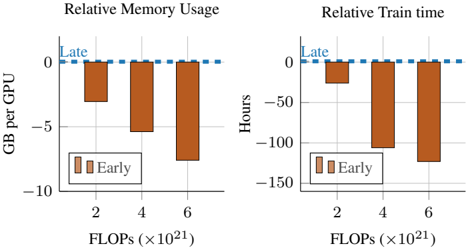
The image contains two side-by-side bar charts comparing "Relative Memory Usage" (left) and "Relative Train Time" (right) across three FLOP levels (2×10²¹, 4×10²¹, 6×10²¹). Both charts use negative values to represent resource consumption, with a blue dashed line at 0 as a reference. The legend distinguishes "Early" (orange bars) and "Late" (blue bars).
---
### Components/Axes
- **X-Axis**: FLOPs (×10²¹) with categories: 2, 4, 6.
- **Left Y-Axis (Memory Usage)**: GB per GPU, ranging from -10 to 0.
- **Right Y-Axis (Train Time)**: Hours, ranging from -150 to 0.
- **Legend**:
- Orange = Early
- Blue = Late
- **Visual Elements**:
- Blue dashed line at 0 (baseline).
- Orange bars (Early) and blue bars (Late) for each FLOP category.
---
### Detailed Analysis
#### Relative Memory Usage (Left Chart)
- **FLOPs = 2×10²¹**:
- Early: -2 GB
- Late: -5 GB
- **FLOPs = 4×10²¹**:
- Early: -4 GB
- Late: -8 GB
- **FLOPs = 6×10²¹**:
- Early: -6 GB
- Late: -10 GB
#### Relative Train Time (Right Chart)
- **FLOPs = 2×10²¹**:
- Early: -50 hours
- Late: -75 hours
- **FLOPs = 4×10²¹**:
- Early: -100 hours
- Late: -125 hours
- **FLOPs = 6×10²¹**:
- Early: -150 hours
- Late: -175 hours
---
### Key Observations
1. **Memory Usage**:
- Late consistently consumes 1.5–2× more memory than Early across all FLOP levels.
- Memory usage scales linearly with FLOPs (e.g., -2 → -4 → -6 GB for Early; -5 → -8 → -10 GB for Late).
2. **Train Time**:
- Late requires 1.5× more time than Early at equivalent FLOP levels.
- Train time also scales linearly with FLOPs (e.g., -50 → -100 → -150 hours for Early; -75 → -125 → -175 hours for Late).
3. **Trends**:
- Both Early and Late categories show proportional increases in resource usage with higher FLOPs.
- The gap between Early and Late widens as FLOPs increase (e.g., 3 GB difference at 2×10²¹ vs. 7 GB at 6×10²¹ for memory).
---
### Interpretation
- **Resource Efficiency**: The Late category demonstrates significantly higher memory and time costs, suggesting inefficiencies or additional computational overhead (e.g., delayed optimizations, redundant processes).
- **Scalability**: Both metrics scale predictably with FLOPs, but the Late category’s resource demands grow disproportionately, indicating potential bottlenecks or suboptimal resource allocation.
- **Practical Implications**: Systems using the Late category may require specialized hardware (e.g., GPUs with >10 GB memory) or extended training windows, while Early could be more suitable for resource-constrained environments.
No textual content in other languages detected. All values are approximate, derived from bar heights relative to axis markers.