## Diagram: Nixpkgs Reproducibility Analysis Pipeline
### Overview
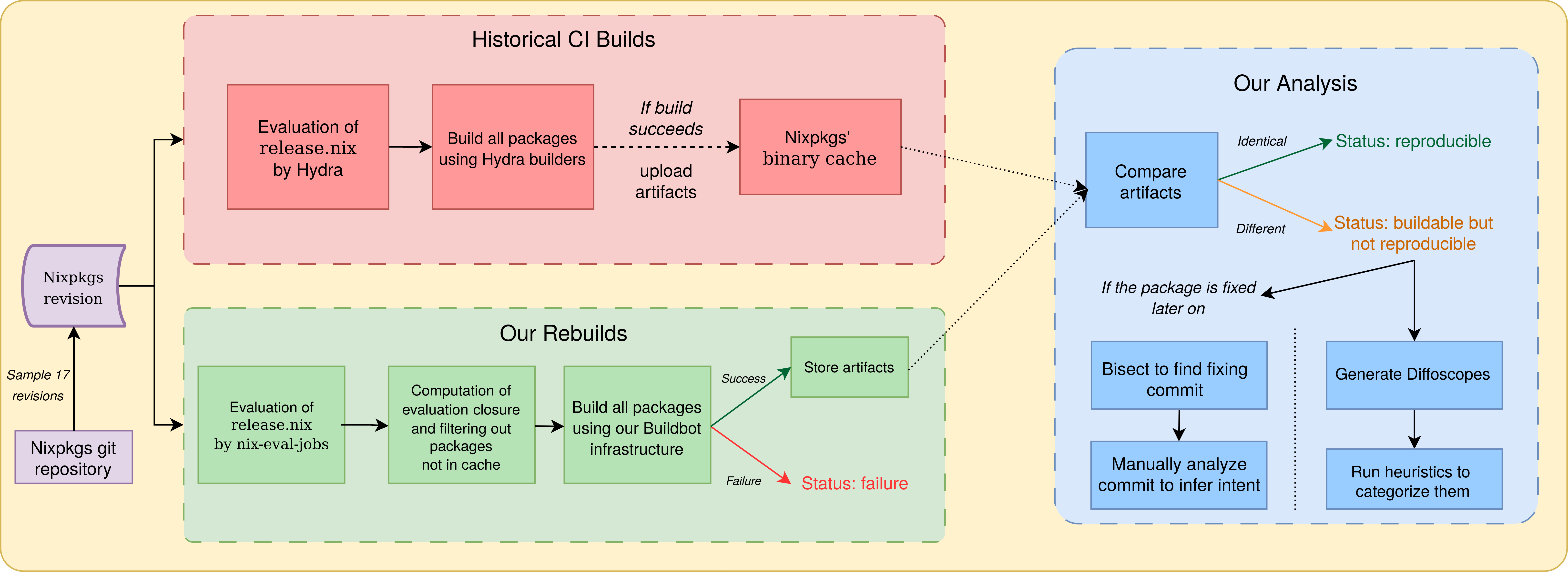
This diagram illustrates a technical workflow for analyzing the reproducibility of software packages within the Nixpkgs ecosystem. It compares historical Continuous Integration (CI) builds against fresh rebuilds to determine if package artifacts are identical, thereby assessing reproducibility. The process involves sampling revisions from a git repository, executing parallel build pipelines, and performing comparative analysis with follow-up diagnostic steps.
### Components/Axes
The diagram is structured into three primary colored regions and two input nodes, connected by directional arrows indicating data and process flow.
**Input Nodes (Left Side):**
1. **Nixpkgs git repository** (Purple box, bottom-left): The source of package definitions.
2. **Nixpkgs revision** (Purple rounded rectangle, center-left): A specific point-in-time snapshot of the repository. An arrow labeled "Sample 17 revisions" points from the repository to this node, indicating the sampling process.
**Process Regions:**
1. **Historical CI Builds** (Red dashed-border region, top-left): Represents the existing, official build process.
2. **Our Rebuilds** (Green dashed-border region, bottom-left): Represents a parallel, independent rebuild process for comparison.
3. **Our Analysis** (Blue dashed-border region, right): The core analysis engine that compares outputs from the two build processes.
**Legend/Status Indicators:**
* **Status: reproducible** (Green text): Outcome when compared artifacts are identical.
* **Status: buildable but not reproducible** (Orange text): Outcome when compared artifacts are different.
* **Status: failure** (Red text): Outcome when a rebuild fails.
### Detailed Analysis
**Flow from Input:**
The "Nixpkgs revision" node feeds into both the "Historical CI Builds" and "Our Rebuilds" regions simultaneously.
**1. Historical CI Builds (Red Region) - Top-Left Quadrant:**
* **Step 1:** "Evaluation of release.nix by Hydra" (Red box).
* **Step 2:** Arrow leads to "Build all packages using Hydra builders" (Red box).
* **Conditional Step:** A dashed arrow labeled "If build succeeds" and "upload artifacts" leads to "Nixpkgs' binary cache" (Red box). This represents the storage of official build artifacts.
**2. Our Rebuilds (Green Region) - Bottom-Left Quadrant:**
* **Step 1:** "Evaluation of release.nix by nix-eval-jobs" (Green box).
* **Step 2:** Arrow leads to "Computation of evaluation closure and filtering out packages not in cache" (Green box).
* **Step 3:** Arrow leads to "Build all packages using our Buildbot infrastructure" (Green box).
* **Conditional Outcomes:**
* A green arrow labeled "Success" leads to "Store artifacts" (Green box).
* A red arrow labeled "Failure" leads to the status "Status: failure".
**3. Our Analysis (Blue Region) - Right Half:**
* **Input:** Dotted arrows from both "Nixpkgs' binary cache" (Historical) and "Store artifacts" (Rebuilds) converge on the "Compare artifacts" node (Blue box).
* **Comparison Logic:**
* A green arrow labeled "Identical" leads to "Status: reproducible".
* An orange arrow labeled "Different" leads to "Status: buildable but not reproducible".
* **Diagnostic Path (for "Different" outcome):** An arrow from the "Different" status leads to a decision point labeled "If the package is fixed later on". This branches into two parallel diagnostic workflows:
* **Left Branch:** "Bisect to find fixing commit" (Blue box) -> "Manually analyze commit to infer intent" (Blue box).
* **Right Branch:** "Generate Diffoscopes" (Blue box) -> "Run heuristics to categorize them" (Blue box).
### Key Observations
1. **Parallel Process Design:** The core methodology is a side-by-side comparison between a trusted historical build (Hydra) and an independent rebuild (Buildbot). This is a standard approach for testing reproducibility.
2. **Tool Differentiation:** The diagram specifies different tools for each pipeline: "Hydra" for historical builds and "nix-eval-jobs" + "Buildbot" for rebuilds. This independence is crucial for a valid reproducibility test.
3. **Filtering Step:** The rebuild process includes an explicit step to filter out packages not present in the cache, suggesting the analysis focuses on packages that were successfully built historically.
4. **Multi-faceted Diagnostics:** When a package is not reproducible, the workflow doesn't stop. It includes sophisticated follow-up actions: bisecting git history to find fixes and using "Diffoscopes" (a tool for comparing binary files) with heuristics to categorize differences.
5. **Clear Status Taxonomy:** The system defines three clear, mutually exclusive outcomes for any given package build: reproducible, buildable but not reproducible, or failure.
### Interpretation
This diagram outlines a rigorous, automated methodology for auditing software supply chain security and reliability within the Nix package manager ecosystem. Reproducibility is a critical property ensuring that the same source code always produces bit-for-bit identical binaries, which is foundational for security verification, trust, and debugging.
The process demonstrates a **Peircean investigative approach**:
* **Abduction:** The initial hypothesis is that packages *should* be reproducible. The comparison test is designed to probe this.
* **Deduction:** If the hypothesis is true (artifacts are identical), the status is confirmed ("reproducible"). If false (artifacts differ), it triggers a specific diagnostic routine.
* **Induction:** The diagnostic steps (bisecting, diffoscope analysis) gather new evidence to understand *why* reproducibility failed, potentially leading to generalizable rules about common failure modes (categorized by heuristics).
The "If the package is fixed later on" branch is particularly insightful. It shows the system is designed not just to detect problems, but to investigate their resolution, turning a failure into a learning opportunity to understand what kinds of changes break reproducibility and how they are fixed. This moves beyond simple monitoring into active forensic analysis of the build process's integrity.