## Bar Chart: MetaQA 3-Hop Hit@1 Scores
### Overview
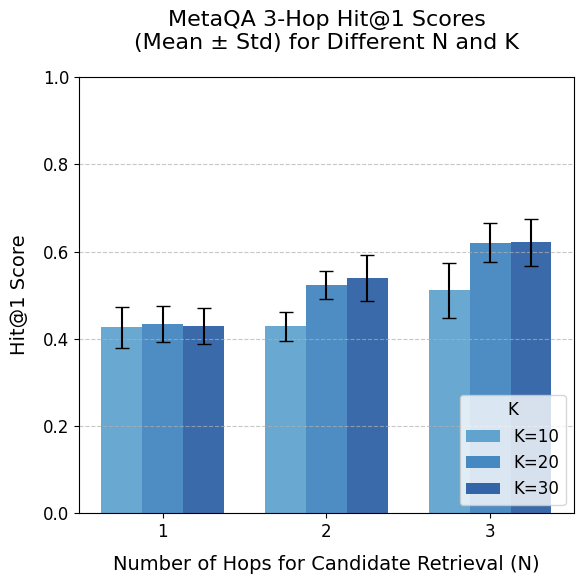
This bar chart displays the Mean ± Standard Deviation of Hit@1 scores for the MetaQA 3-Hop dataset, varying the number of hops (N) for candidate retrieval and the value of K. The chart compares performance across three different K values (10, 20, and 30) for each hop count (1, 2, and 3).
### Components/Axes
* **Title:** "MetaQA 3-Hop Hit@1 Scores (Mean ± Std) for Different N and K" - positioned at the top-center.
* **X-axis:** "Number of Hops for Candidate Retrieval (N)" - with markers at 1, 2, and 3.
* **Y-axis:** "Hit@1 Score" - ranging from 0.0 to 1.0, with gridlines at 0.2, 0.4, 0.6, and 0.8.
* **Legend:** Located in the bottom-right corner, identifying the K values:
* K=10 (Light Blue)
* K=20 (Medium Blue)
* K=30 (Dark Blue)
* **Error Bars:** Represent the standard deviation for each data point.
### Detailed Analysis
The chart consists of three groups of bars, one for each value of N (1, 2, and 3). Within each group, there are three bars representing the Hit@1 score for K=10, K=20, and K=30. The error bars indicate the variability of the scores.
**N = 1:**
* K=10: The bar is approximately at 0.42, with an error bar extending from roughly 0.38 to 0.46.
* K=20: The bar is approximately at 0.44, with an error bar extending from roughly 0.40 to 0.48.
* K=30: The bar is approximately at 0.41, with an error bar extending from roughly 0.37 to 0.45.
**N = 2:**
* K=10: The bar is approximately at 0.46, with an error bar extending from roughly 0.42 to 0.50.
* K=20: The bar is approximately at 0.53, with an error bar extending from roughly 0.49 to 0.57.
* K=30: The bar is approximately at 0.55, with an error bar extending from roughly 0.51 to 0.59.
**N = 3:**
* K=10: The bar is approximately at 0.56, with an error bar extending from roughly 0.52 to 0.60.
* K=20: The bar is approximately at 0.60, with an error bar extending from roughly 0.56 to 0.64.
* K=30: The bar is approximately at 0.62, with an error bar extending from roughly 0.58 to 0.66.
### Key Observations
* The Hit@1 score generally increases as the number of hops (N) increases.
* For each value of N, increasing K (from 10 to 30) generally leads to a higher Hit@1 score.
* The error bars suggest that the variability in scores decreases slightly as N increases.
* The difference in performance between K=20 and K=30 is relatively small, especially at N=3.
### Interpretation
The data suggests that increasing the number of hops for candidate retrieval (N) improves the Hit@1 score in the MetaQA 3-Hop dataset. Furthermore, increasing the value of K (the number of candidates retrieved) also generally improves performance, although the benefit diminishes as K increases. The consistent upward trend with increasing N indicates that exploring more candidate paths is beneficial for this task. The relatively small error bars at N=3 suggest that the performance is more stable with a larger number of hops. This could be due to the model being able to better identify relevant candidates with more hops, or it could be a result of the dataset characteristics. The chart demonstrates a clear relationship between retrieval strategy (N and K) and the quality of the retrieved results (Hit@1 score).