## Chart: Accuracy vs. Sampled Reasoning Chains/Paths for Various Datasets
### Overview
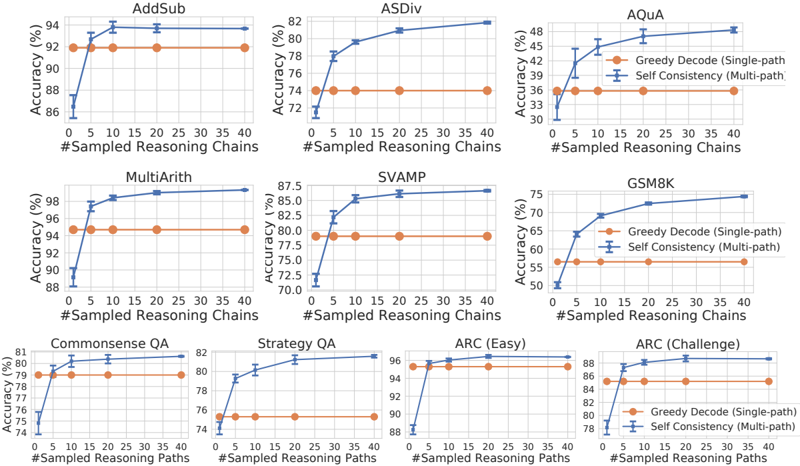
The image presents a series of line graphs comparing the accuracy of two methods, "Greedy Decode (Single-path)" and "Self Consistency (Multi-path)", across different datasets. The x-axis represents the number of sampled reasoning chains or paths, while the y-axis represents the accuracy in percentage. Each graph corresponds to a specific dataset.
### Components/Axes
* **X-axis:** "#Sampled Reasoning Chains" or "#Sampled Reasoning Paths". The scale ranges from 0 to 40 in increments of 5.
* **Y-axis:** "Accuracy (%)". The scale varies depending on the dataset, but generally covers a range relevant to the observed accuracy.
* **Legend (Located in the top-right of the AQUA chart and bottom-right of the GSM8K and ARC(Challenge) charts):**
* **Orange Line:** "Greedy Decode (Single-path)"
* **Blue Line:** "Self Consistency (Multi-path)"
* **Titles:** Each chart has a title indicating the dataset name (e.g., "AddSub", "ASDiv", "AQuA", "MultiArith", "SVAMP", "GSM8K", "Commonsense QA", "Strategy QA", "ARC (Easy)", "ARC (Challenge)").
### Detailed Analysis
**1. AddSub**
* **Y-axis:** 86 to 94
* **Greedy Decode (Single-path) - Orange:** The accuracy is constant at approximately 92%.
* **Self Consistency (Multi-path) - Blue:** The accuracy starts at approximately 87% at 0 sampled chains, rises sharply to approximately 92% at 5 sampled chains, and then plateaus around 93-94% with minor fluctuations.
**2. ASDiv**
* **Y-axis:** 72 to 82
* **Greedy Decode (Single-path) - Orange:** The accuracy is constant at approximately 74%.
* **Self Consistency (Multi-path) - Blue:** The accuracy starts at approximately 72% at 0 sampled chains, rises sharply to approximately 80% at 10 sampled chains, and then continues to increase gradually to approximately 82% at 40 sampled chains.
**3. AQuA**
* **Y-axis:** 30 to 48
* **Greedy Decode (Single-path) - Orange:** The accuracy is constant at approximately 36%.
* **Self Consistency (Multi-path) - Blue:** The accuracy starts at approximately 32% at 0 sampled chains, rises sharply to approximately 44% at 10 sampled chains, and then continues to increase gradually to approximately 48% at 40 sampled chains.
**4. MultiArith**
* **Y-axis:** 88 to 98
* **Greedy Decode (Single-path) - Orange:** The accuracy is constant at approximately 95%.
* **Self Consistency (Multi-path) - Blue:** The accuracy starts at approximately 89% at 0 sampled chains, rises sharply to approximately 97% at 10 sampled chains, and then plateaus around 98% with minor fluctuations.
**5. SVAMP**
* **Y-axis:** 70 to 87.5
* **Greedy Decode (Single-path) - Orange:** The accuracy is constant at approximately 80%.
* **Self Consistency (Multi-path) - Blue:** The accuracy starts at approximately 72% at 0 sampled chains, rises sharply to approximately 85% at 10 sampled chains, and then plateaus around 86-87% with minor fluctuations.
**6. GSM8K**
* **Y-axis:** 50 to 75
* **Greedy Decode (Single-path) - Orange:** The accuracy is constant at approximately 57%.
* **Self Consistency (Multi-path) - Blue:** The accuracy starts at approximately 50% at 0 sampled chains, rises sharply to approximately 68% at 10 sampled chains, and then continues to increase gradually to approximately 74% at 40 sampled chains.
**7. Commonsense QA**
* **Y-axis:** 74 to 81
* **Greedy Decode (Single-path) - Orange:** The accuracy is constant at approximately 79%.
* **Self Consistency (Multi-path) - Blue:** The accuracy starts at approximately 75% at 0 sampled paths, rises sharply to approximately 80% at 5 sampled paths, and then plateaus around 80-81% with minor fluctuations.
**8. Strategy QA**
* **Y-axis:** 74 to 82
* **Greedy Decode (Single-path) - Orange:** The accuracy is constant at approximately 76%.
* **Self Consistency (Multi-path) - Blue:** The accuracy starts at approximately 75% at 0 sampled paths, rises sharply to approximately 81% at 5 sampled paths, and then plateaus around 81-82% with minor fluctuations.
**9. ARC (Easy)**
* **Y-axis:** 88 to 96
* **Greedy Decode (Single-path) - Orange:** The accuracy is constant at approximately 91%.
* **Self Consistency (Multi-path) - Blue:** The accuracy starts at approximately 89% at 0 sampled paths, rises sharply to approximately 96% at 5 sampled paths, and then plateaus around 96% with minor fluctuations.
**10. ARC (Challenge)**
* **Y-axis:** 78 to 88
* **Greedy Decode (Single-path) - Orange:** The accuracy is constant at approximately 85%.
* **Self Consistency (Multi-path) - Blue:** The accuracy starts at approximately 79% at 0 sampled paths, rises sharply to approximately 87% at 5 sampled paths, and then plateaus around 88% with minor fluctuations.
### Key Observations
* For all datasets, the "Self Consistency (Multi-path)" method generally outperforms the "Greedy Decode (Single-path)" method, especially as the number of sampled reasoning chains/paths increases.
* The "Greedy Decode (Single-path)" method shows a relatively constant accuracy regardless of the number of sampled reasoning chains/paths.
* The "Self Consistency (Multi-path)" method shows a significant initial increase in accuracy with a small number of sampled reasoning chains/paths (typically up to 10), after which the accuracy plateaus or increases only marginally.
* The performance difference between the two methods varies across datasets.
### Interpretation
The data suggests that using a self-consistency approach with multiple reasoning paths significantly improves the accuracy of the models on these datasets compared to a greedy decoding approach with a single path. The initial increase in accuracy with a small number of sampled paths indicates that exploring multiple reasoning paths is beneficial, but the diminishing returns suggest that there is a limit to the benefits of increasing the number of sampled paths. The consistent performance of the greedy decoding method implies that it may be less sensitive to the complexity of the reasoning process and more reliant on the inherent structure of the dataset. The varying performance differences across datasets highlight the importance of choosing the appropriate method based on the specific characteristics of the task.