\n
## Diagram: The Gnomon and its Shadow
### Overview
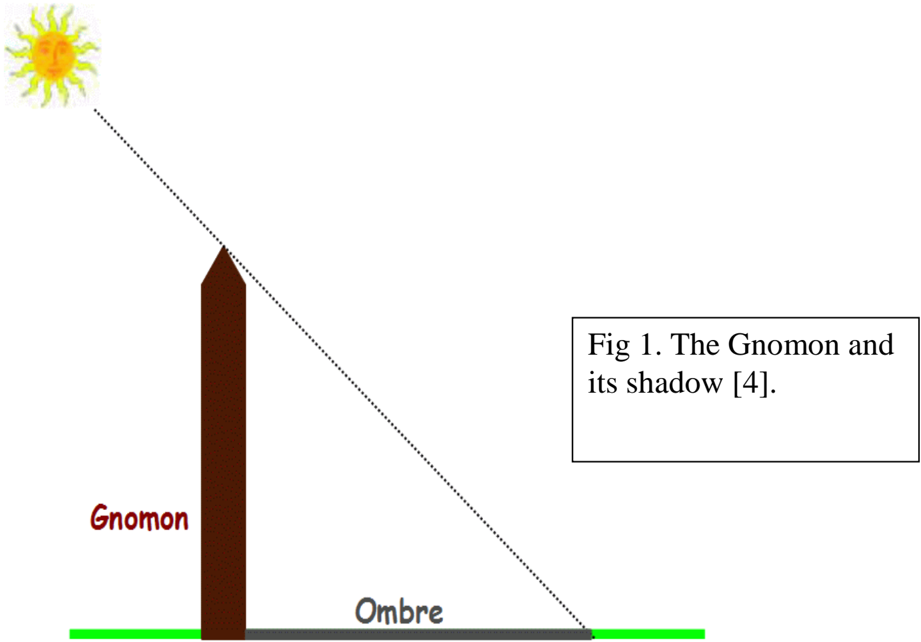
The image is a diagram illustrating the relationship between a gnomon (a vertical rod), the sun, and its resulting shadow. It depicts a simplified model of how a gnomon casts a shadow based on the sun's position.
### Components/Axes
The diagram consists of the following components:
* **Sun:** Represented as a yellow, radiating circle in the top-left corner.
* **Gnomon:** A dark red, vertical rectangular rod labeled "Gnomon" in red text on the left side.
* **Shadow:** A green line labeled "Ombre" in black text, extending from the base of the gnomon to the right.
* **Sun Rays:** Dotted lines representing the path of sunlight from the sun to the gnomon and its shadow.
* **Caption:** A white box in the top-right corner containing the text "Fig 1. The Gnomon and its shadow [4]."
### Detailed Analysis or Content Details
The diagram shows a simple geometric relationship. The sun's rays are depicted as straight lines. The gnomon is positioned vertically, and the shadow extends horizontally to the right. The angle between the sun's rays and the gnomon creates the shadow.
The text within the white box reads: "Fig 1. The Gnomon and its shadow [4]." This indicates that this is Figure 1 and the source is referenced as "[4]".
The label "Gnomon" is positioned to the left of the vertical rod. The label "Ombre" (French for "shadow") is positioned below the green shadow line.
### Key Observations
The diagram is a conceptual illustration rather than a precise measurement. It does not include any numerical data or scales. The diagram's purpose is to visually explain the basic principle of how a gnomon creates a shadow.
### Interpretation
The diagram demonstrates the fundamental principle behind sundials and other timekeeping devices that rely on the position of the sun and the length/direction of a shadow. The gnomon acts as the object casting the shadow, and the shadow's position changes throughout the day as the sun moves across the sky. The diagram is a simplified representation, omitting factors like the Earth's rotation and atmospheric effects. The inclusion of the French word "Ombre" suggests a potential origin or influence from French scientific or historical contexts related to sundials or gnomonics. The reference "[4]" indicates that this diagram is likely part of a larger work and that further information can be found in the source cited as number 4.