## Diagram: Cognitive Architecture for Goal-Driven Systems
### Overview
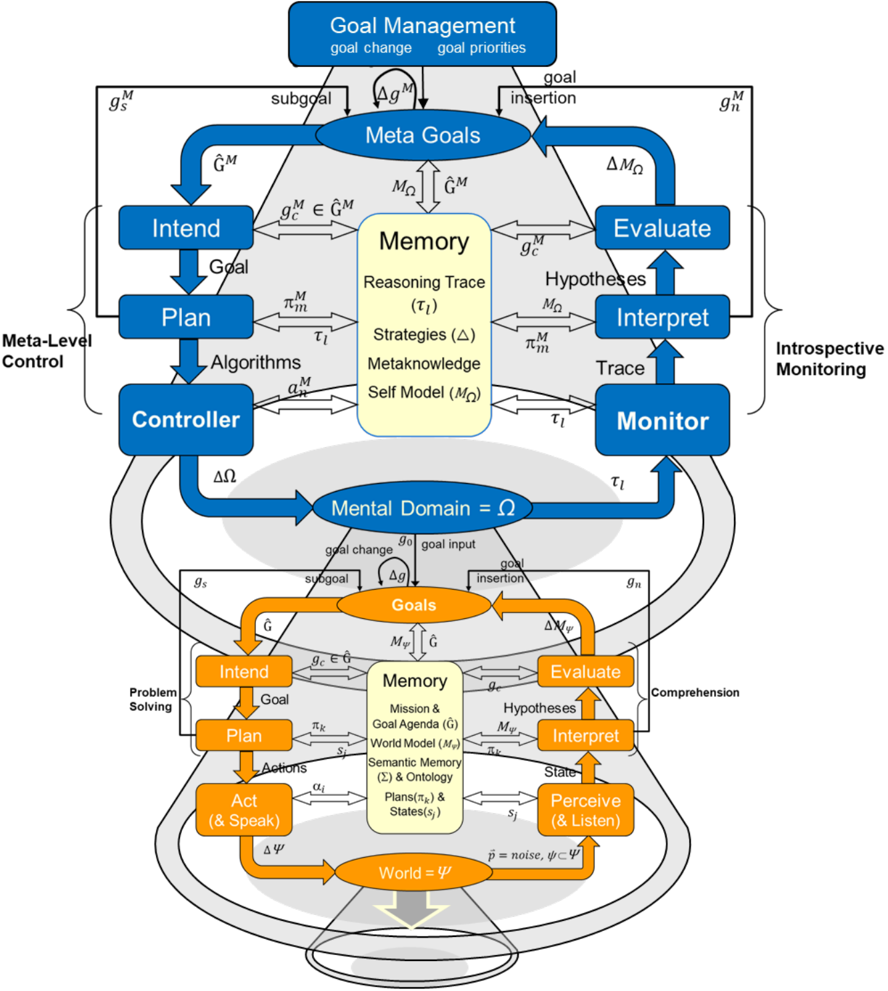
This diagram illustrates a hierarchical cognitive architecture designed for goal-driven systems, integrating meta-level control, memory, and problem-solving processes. It emphasizes the interplay between high-level goal management, memory systems, and real-time perception/action loops. The diagram uses color-coded components (blue for meta-level, orange for problem-solving) and directional arrows to represent information flow and control mechanisms.
### Components/Axes
1. **Top Section (Meta-Level Control)**:
- **Goal Management**: Manages goal changes and priorities.
- **Meta Goals**: Contains subgoals (`g_s^M`, `g_n^M`) and goal insertion.
- **Intend**: Connects to "Goal" and "Plan" via arrows labeled "Goal" and "Algorithms."
- **Plan**: Links to "Controller" and "Algorithms."
- **Controller**: Receives input from "Mental Domain = Ω" and outputs to "Monitor."
- **Evaluate/Interpret/Monitor**: Forms a feedback loop with "Hypotheses" and "Trace."
2. **Central Section (Memory)**:
- **Memory**: Contains subcomponents:
- **Reasoning Trace (τ_l)**
- **Strategies (Δ)**
- **Metaknowledge**
- **Self Model (M_Ω)**
- **Memory Trace (τ_l)** and **Hypotheses** are connected to "Evaluate" and "Interpret."
3. **Bottom Section (Problem-Solving/World Modeling)**:
- **Goals**: Includes "Intend," "Plan," "Act (& Speak)," and "Perceive (& Listen)."
- **World = ψ**: Represents the environment model, with inputs from "Perceive (& Listen)" and outputs to "Act (& Speak)."
- **Problem Solving**: Connects to "Goals" via "Goal Agenda (Ĝ)" and "World Model (M_ψ)."
4. **Arrows and Labels**:
- **Blue Arrows**: Represent meta-level control (e.g., "goal change," "goal input").
- **Orange Arrows**: Represent problem-solving and perception-action loops (e.g., "Δg," "Δψ").
- **Mathematical Notations**:
- **Mental Domain = Ω** (central hub).
- **World = ψ** (environment model).
- **Δg, ΔΩ, Δψ**: Indicate changes in goals, mental domain, and world state.
5. **Legends and Colors**:
- **Blue**: Meta-level components (e.g., "Goal Management," "Meta Goals").
- **Orange**: Problem-solving components (e.g., "Goals," "World = ψ").
- **Yellow**: Memory subcomponents (e.g., "Reasoning Trace," "Metaknowledge").
### Detailed Analysis
- **Goal Management**: Positioned at the top, it governs goal changes and priorities, feeding into "Meta Goals" and "Intend."
- **Memory**: Acts as a central repository for reasoning traces, strategies, and self-models, enabling adaptive decision-making.
- **Controller**: Bridges meta-level goals and problem-solving by processing inputs from the "Mental Domain = Ω" and directing outputs to "Monitor."
- **Problem-Solving Loop**: The orange section forms a closed loop between "Goals," "World = ψ," and "Perceive (& Listen)/Act (& Speak)," emphasizing real-time adaptation.
- **Feedback Mechanisms**: Arrows like "Evaluate," "Interpret," and "Monitor" create a cyclical process for hypothesis testing and state evaluation.
### Key Observations
- **Hierarchical Structure**: The diagram separates high-level goal management (blue) from low-level problem-solving (orange), with memory as the integrator.
- **Dynamic Adaptation**: The use of "Δg," "ΔΩ," and "Δψ" suggests the system continuously adjusts to changes in goals, mental states, and the environment.
- **Integration of Memory**: The "Memory" block is critical for storing and retrieving strategies, traces, and self-models, enabling long-term learning.
- **Color-Coded Flow**: Blue arrows (meta-level) and orange arrows (problem-solving) visually distinguish between strategic and operational processes.
### Interpretation
This architecture demonstrates a **goal-driven, adaptive system** where meta-level control (e.g., goal prioritization) and real-time problem-solving (e.g., perception-action loops) are tightly coupled through memory. The "Mental Domain = Ω" and "World = ψ" represent abstract and concrete layers of processing, respectively. The feedback loops (e.g., "Evaluate" → "Interpret" → "Monitor") ensure the system refines its strategies based on outcomes.
The diagram highlights the importance of **memory as a bridge** between abstract goals and concrete actions, enabling the system to learn from experience and adjust its behavior. The separation of meta-level and problem-solving components suggests a modular design, allowing for scalability and flexibility in complex environments.
**Notable Trends**:
- The central role of "Memory" underscores its importance in maintaining coherence between high-level goals and low-level actions.
- The bidirectional flow between "World = ψ" and "Goals" indicates a dynamic interaction between the environment and the system's objectives.
- The use of mathematical notations (e.g., "Δg") implies a formal framework for modeling goal changes and system dynamics.