## Diagram: KGoT Task Resolution Process Flow
### Overview
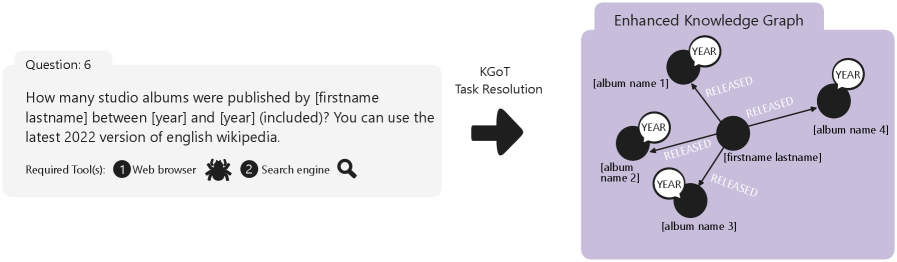
The image is a conceptual diagram illustrating a two-step process for resolving a natural language question using a Knowledge Graph-based Task (KGoT) resolution system. It visually maps a user's question to a structured knowledge graph representation. The diagram is composed of two primary rectangular containers connected by a directional arrow, set against a plain, light gray background.
### Components/Axes
The diagram has two main components arranged horizontally:
1. **Left Component (Input):** A white, rounded rectangle with a subtle drop shadow, labeled "Question: 6" at the top.
2. **Central Connector:** A thick, black, right-pointing arrow labeled "KGoT Task Resolution" above it.
3. **Right Component (Output):** A larger, light purple rounded rectangle with a darker purple header bar, titled "Enhanced Knowledge Graph".
### Detailed Analysis
**Left Component - Question Box:**
* **Header:** "Question: 6"
* **Main Text:** "How many studio albums were published by [firstname lastname] between [year] and [year] (included)? You can use the latest 2022 version of english wikipedia."
* **Footer Label:** "Required Tool(s):"
* **Tool Icons & Labels:**
* Icon 1: A stylized globe/web icon. Label: "1 Web browser"
* Icon 2: A magnifying glass icon. Label: "2 Search engine"
**Central Connector:**
* **Arrow:** A solid black arrow pointing from the left box to the right box.
* **Label:** "KGoT Task Resolution" is written in black text above the arrow shaft.
**Right Component - Enhanced Knowledge Graph:**
* **Header:** "Enhanced Knowledge Graph" in white text on a dark purple bar.
* **Graph Structure:** A network diagram with black circular nodes and connecting lines.
* **Node Types & Labels:**
* **Central Node:** A large black circle labeled "[firstname lastname]" in white text.
* **Album Nodes:** Four black circles labeled "[album name 1]", "[album name 2]", "[album name 3]", and "[album name 4]" in white text.
* **Year Nodes:** Four smaller black circles, each labeled "YEAR" in white text. Each is connected to one of the album nodes.
* **Relationships (Edges):** Lines connect the central node to each album node. Each connecting line is labeled with the word "RELEASED" in gray, uppercase text, oriented along the line.
### Key Observations
* **Spatial Grounding:** The legend (the "Required Tool(s)" list) is positioned at the bottom of the input box. The knowledge graph is the dominant element on the right side.
* **Component Isolation:** The diagram is cleanly segmented into an input region (question and tools), a processing step (arrow), and an output region (knowledge graph).
* **Trend/Flow Verification:** The visual flow is strictly left-to-right, indicating a transformation process. The graph structure shows a one-to-many relationship from the artist (central node) to multiple albums, each with an associated release year.
* **Placeholder Consistency:** The placeholders `[firstname lastname]`, `[year]`, and `[album name X]` in the question text directly correspond to the labeled nodes in the knowledge graph, demonstrating how the system parses the query into structured entities.
### Interpretation
This diagram serves as a visual explanation of how a natural language question-answering system, specifically one using a Knowledge Graph-based Task (KGoT) resolver, processes a query.
1. **Process Demonstration:** It illustrates the transformation from an unstructured, parameterized question ("How many studio albums...") into a structured data model. The "Enhanced Knowledge Graph" is the system's internal representation of the query's core entities (artist, albums, years) and their relationships (RELEASED).
2. **System Logic:** The diagram reveals the underlying logic: to answer the question, the system must first identify the artist entity, then find all album entities connected to that artist via a "RELEASED" relationship, and finally filter those albums based on the release year nodes to count those within the specified range.
3. **Tool Integration:** The inclusion of "Required Tool(s)" (Web browser, Search engine) indicates that the KGoT system is not operating on a pre-existing, complete knowledge graph. It must actively use these tools to gather the necessary information (likely from Wikipedia as specified) to populate the graph structure shown on the right before it can compute the final answer.
4. **Abstraction Level:** The use of placeholders (`[firstname lastname]`, `[album name 1]`) instead of specific data shows this is a template or schema for a class of questions, not a resolved instance. The diagram explains the *method*, not a specific result.
In essence, the image argues that complex factual questions can be systematically broken down into a graph of entities and relationships, which can then be queried computationally, potentially with the aid of external information retrieval tools.