## Line Chart: Accuracy vs. Regularization Parameter (λ)
### Overview
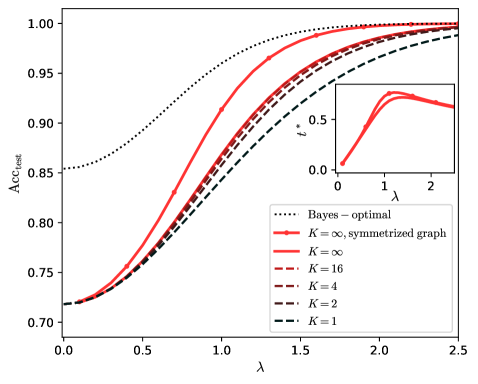
The chart compares the test accuracy (Acc_test) of different model configurations against the regularization parameter λ. It includes a main graph and an inset zoomed-in view of the lower λ range. Multiple lines represent different configurations, with the Bayes-optimal performance as a reference.
### Components/Axes
- **X-axis (λ)**: Ranges from 0.0 to 2.5 in increments of 0.5.
- **Y-axis (Acc_test)**: Ranges from 0.70 to 1.00 in increments of 0.05.
- **Legend**: Located in the bottom-right corner, with the following entries:
- Dotted black: Bayes-optimal
- Solid red: K = ∞, symmetrized graph
- Dashed red: K = ∞
- Dashed brown: K = 16
- Dashed maroon: K = 4
- Dashed dark gray: K = 2
- Dashed black: K = 1
- **Inset Graph**: Located in the upper-right corner of the main graph, showing a zoomed-in view of λ ∈ [0, 2] with a secondary y-axis labeled *t*.
### Detailed Analysis
1. **Bayes-optimal (dotted black)**:
- Starts at ~0.85 at λ=0 and rises smoothly to ~1.00 by λ=2.5.
- Acts as the upper bound for all configurations.
2. **K = ∞, symmetrized graph (solid red)**:
- Begins at ~0.72 at λ=0, peaks at ~0.95 near λ=0.5 (inset confirms this), then plateaus near 1.00.
- Matches the Bayes-optimal curve closely at higher λ values.
3. **K = ∞ (dashed red)**:
- Starts at ~0.70 at λ=0, rises steeply to ~0.95 by λ=1.5, then converges with the Bayes-optimal curve.
- Slightly lags behind the symmetrized graph at lower λ values.
4. **K = 16 (dashed brown)**:
- Begins at ~0.70 at λ=0, rises to ~0.90 by λ=1.5, then plateaus.
- Shows slower convergence compared to higher K values.
5. **K = 4 (dashed maroon)**:
- Starts at ~0.70 at λ=0, rises to ~0.85 by λ=1.5, then plateaus.
- Demonstrates a trade-off between bias and variance.
6. **K = 2 (dashed dark gray)**:
- Begins at ~0.70 at λ=0, rises to ~0.80 by λ=1.5, then plateaus.
- Shows limited improvement over K=1.
7. **K = 1 (dashed black)**:
- Starts at ~0.70 at λ=0, rises to ~0.75 by λ=1.5, then plateaus.
- Minimal improvement over baseline.
8. **Inset Graph**:
- Focuses on λ ∈ [0, 2] with a secondary y-axis (*t*).
- The red line (K=∞, symmetrized graph) peaks at ~0.95 at λ=0.5, then declines slightly.
### Key Observations
- **Bayes-optimal performance** is the theoretical upper limit, approached by all configurations as λ increases.
- **Symmetrized graph (K=∞)** achieves the highest accuracy at lower λ values (~0.95 at λ=0.5) compared to non-symmetrized configurations.
- **Higher K values** (e.g., K=16, K=4) show better performance than lower K values (e.g., K=2, K=1), indicating that larger neighborhoods improve accuracy.
- The **inset graph** highlights a critical region where λ=0.5 maximizes accuracy for the symmetrized graph, suggesting an optimal trade-off between regularization and model complexity.
### Interpretation
The chart demonstrates that:
1. **Model complexity (K)** directly impacts accuracy: Higher K values reduce bias, allowing configurations to approach the Bayes-optimal performance.
2. **Symmetrization** enhances performance at lower λ values, suggesting it mitigates overfitting or improves generalization.
3. **Regularization (λ)** balances model complexity and generalization: Too little regularization (low λ) risks overfitting, while excessive regularization (high λ) underfits.
4. The **peak at λ=0.5** in the inset graph implies an optimal regularization strength for the symmetrized graph, balancing bias-variance trade-offs.
This analysis aligns with principles of statistical learning theory, where increasing model capacity (via K) and regularization (via λ) jointly optimize performance toward theoretical bounds.