\n
## Image: LEGO Bulldozer Training Comparison
### Overview
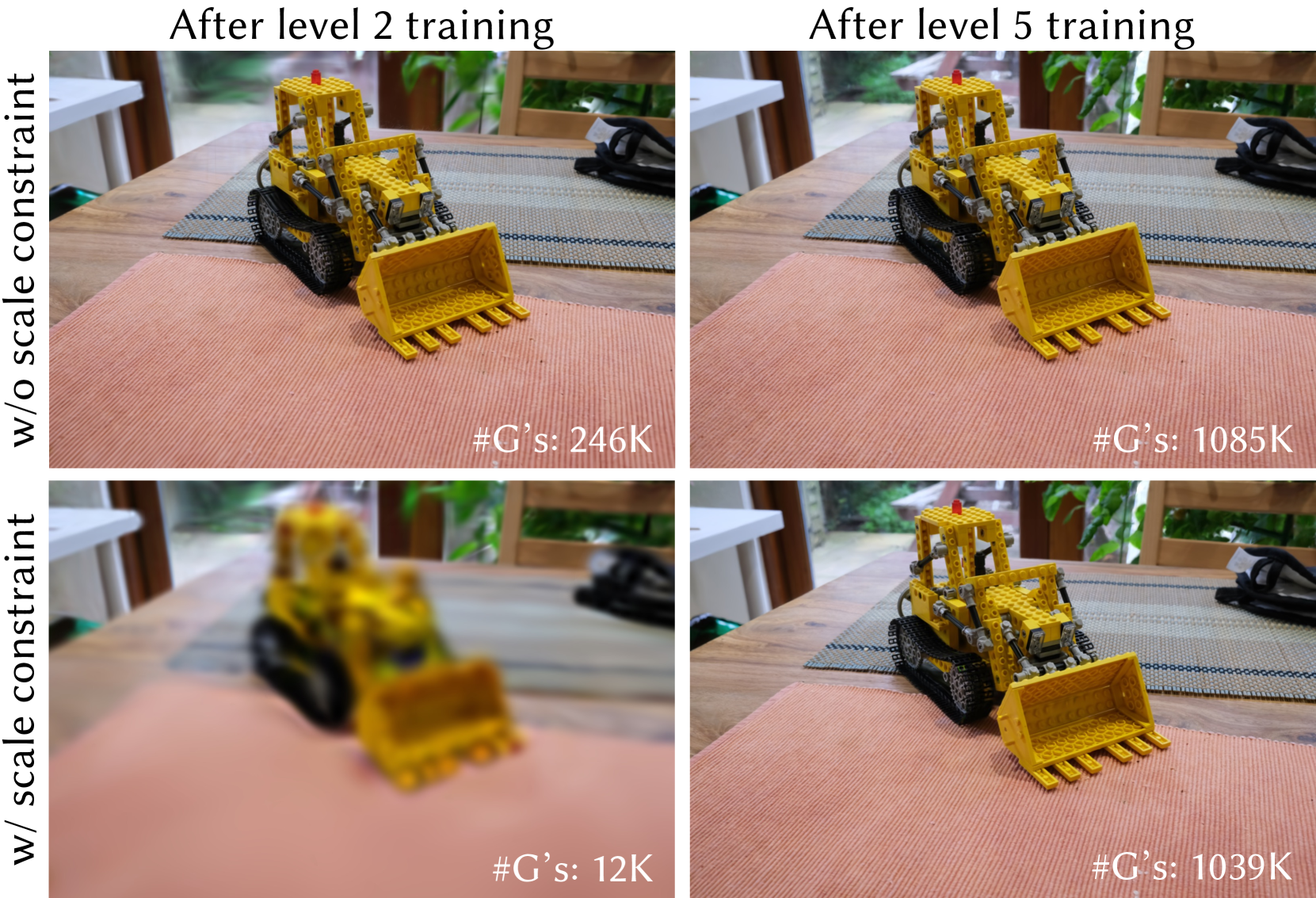
The image presents a 2x2 grid of photographs comparing the visual quality of a LEGO bulldozer model generated under different training levels and with/without a scale constraint. Each image displays the bulldozer on a textured surface (likely a rug) and a wooden table, with a blurred background of outdoor greenery and furniture. Each image also includes a text label indicating the number of "G's" (likely representing gradients or generative steps) used in the process.
### Components/Axes
The image is organized as follows:
* **Rows:** Represent the presence or absence of a "scale constraint". The left row is labeled "w/o scale constraint" (without scale constraint), and the right row is labeled "w/ scale constraint". These labels are positioned vertically along the left edge of the image.
* **Columns:** Represent the training level. The top row is labeled "After level 2 training", and the bottom row is labeled "After level 5 training". These labels are positioned horizontally along the top edge of the image.
* **Images:** Each cell in the grid contains a photograph of the LEGO bulldozer.
* **Text Labels:** Each image has a text label in the bottom-right corner indicating the number of "G's" used.
### Detailed Analysis or Content Details
Here's a breakdown of each image and its associated label:
1. **Top-Left:** "After level 2 training" & "w/o scale constraint". The bulldozer appears somewhat blurry and distorted, with visible artifacts. The label reads "#G's: 246K".
2. **Top-Right:** "After level 5 training" & "w/o scale constraint". The bulldozer appears slightly sharper than the top-left image, but still exhibits some blurriness and distortion. The label reads "#G's: 1085K".
3. **Bottom-Left:** "After level 5 training" & "w/ scale constraint". The bulldozer is significantly sharper and more detailed than the images above. It appears more realistically rendered. The label reads "#G's: 12K".
4. **Bottom-Right:** "After level 5 training" & "w/ scale constraint". The bulldozer is very sharp and detailed, similar to the bottom-left image. The label reads "#G's: 1039K".
### Key Observations
* **Scale Constraint Impact:** The presence of a scale constraint dramatically improves the visual quality of the generated bulldozer, resulting in a much sharper and more detailed image.
* **Training Level Impact:** Increasing the training level from 2 to 5 improves the visual quality, but the effect is less pronounced than the impact of the scale constraint.
* **G's Count:** The number of "G's" appears to be inversely related to the visual quality when a scale constraint is *not* used. Higher "G's" values (246K, 1085K) correspond to lower quality images. However, when a scale constraint *is* used, the "G's" values are much lower (12K, 1039K) and the quality is high. This suggests that the scale constraint allows for efficient generation with fewer steps.
### Interpretation
This image demonstrates the importance of incorporating scale constraints in generative modeling, particularly when dealing with 3D objects like LEGO models. Without a scale constraint, the model struggles to produce a coherent and detailed image, even with increased training. The number of "G's" likely represents the computational cost of the generation process. The data suggests that the scale constraint significantly reduces the computational cost while simultaneously improving the visual quality.
The difference in "G's" count between the images with and without the scale constraint is striking. This could indicate that the model without the constraint is exploring a much larger and more complex solution space, requiring many more iterations to converge on a reasonable result. The scale constraint effectively narrows the solution space, allowing the model to find a good solution with fewer steps.
The blurry images without the scale constraint suggest that the model is struggling to maintain consistent proportions and details. The scale constraint likely provides a crucial geometric prior that guides the generation process and prevents these distortions. This is a clear demonstration of how incorporating domain-specific knowledge (in this case, the concept of scale) can significantly improve the performance of generative models.