## Line Chart: CIFAR-10 Test Accuracy vs. Number of Classes
### Overview
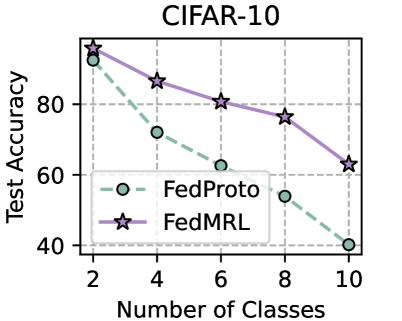
The image is a line chart titled "CIFAR-10" that compares the test accuracy of two machine learning methods, FedProto and FedMRL, as the number of classes in the classification task increases. The chart demonstrates a clear negative correlation between the number of classes and test accuracy for both methods, with FedMRL consistently outperforming FedProto.
### Components/Axes
* **Chart Title:** "CIFAR-10" (centered at the top).
* **Y-Axis:**
* **Label:** "Test Accuracy" (rotated vertically on the left).
* **Scale:** Linear scale from 40 to 80, with major tick marks and labels at 40, 60, and 80.
* **X-Axis:**
* **Label:** "Number of Classes" (centered at the bottom).
* **Scale:** Linear scale from 2 to 10, with major tick marks and labels at 2, 4, 6, 8, and 10.
* **Legend:** Positioned in the top-right quadrant of the chart area.
* **FedProto:** Represented by a green dashed line with circular markers (○).
* **FedMRL:** Represented by a purple solid line with star markers (☆).
* **Grid:** A dashed grid is present for both major x and y ticks.
### Detailed Analysis
**Data Series & Trends:**
1. **FedProto (Green, Dashed Line, Circles):**
* **Trend:** Shows a steep, consistent downward slope. Accuracy decreases significantly as the number of classes increases.
* **Data Points (Approximate):**
* At 2 Classes: ~92% accuracy.
* At 4 Classes: ~72% accuracy.
* At 6 Classes: ~62% accuracy.
* At 8 Classes: ~54% accuracy.
* At 10 Classes: ~40% accuracy.
2. **FedMRL (Purple, Solid Line, Stars):**
* **Trend:** Also shows a downward slope, but it is less steep than FedProto. The decline is more gradual, especially between 6 and 8 classes.
* **Data Points (Approximate):**
* At 2 Classes: ~94% accuracy.
* At 4 Classes: ~86% accuracy.
* At 6 Classes: ~80% accuracy.
* At 8 Classes: ~77% accuracy.
* At 10 Classes: ~63% accuracy.
**Spatial & Visual Grounding:**
* The legend is placed in the upper right, overlapping the chart area but not obscuring any data points.
* The green circle marker for FedProto at x=10 is positioned directly on the y=40 grid line.
* The purple star marker for FedMRL at x=10 is positioned slightly above the y=60 grid line.
* The gap between the two lines widens progressively from left to right.
### Key Observations
1. **Performance Gap:** FedMRL maintains a significant accuracy advantage over FedProto at every measured number of classes.
2. **Diverging Performance:** The performance gap between the two methods increases as the task becomes more complex (more classes). At 2 classes, the difference is minor (~2%), but at 10 classes, the difference is substantial (~23%).
3. **Rate of Decline:** FedProto's accuracy drops by approximately 52 percentage points (from ~92% to ~40%) when moving from 2 to 10 classes. FedMRL's accuracy drops by approximately 31 percentage points (from ~94% to ~63%) over the same range.
4. **Plateau Hint:** The FedMRL line shows a slight flattening between 6 and 8 classes (from ~80% to ~77%), suggesting a potential region of more stable performance before dropping again at 10 classes.
### Interpretation
The chart presents a comparative analysis of two federated learning methods on the CIFAR-10 dataset under a class-incremental or multi-class scenario. The data suggests that **FedMRL is a more robust and scalable method** than FedProto for handling an increasing number of classes.
* **Scalability:** The shallower slope of the FedMRL line indicates it scales better with problem complexity. Its architecture or learning mechanism appears better suited to managing the interference or confusion that arises when distinguishing between a larger set of categories.
* **Practical Implication:** For real-world applications where the number of target classes may grow or be large, FedMRL would be the preferable choice based on this evidence. FedProto's sharp decline suggests it may suffer from catastrophic forgetting or an inability to form sufficiently distinct prototypes as the class count rises.
* **Underlying Mechanism:** The names hint at the reason. "FedProto" likely relies on class prototypes, which may become crowded and less separable in high-dimensional space as classes multiply. "FedMRL" (possibly Federated Meta-Reinforcement Learning) might employ a more adaptive, meta-learning strategy that allows it to better navigate the expanding decision space.
**Language Declaration:** All text in the image is in English.