## Screenshot: R Code in Text Editor
### Overview
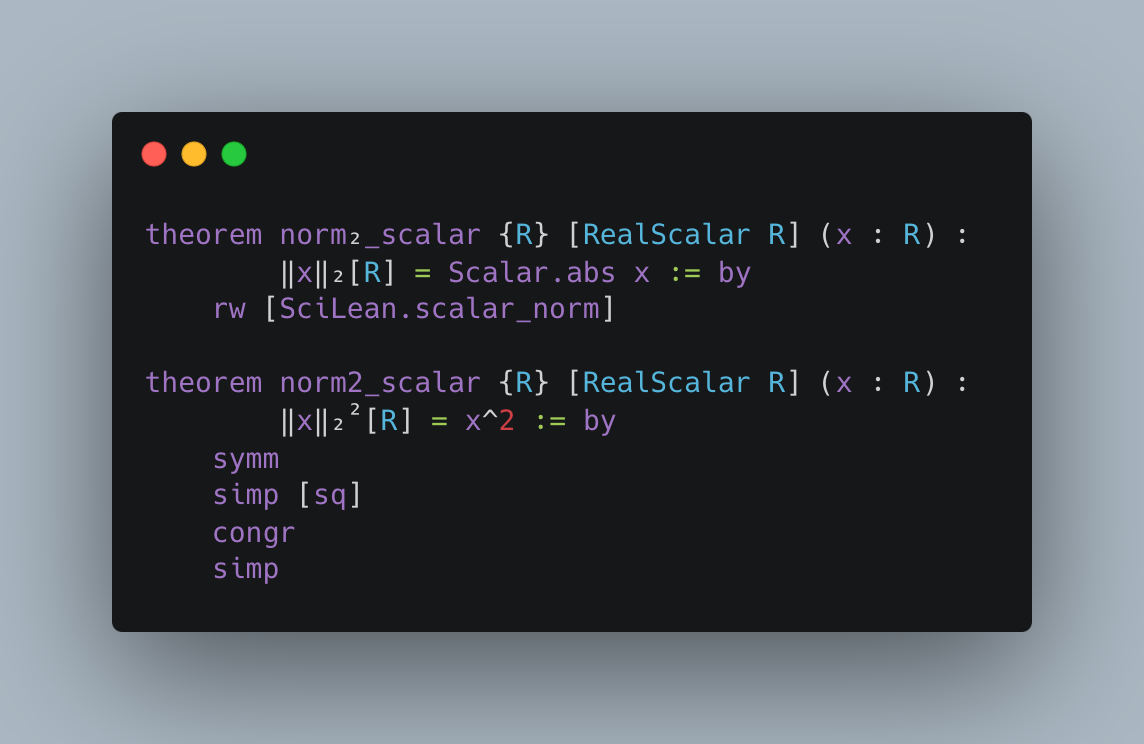
The image shows a code editor window displaying two theorem definitions in the Lean proof assistant (SciLean) for scalar norms in the real numbers (`RealScalar R`). The code uses syntax highlighting with distinct colors for keywords, types, and operations.
### Components/Axes
- **Window Controls**: Top-left corner has three macOS window control dots (red, yellow, green).
- **Code Structure**:
- **Theorem 1**:
- Definition: `theorem norm2_scalar {R} [RealScalar R] (x : R) :`
- Body: `||x||² [R] = Scalar.abs x := by rw [SciLean.scalar_norm]`
- **Theorem 2**:
- Definition: `theorem norm2_scalar {R} [RealScalar R] (x : R) :`
- Body: `||x||² [R] = x^2 := by symm simp [sq] congr simp`
### Detailed Analysis
- **Syntax Highlighting**:
- **Purple**: Keywords (`theorem`, `symm`, `simp`, `congr`).
- **Blue**: Types (`RealScalar R`, `R`).
- **Green**: Operators (`=`, `^2`, `:=`).
- **White**: Variable names (`x`), function names (`Scalar.abs`, `SciLean.scalar_norm`).
- **Theorem 1**:
- Defines `norm2_scalar` as the absolute value of `x` (`Scalar.abs x`).
- Proof uses `rw` (rewrite) with `SciLean.scalar_norm`.
- **Theorem 2**:
- Defines `norm2_scalar` as `x^2`.
- Proof uses `symm` (symmetry), `simp [sq]` (simplification with squaring), `congr` (congruence), and `simp` (simplification).
### Key Observations
- Both theorems share the same name (`norm2_scalar`) but define different properties of scalar norms.
- Theorem 1 uses a rewrite tactic, while Theorem 2 uses simplification and congruence.
- The code assumes `RealScalar R` (real numbers) as the domain.
### Interpretation
This code formalizes two equivalent definitions of the Euclidean norm squared (`||x||²`) in Lean:
1. As the absolute value of `x` (Theorem 1).
2. As `x^2` (Theorem 2).
The proofs demonstrate that these definitions are interchangeable under Lean’s type system and algebraic axioms. The use of `symm` and `congr` suggests the proof leverages symmetric properties of equality and congruence rules for squaring operations. This is critical for verifying mathematical correctness in formal systems like SciLean.
**Note**: No numerical data or visual trends are present, as this is a code snippet rather than a chart or diagram.