## Diagram: Grid-Based Pathfinding Visualization
### Overview
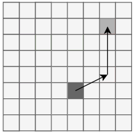
The image displays a 7x7 square grid containing two highlighted cells and a directional arrow indicating a path between them. This is a standard visual representation used in computer science and robotics to illustrate pathfinding algorithms or movement planning within a discrete environment.
### Components/Axes
* **Grid Structure:** A 7x7 matrix of squares.
* **Start Point:** A dark grey square located at coordinates (Row 5, Column 4), assuming a 1-based index starting from the top-left corner (1,1).
* **End Point:** A light grey square located at coordinates (Row 2, Column 6).
* **Path Indicator:** A two-segment arrow connecting the start and end points.
### Detailed Analysis
The path is defined by two distinct segments:
1. **Segment 1:** Originates at the center of the dark grey square at (5, 4). The arrow extends diagonally upward and to the right, terminating at the center of the cell at (4, 5).
2. **Segment 2:** Originates at the center of the cell at (4, 5). The arrow extends vertically upward and slightly to the right, terminating at the center of the light grey square at (2, 6).
### Coordinate Mapping (Row, Column)
| Point | Coordinates | Description |
| :--- | :--- | :--- |
| Start | (5, 4) | Dark Grey |
| Intermediate Point | (4, 5) | N/A |
| End | (2, 6) | Light Grey |
### Key Observations
* **Non-Linear Path:** The path is not a straight line, indicating a deliberate change in direction at the intermediate point (4, 5).
* **Movement Logic:** The path suggests a movement pattern that is not strictly Manhattan distance (which would require only horizontal and vertical moves) nor strictly diagonal. The first segment is diagonal, and the second segment is a steep diagonal/vertical hybrid.
* **Visual Hierarchy:** The dark grey square acts as the origin (source), while the light grey square acts as the destination (target).
### Interpretation
This diagram is a simplified model of **pathfinding or trajectory planning**.
* **Context:** In a technical context, this likely represents an agent (the dark grey square) calculating a route to a goal (the light grey square) within a grid-based environment.
* **Algorithmic Implication:** The bend in the arrow at (4, 5) suggests that the path was calculated to avoid an obstacle or to optimize for a specific cost function (e.g., minimizing distance or energy). Even though no obstacles are explicitly drawn, the deviation from a straight line implies that the "cost" of moving through the grid is not uniform, or that the movement rules of the agent are constrained (e.g., a robot that cannot move in a straight line to the target).
* **Peircean Investigative Note:** The visual language is minimalist. The use of different shades of grey (dark vs. light) creates a clear hierarchy between the "source" and the "destination," allowing the viewer to immediately identify the direction of flow without needing labels. The arrow serves as the "interpretant," connecting the two states and defining the relationship between them as a sequence of actions.