## Bar Chart: Refusal Ratio by Training Set and Hallucination Type
### Overview
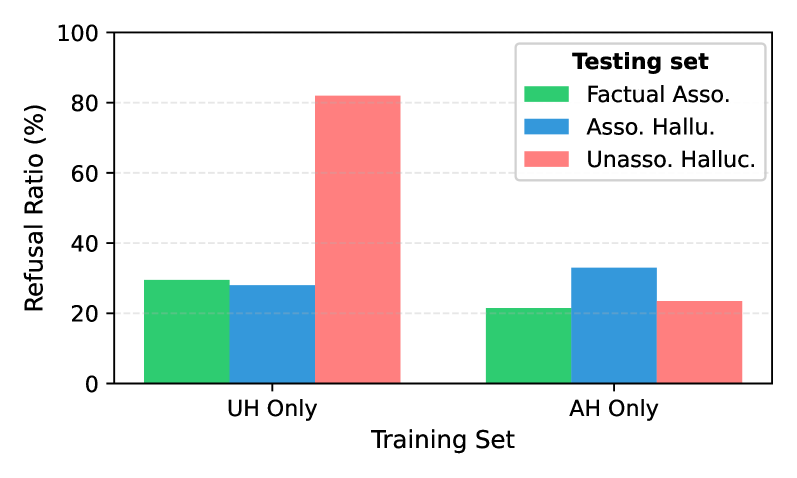
The image is a bar chart comparing the refusal ratio (%) for different types of hallucinations (Factual Asso., Asso. Hallu., Unasso. Halluc.) across two training sets (UH Only, AH Only). The chart uses color-coded bars to represent each hallucination type, with the y-axis representing the refusal ratio and the x-axis representing the training set.
### Components/Axes
* **Title:** There is no explicit title on the chart.
* **X-axis:**
* Label: "Training Set"
* Categories: "UH Only", "AH Only"
* **Y-axis:**
* Label: "Refusal Ratio (%)"
* Scale: 0 to 100, with gridlines at intervals of 20.
* **Legend:** Located in the top-right corner, titled "Testing set".
* Factual Asso. (Green)
* Asso. Hallu. (Blue)
* Unasso. Halluc. (Red)
### Detailed Analysis
Here's a breakdown of the refusal ratios for each category:
* **UH Only Training Set:**
* Factual Asso. (Green): Approximately 30%
* Asso. Hallu. (Blue): Approximately 28%
* Unasso. Halluc. (Red): Approximately 82%
* **AH Only Training Set:**
* Factual Asso. (Green): Approximately 22%
* Asso. Hallu. (Blue): Approximately 33%
* Unasso. Halluc. (Red): Approximately 24%
### Key Observations
* For the "UH Only" training set, the "Unasso. Halluc." category has a significantly higher refusal ratio compared to "Factual Asso." and "Asso. Hallu.".
* For the "AH Only" training set, the refusal ratios for all three categories are much closer together, with "Asso. Hallu." having a slightly higher ratio.
* The "Factual Asso." category has a lower refusal ratio in the "AH Only" training set compared to the "UH Only" training set.
* The "Asso. Hallu." category has a higher refusal ratio in the "AH Only" training set compared to the "UH Only" training set.
* The "Unasso. Halluc." category has a significantly lower refusal ratio in the "AH Only" training set compared to the "UH Only" training set.
### Interpretation
The data suggests that the type of training set significantly impacts the refusal ratio for different types of hallucinations. Specifically, training with "UH Only" leads to a much higher refusal ratio for "Unasso. Halluc." compared to training with "AH Only". This could indicate that the model trained with "UH Only" is better at identifying and refusing to generate unassociated hallucinations. The "AH Only" training set seems to result in a more balanced refusal ratio across all hallucination types. The differences in refusal ratios between the training sets could be due to the specific characteristics and biases present in each training dataset. Further investigation would be needed to understand the underlying reasons for these differences.