## Line Chart: Proportion of Bitwise Reproducible Packages Over Time
### Overview
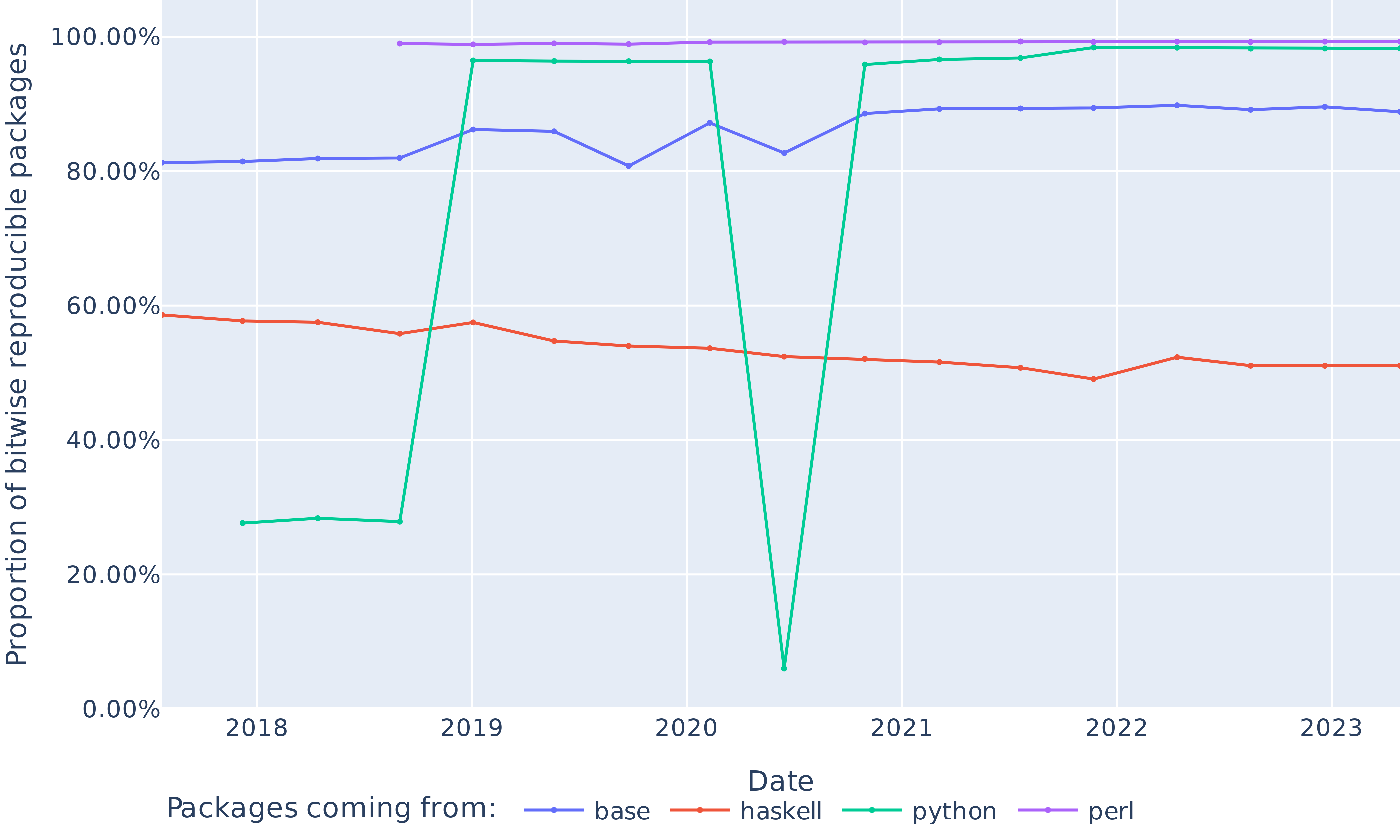
This is a line chart tracking the percentage of packages that are "bitwise reproducible" for four different package sources over a period from early 2018 to late 2023. The chart reveals significant differences in reproducibility rates and stability among the sources, with one source (python) exhibiting a dramatic, temporary collapse.
### Components/Axes
* **Chart Type:** Multi-line chart.
* **Y-Axis (Vertical):**
* **Label:** "Proportion of bitwise reproducible packages"
* **Scale:** Percentage, from 0.00% to 100.00%.
* **Major Tick Marks:** 0.00%, 20.00%, 40.00%, 60.00%, 80.00%, 100.00%.
* **X-Axis (Horizontal):**
* **Label:** "Date"
* **Scale:** Time in years.
* **Major Tick Marks:** 2018, 2019, 2020, 2021, 2022, 2023.
* **Legend:**
* **Position:** Centered at the bottom of the chart.
* **Title:** "Packages coming from:"
* **Categories & Colors:**
* `base` - Blue line with circular markers.
* `haskell` - Red/Orange line with circular markers.
* `python` - Green/Teal line with circular markers.
* `perl` - Purple line with circular markers.
### Detailed Analysis
**Trend Verification & Data Point Extraction (Approximate Values):**
1. **`perl` (Purple Line):**
* **Trend:** Extremely stable and high. The line is nearly flat at the very top of the chart.
* **Data Points:** Consistently at or very near **100.00%** for the entire duration from its first appearance in late 2018 through 2023.
2. **`python` (Green/Teal Line):**
* **Trend:** Highly volatile. Starts low, jumps to a high plateau, suffers a catastrophic drop, then recovers to a new high plateau.
* **Data Points:**
* Early 2018 - Late 2018: Stable at ~**28%**.
* Early 2019: Sharp increase to ~**96%**.
* 2019 - Early 2020: Maintains plateau at ~**96%**.
* Mid-2020: **Dramatic, sharp drop** to a minimum of ~**5%** (the lowest point on the entire chart).
* Late 2020: Sharp recovery back to ~**96%**.
* 2021 - 2023: Gradual increase, stabilizing near **98-99%**.
3. **`base` (Blue Line):**
* **Trend:** Generally stable with a slight upward trend and minor fluctuations.
* **Data Points:**
* 2018: Starts at ~**81%**.
* 2019: Increases to ~**86%**.
* Mid-2020: Dips to ~**80%**.
* Late 2020: Recovers to ~**87%**.
* 2021 - 2023: Hovers between **88% and 90%**, ending near **89%**.
4. **`haskell` (Red/Orange Line):**
* **Trend:** Gradual, consistent decline over the observed period.
* **Data Points:**
* Early 2018: Starts at ~**59%**.
* Shows a slow, steady downward slope with minor bumps.
* 2020: ~**54%**.
* 2021: ~**52%**.
* 2022: Dips to a low of ~**49%**.
* 2023: Slight recovery to ~**51%**.
### Key Observations
1. **Extreme Stability of `perl`:** The `perl` package source maintains near-perfect bitwise reproducibility (~100%) consistently over five years.
2. **Volatility of `python`:** The `python` source shows the most dramatic behavior, with a sudden collapse to near 0% reproducibility in mid-2020, followed by an equally rapid recovery. This suggests a major, temporary systemic issue.
3. **Diverging Long-Term Trends:** While `base` and `python` (post-recovery) show stable or slightly improving reproducibility, `haskell` demonstrates a clear, long-term decreasing trend.
4. **Clustering at High Levels:** By 2023, three of the four sources (`perl`, `python`, `base`) have reproducibility rates at or above ~89%, forming a high-performance cluster, while `haskell` remains an outlier below 55%.
### Interpretation
This chart visualizes the health and reliability of software package ecosystems from a reproducibility standpoint. Bitwise reproducibility is critical for security, verification, and debugging.
* **`perl`'s** perfect score suggests an exceptionally mature and controlled build environment or packaging standard.
* The **`python`** anomaly in 2020 is the most significant finding. It points to a specific event—perhaps a change in build tooling, a compromised dependency, or a shift in packaging policy—that temporarily broke the reproducibility guarantee for the entire ecosystem. The swift recovery indicates effective problem identification and resolution.
* The **`haskell`** decline is concerning. It may indicate increasing complexity in the build process, greater reliance on non-deterministic dependencies, or a shift in community practices away from reproducibility as a priority.
* The **`base`** category (likely core system packages) shows the steady, reliable behavior expected from a foundational layer.
In summary, the data demonstrates that while high reproducibility is achievable and maintained by some ecosystems (`perl`), it is not universal and can be subject to severe, albeit temporary, disruption (`python`). The downward trend in `haskell` warrants investigation to prevent further erosion of reproducibility.