## Diagram: Application Domains of Probabilistic Computing with p-bits
### Overview
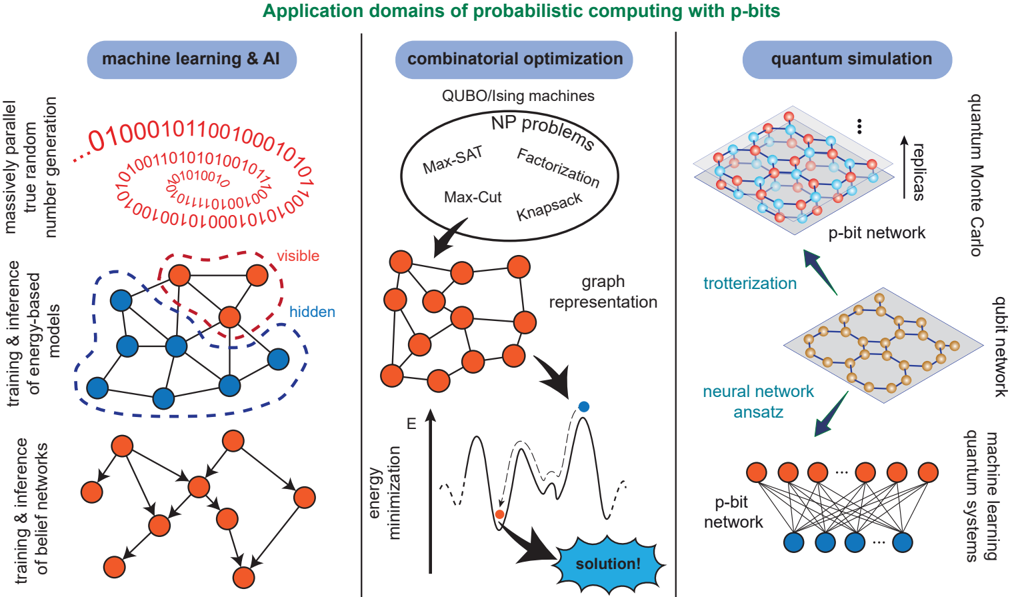
This diagram illustrates the diverse application domains of probabilistic computing utilizing "p-bits" (probabilistic bits). It is structured into three main vertical columns, each representing a distinct application area: "machine learning & AI", "combinatorial optimization", and "quantum simulation". Within each column, a series of sub-diagrams and textual descriptions explain how p-bits are applied or conceptualized in that specific domain, often showing a flow or transformation from a problem definition to a p-bit-based solution or representation.
### Components/Axes
The diagram's header is "Application domains of probabilistic computing with p-bits" in green text.
**Column 1: machine learning & AI** (Header: Blue oval with white text "machine learning & AI")
* **Top Sub-diagram:**
* Vertical text label on the left: "massively parallel true random number generation"
* Content: A circular arrangement of red binary digits (0s and 1s). The outermost visible string starts with "01000101100100010101..." and spirals inwards, with inner layers showing "0100110101010100101..." and "01010010".
* **Middle Sub-diagram:**
* Vertical text label on the left: "training & inference of energy-based models"
* Content: An undirected graph with 13 nodes.
* **Legend/Labels:** A red dashed line encircles 6 red nodes, labeled "visible". A blue dashed line encircles 7 blue nodes, labeled "hidden".
* Nodes: The graph shows interconnections between red and blue nodes, and within each group.
* **Bottom Sub-diagram:**
* Vertical text label on the left: "training & inference of belief networks"
* Content: A directed acyclic graph (DAG) with 10 orange nodes. Arrows indicate the flow of influence or dependency between nodes.
**Column 2: combinatorial optimization** (Header: Blue oval with white text "combinatorial optimization")
* **Top Sub-diagram:**
* Text label above the oval: "QUBO/Ising machines"
* Content: An oval shape labeled "NP problems" in its center.
* **Sub-categories within oval:** "Max-SAT" (bottom-left), "Factorization" (top-right), "Max-Cut" (bottom-center-left), "Knapsack" (bottom-right).
* **Flow:** A downward-pointing black arrow originates from the "NP problems" oval.
* **Middle Sub-diagram:**
* Text label on the right: "graph representation"
* Content: An undirected graph with 12 orange nodes, interconnected.
* **Flow:** A downward-pointing black arrow originates from this graph.
* **Bottom Sub-diagram:**
* Vertical text label on the left: "energy minimization"
* Content: A 2D plot representing an energy landscape.
* **Vertical Axis:** Labeled "E" (for Energy). The horizontal axis is implicit, representing the configuration space.
* **Plot Lines:** A solid black line depicts a complex energy landscape with multiple peaks and valleys. A dashed black line shows an alternative or related energy landscape.
* **Data Points:** A small blue dot is positioned on a local maximum or saddle point of the solid black line. A small orange dot is positioned in the deepest valley (global minimum) of the solid black line.
* **Flow:** A downward-pointing black arrow originates from the orange dot, leading to a blue speech bubble.
* **Solution Bubble:** A blue speech bubble contains the white text "solution!".
**Column 3: quantum simulation** (Header: Blue oval with white text "quantum simulation")
* **Top Sub-diagram:**
* Vertical text label on the right: "quantum Monte Carlo"
* Vertical text label on the right, with an upward arrow: "replicas"
* Content: Multiple stacked layers of a hexagonal lattice network. Each layer contains red and blue nodes interconnected in a honeycomb pattern. An ellipsis "..." above the top layer indicates more layers.
* Text label below the layers: "p-bit network"
* **Flow:** A downward-pointing teal arrow originates from this "p-bit network".
* **Middle Sub-diagram:**
* Vertical text label on the right: "qubit network"
* Content: A single layer of a hexagonal lattice network with tan/light brown nodes.
* **Flow:** A downward-pointing teal arrow originates from this "qubit network".
* **Arrow Label:** "trotterization" (Green text, along the arrow from the top p-bit network to the qubit network).
* **Bottom Sub-diagram:**
* Vertical text label on the right: "machine learning quantum systems"
* Content: A bipartite network.
* Nodes: The top row consists of 6 orange nodes followed by an ellipsis "...". The bottom row consists of 6 blue nodes followed by an ellipsis "...".
* Connections: Each orange node in the top row is connected to every blue node in the bottom row, indicating a fully connected bipartite graph.
* Text label on the left: "p-bit network"
* **Arrow Label:** "neural network ansatz" (Green text, along the arrow from the qubit network to the bottom p-bit network).
### Detailed Analysis
The diagram presents three distinct workflows or conceptual frameworks for applying p-bits.
**In "machine learning & AI":**
1. **True Random Number Generation:** P-bits are depicted as generating binary sequences, implying their use in creating high-quality, massively parallel true random numbers, which are crucial for various stochastic algorithms in AI.
2. **Energy-Based Models:** P-bits are used to represent nodes in an energy-based model (e.g., a Restricted Boltzmann Machine). The distinction between "visible" (red nodes) and "hidden" (blue nodes) highlights the typical architecture where visible nodes interact with the environment/data and hidden nodes learn latent features. Training and inference involve adjusting the connections and states of these nodes to minimize an energy function.
3. **Belief Networks:** P-bits can also form the basis of belief networks (e.g., Bayesian networks), where directed edges between orange nodes represent probabilistic dependencies. This suggests p-bits can be used to model causal relationships and perform inference in such probabilistic graphical models.
**In "combinatorial optimization":**
1. **Problem Formulation:** The process begins with "NP problems" such as Max-SAT, Factorization, Max-Cut, and Knapsack, which are known to be computationally hard. These problems are often mapped to "QUBO/Ising machines", a common framework for expressing combinatorial optimization problems.
2. **Graph Representation:** These problems are then translated into a "graph representation" (an undirected network of orange nodes), where nodes and edges encode the problem's variables and constraints.
3. **Energy Minimization:** The graph representation is then mapped to an energy landscape. The goal is "energy minimization," where the system seeks the lowest energy state (the orange dot in the deepest valley). The blue dot represents a higher energy state, and the arrow from the orange dot to "solution!" indicates that the global minimum of this energy landscape corresponds to the optimal solution of the combinatorial problem.
**In "quantum simulation":**
1. **Quantum Monte Carlo with p-bits:** P-bit networks are used to simulate quantum systems, specifically in the context of "quantum Monte Carlo" methods. The stacked "replicas" of the p-bit network (red and blue nodes in a hexagonal lattice) suggest a representation of quantum states or paths in a path integral formulation.
2. **Trotterization to Qubit Network:** A "trotterization" step is shown, transforming the p-bit network (representing a quantum system) into a "qubit network" (tan nodes in a hexagonal lattice). This implies that p-bits can be used to simulate or approximate the behavior of quantum bits (qubits), potentially through a classical simulation of quantum dynamics.
3. **Neural Network Ansatz for Quantum Systems:** The qubit network, in turn, can be related back to another "p-bit network" through a "neural network ansatz". This suggests using p-bit-based neural networks as a machine learning approach to find approximate solutions or ground states for quantum systems, effectively using classical probabilistic computing to learn about quantum phenomena. The bipartite p-bit network structure is a common architecture for neural network models.
### Key Observations
* **Versatility of p-bits:** P-bits are presented as a fundamental building block for diverse computational tasks across AI, optimization, and quantum simulation.
* **Network Representations:** Different types of network structures (undirected, directed, bipartite, hexagonal lattices) are employed, highlighting the adaptability of p-bits to model various problem types.
* **Energy-Based Computing:** A recurring theme, particularly in combinatorial optimization and energy-based ML models, is the concept of finding solutions by minimizing an an energy function.
* **Bridging Classical and Quantum:** In quantum simulation, p-bits are shown to interact with the concept of "qubit networks," suggesting their role in classical simulations of quantum systems or in hybrid quantum-classical approaches.
* **Flow and Transformation:** Arrows consistently indicate a progression or transformation from abstract problems to p-bit representations, and then to solutions or other computational models.
* **Color Coding:** Node colors (red, blue, orange, tan) differentiate roles or types of computational units (e.g., visible/hidden, p-bits/qubits).
### Interpretation
This diagram fundamentally argues for the broad applicability and power of probabilistic computing using p-bits. It suggests that p-bits are not merely a theoretical concept but a practical computational primitive capable of addressing complex challenges in modern computing.
In **Machine Learning & AI**, p-bits offer a hardware-friendly approach to generate true randomness, which is critical for Monte Carlo methods, sampling, and training robust models. Their ability to naturally represent and process probabilistic information makes them well-suited for energy-based models (like Boltzmann Machines) and belief networks, which are foundational to many AI tasks involving uncertainty and inference.
For **Combinatorial Optimization**, the diagram positions p-bits as a viable technology for solving NP-hard problems. By mapping these problems onto QUBO/Ising models and then to graph representations, p-bits can be used to explore vast solution spaces and find optimal or near-optimal solutions through energy minimization, a process that inherently leverages their probabilistic nature to escape local minima. This implies p-bits could offer a new avenue for tackling problems that are intractable for traditional deterministic computers.
In **Quantum Simulation**, the diagram highlights p-bits as a tool for classical simulation of quantum phenomena. The "quantum Monte Carlo" and "trotterization" steps suggest that p-bits can model quantum dynamics and states, potentially offering a scalable way to explore quantum systems without requiring full-fledged quantum computers. Furthermore, the "neural network ansatz" indicates that p-bit-based machine learning can be applied to quantum problems, potentially discovering novel quantum states or optimizing quantum algorithms. This positions p-bits as a bridge technology, enabling classical systems to gain insights into the quantum realm, or even to serve as a classical co-processor for future quantum machines.
Overall, the diagram presents p-bits as a versatile and powerful computational paradigm that can enhance or provide alternative solutions across a spectrum of demanding computational tasks, from generating randomness to solving hard optimization problems and simulating quantum mechanics.