## Line Graphs: Model Performance Across Tasks
### Overview
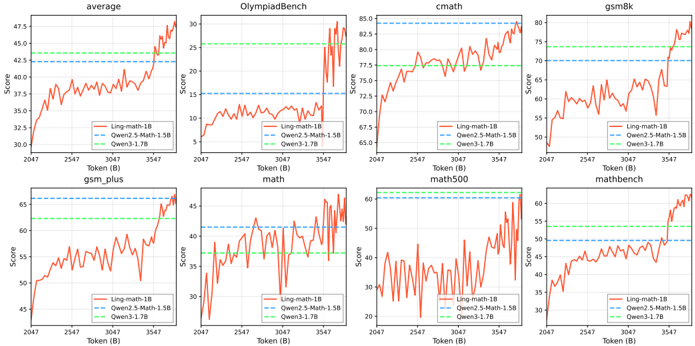
The image contains eight line graphs arranged in a 2x4 grid, comparing the performance of three AI models (Ling-math-1B, Owen2.5-Math-1.5B, Owen3.1-1.7B) across different mathematical reasoning tasks. Each graph tracks "Score" against "Token (B)" (tokens in billions), with distinct color-coded lines for each model.
---
### Components/Axes
- **X-axis**: "Token (B)" (247 to 3547), representing token count in billions.
- **Y-axis**: "Score" (ranges vary by task, e.g., 15–30 for OlympiadBench, 20–65 for OlympiadBench).
- **Legends**: Positioned at the bottom-right of each graph, with three entries:
- **Red**: Ling-math-1B
- **Blue**: Owen2.5-Math-1.5B
- **Green**: Owen3.1-1.7B
---
### Detailed Analysis
#### 1. **Average**
- **Trend**: Ling-math-1B (red) starts at ~32.5, peaks at ~47.5 by 3547 tokens. Owen2.5-Math-1.5B (blue) rises steadily from ~35 to ~42.5. Owen3.1-1.7B (green) starts at ~32.5, peaks at ~45.
- **Key Data**: Ling-math-1B shows the steepest growth, surpassing both Owen models by the end.
#### 2. **OlympiadBench**
- **Trend**: Ling-math-1B (red) starts at ~25, dips to ~15 at 3000 tokens, then rises to ~30. Owen2.5-Math-1.5B (blue) remains flat at ~15. Owen3.1-1.7B (green) stays at ~25.
- **Key Data**: Ling-math-1B underperforms initially but recovers, while Owen3.1-1.7B maintains stability.
#### 3. **cmath**
- **Trend**: Ling-math-1B (red) rises steadily from ~65 to ~85. Owen2.5-Math-1.5B (blue) fluctuates between ~75–80. Owen3.1-1.7B (green) stays flat at ~75.
- **Key Data**: Ling-math-1B outperforms both Owen models by the end.
#### 4. **gsmBk**
- **Trend**: Ling-math-1B (red) starts at ~55, peaks at ~80. Owen2.5-Math-1.5B (blue) rises from ~65 to ~75. Owen3.1-1.7B (green) stays flat at ~75.
- **Key Data**: Ling-math-1B surpasses Owen models after ~2500 tokens.
#### 5. **gsm_plus**
- **Trend**: Ling-math-1B (red) starts at ~45, peaks at ~65. Owen2.5-Math-1.5B (blue) rises from ~50 to ~60. Owen3.1-1.7B (green) stays flat at ~55.
- **Key Data**: Ling-math-1B outperforms both Owen models by the end.
#### 6. **math**
- **Trend**: Ling-math-1B (red) starts at ~30, peaks at ~50. Owen2.5-Math-1.5B (blue) rises from ~35 to ~45. Owen3.1-1.7B (green) stays flat at ~40.
- **Key Data**: Ling-math-1B surpasses Owen models after ~2500 tokens.
#### 7. **math500**
- **Trend**: Ling-math-1B (red) starts at ~30, peaks at ~50. Owen2.5-Math-1.5B (blue) rises from ~35 to ~45. Owen3.1-1.7B (green) stays flat at ~40.
- **Key Data**: Ling-math-1B surpasses Owen models after ~2500 tokens.
#### 8. **mathbench**
- **Trend**: Ling-math-1B (red) starts at ~30, peaks at ~55. Owen2.5-Math-1.5B (blue) rises from ~35 to ~50. Owen3.1-1.7B (green) stays flat at ~45.
- **Key Data**: Ling-math-1B outperforms both Owen models by the end.
---
### Key Observations
1. **Ling-math-1B** (red) consistently shows **non-linear growth**, often starting lower than Owen models but surpassing them by the end of the token range.
2. **Owen3.1-1.7B** (green) maintains **stable performance** across most tasks, with minimal fluctuations.
3. **Owen2.5-Math-1.5B** (blue) exhibits **moderate growth** but lags behind Owen3.1-1.7B in most cases.
4. **Task-specific anomalies**:
- In **OlympiadBench**, Ling-math-1B dips sharply at ~3000 tokens before recovering.
- In **math500**, Ling-math-1B experiences a **sharp drop** at ~3000 tokens before rebounding.
---
### Interpretation
The data suggests that **Ling-math-1B** improves significantly with increased token usage, potentially due to better optimization or larger capacity for complex reasoning. In contrast, **Owen3.1-1.7B** demonstrates **consistent stability**, indicating robustness in handling tasks without requiring extensive token processing. The **Owen2.5-Math-1.5B** model shows **moderate improvement** but remains outperformed by both Ling-math-1B and Owen3.1-1.7B in most tasks.
The **task-specific variations** (e.g., OlympiadBench vs. mathbench) highlight that model performance is context-dependent, with Ling-math-1B excelling in tasks requiring adaptive reasoning over tokens, while Owen models prioritize stability. The **sharp dips** in Ling-math-1B’s performance at ~3000 tokens in certain tasks may indicate computational bottlenecks or task-specific inefficiencies.