\n
## Bar Chart: Hits@1 Performance Comparison
### Overview
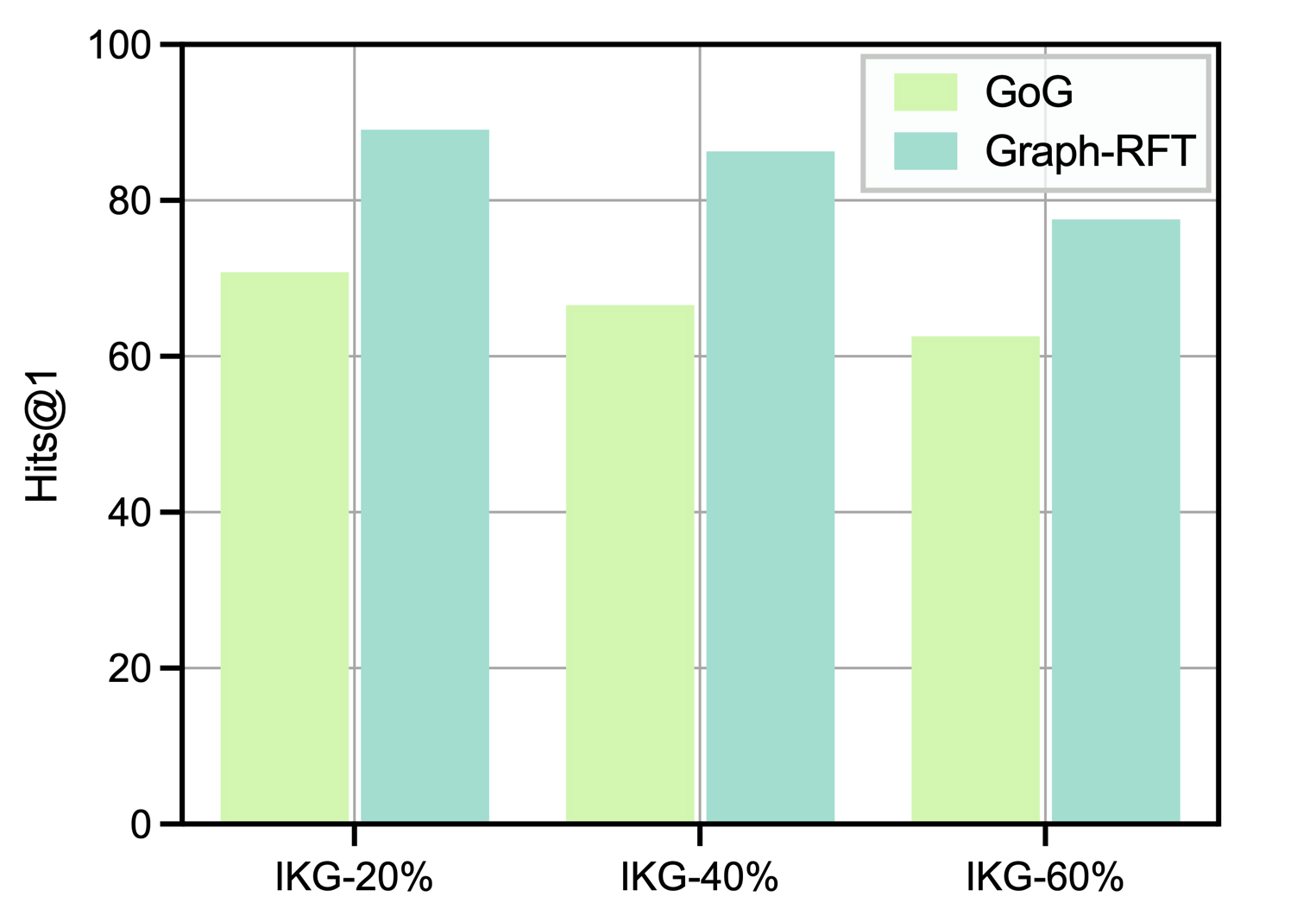
This bar chart compares the performance of two models, GoG and Graph-RFT, across three different IKGs (IKG-20%, IKG-40%, and IKG-60%) based on the Hits@1 metric. The chart uses paired bars for each IKG, allowing for a direct visual comparison between the two models.
### Components/Axes
* **X-axis:** Represents the IKG configurations: IKG-20%, IKG-40%, and IKG-60%.
* **Y-axis:** Represents the Hits@1 metric, ranging from 0 to 100.
* **Legend:** Located in the top-right corner, identifies the two models:
* GoG (Light Green)
* Graph-RFT (Light Teal)
* **Gridlines:** Horizontal gridlines are present to aid in reading the values.
### Detailed Analysis
The chart consists of six bars, grouped by IKG configuration.
* **IKG-20%:**
* GoG: Approximately 68 Hits@1.
* Graph-RFT: Approximately 92 Hits@1.
* **IKG-40%:**
* GoG: Approximately 69 Hits@1.
* Graph-RFT: Approximately 86 Hits@1.
* **IKG-60%:**
* GoG: Approximately 62 Hits@1.
* Graph-RFT: Approximately 80 Hits@1.
The Graph-RFT model consistently outperforms the GoG model across all three IKG configurations. The difference in performance appears to be most significant for IKG-20%.
### Key Observations
* Graph-RFT consistently achieves higher Hits@1 scores than GoG.
* The performance of Graph-RFT decreases slightly as the IKG percentage increases (92 -> 86 -> 80).
* The performance of GoG remains relatively stable across the three IKG configurations (68 -> 69 -> 62).
* The gap between the two models is largest at IKG-20% and narrows as the IKG percentage increases.
### Interpretation
The data suggests that the Graph-RFT model is more effective than the GoG model in this task, as measured by the Hits@1 metric. The consistent outperformance of Graph-RFT indicates that its architecture or training process is better suited to leveraging the information contained within the IKGs. The decreasing performance of Graph-RFT with increasing IKG percentage could indicate a point of diminishing returns, where adding more information to the IKG does not proportionally improve performance. The relative stability of GoG's performance suggests it may be less sensitive to the size of the IKG, or that it reaches its performance limit earlier. The larger performance gap at IKG-20% could mean that Graph-RFT benefits more from even a small amount of knowledge graph information, while GoG's performance is less affected by the initial IKG size. This could be due to Graph-RFT's ability to better integrate and utilize the knowledge graph structure.